
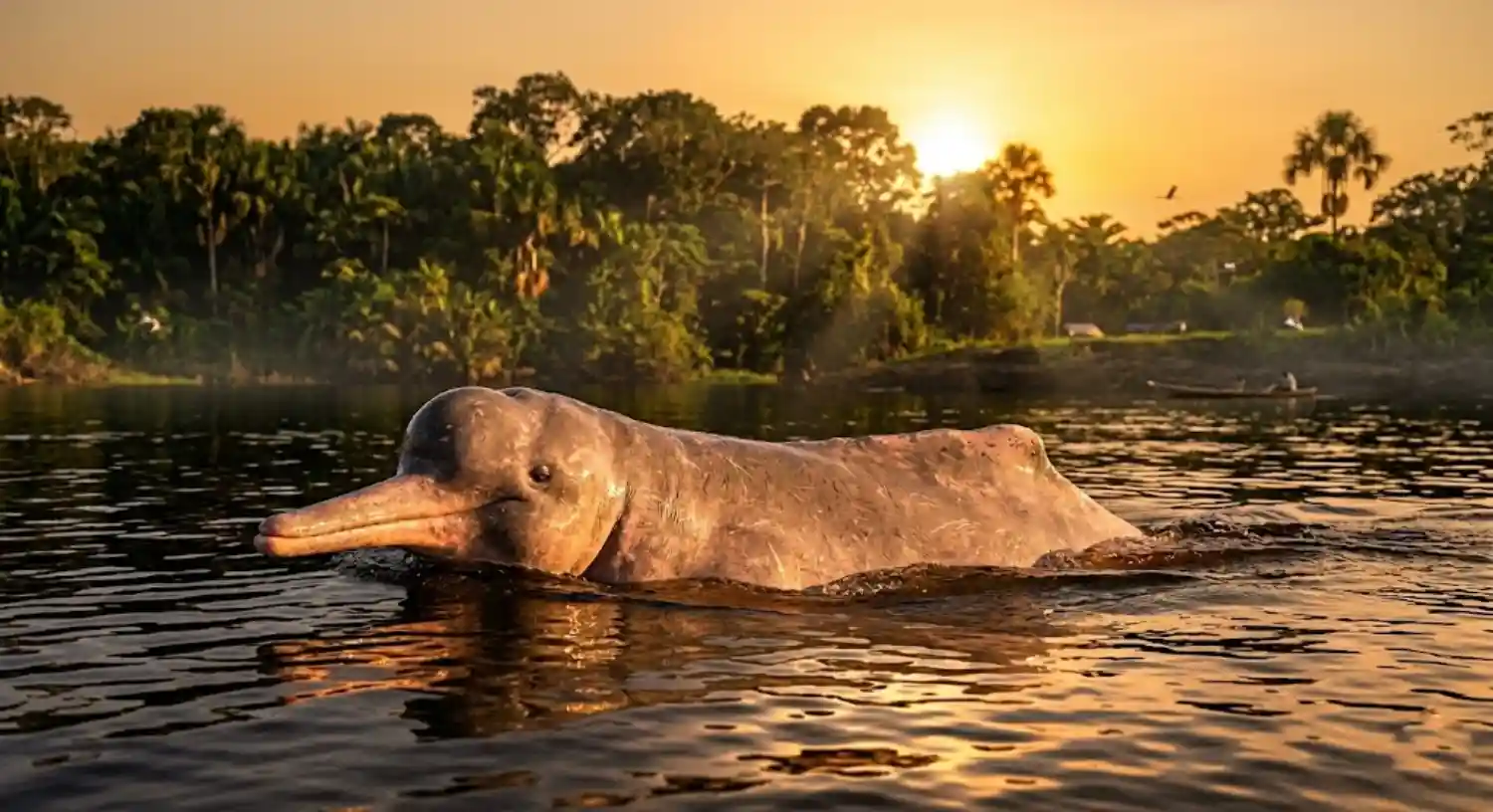
The pink river dolphin, the largest freshwater dolphin in the world, has an anatomical feature that makes it one of the most agile and highly adapted creatures in the Amazonian rivers. Unlike most cetaceans, whose cervical vertebrae are fused to provide hydrodynamic stability at high speeds in the ocean, Inia geoffrensis has completely free, unfused neck vertebrae.
This unusual structure gives the animal extraordinary cervical mobility. It can turn its head by as much as 90 degrees in relation to its body without moving the rest of its torso. In a habitat where maneuverability matters more than speed, that flexibility is a crucial survival advantage.
A neck adapted to the flooded forest
The freedom of its cervical vertebrae breaks from the pattern most commonly seen among dolphins. In the open ocean, a stable body supports fast and efficient movement, but Amazonian rivers present a different challenge. Their waters contain submerged trunks, roots and branches, while the available passages change as water levels rise and fall.
During the flood season, rivers spill over and cover miles of forest. The pink river dolphin then leaves the main channel and moves through the vegetation of the igapó, the flooded forest. Its ability to move its head independently of its body allows it to travel through narrow passages, inspect crevices and pursue prey trying to hide in dense vegetation.
A marine dolphin would be extremely challenged in this setting and could even become trapped. The pink river dolphin, by contrast, can snake through the obstacles and explore each part of the flooded environment. Its flexible neck acts as a tool for navigation and hunting in a maze where a powerful body cannot always turn easily.
Sound turns darkness into a map
The flexible neck works together with another powerful adaptation, a highly sophisticated echolocation system. Through the melon, a fatty structure on its forehead, the animal produces clicking sounds that travel through the water and bounce off objects.
When the echoes return, the dolphin builds a detailed, three-dimensional mental map of its surroundings, even when visibility is effectively zero. Amazonian water may be cloudy and crowded with obstacles, but sound supplies information about what lies ahead, beside the animal and inside hidden spaces among the vegetation.
The dolphin’s cervical mobility helps it aim the sound beam precisely. Instead of rotating its entire robust body to examine an area, it can move its head and scan the surroundings. This allows it to detect a fish hidden behind a root or distinguish the shape of prey within the disorder of branches and submerged trunks.
According to studies, the pink river dolphin’s echolocation is so precise that these animals can distinguish not only the shape of nearby objects, but also their texture and density. They can tell, for example, the difference between a fish with scales and one with skin, or between a dry branch and an edible fruit floating at the surface.
This ability transforms the darkness of Amazonian waters into a scene filled with acoustic information. Each echo helps guide the dolphin’s movements, while its flexible neck directs the scan. To this predator, the flooded forest is not a featureless space. It is an environment that can be interpreted through sound.
A menu with more than 50 fish species
The combination of a mobile neck and precise biosonar contributes to one of the most varied diets among cetaceans. Studies indicate that the pink river dolphin feeds on more than 50 different fish species, varying in size and behavior.
Its menu includes schooling fish as well as solitary bottom-dwelling species, including catfish and armored catfish with hard coverings. The flexible neck helps the dolphin seize prey from difficult positions, especially when it must approach from an unusual angle or place its head among roots and branches.
The animal’s teeth are also suited to different types of prey. Conical teeth at the front hold fish, while flatter teeth farther back crush them. This combination allows the dolphin to handle the varied textures and defenses found among the fish it catches.
That dietary flexibility is essential in an ecosystem as dynamic and seasonal as the Amazon. Food availability changes drastically throughout the year, following changes in river levels and the expansion or retreat of flooded forests.
An adaptation threatened by changes to the river
The pink river dolphin’s distinctive anatomy does not shield it from the growing threats in its habitat. Science recognizes that the species faces serious risks that place it in danger of extinction. Mercury pollution in rivers, originating from illegal mining, bioaccumulates through the food chain and affects the health of these top predators.
Hydroelectric dam construction fragments populations, while collisions with boats are becoming more frequent. The greatest threat, however, has been intentional capture for the use of its meat as bait in piracatinga fishing. The practice is prohibited in Brazil, but it continues because enforcement is insufficient in remote areas.
Protecting the pink river dolphin means protecting the full complexity of the rivers and forests where it lives. Its neck anatomy is more than a biological curiosity. It is a lesson in how life takes shape to prosper in some of Earth’s most challenging niches.
Every turn of the dolphin’s head in the depths of the igapó is evidence of evolution’s ability to create solutions for survival amid the Amazon’s tangled vegetation. The animal’s cervical freedom depends directly on forests continuing to flood and rivers continuing to run freely and cleanly.
When those conditions remain, this gardener of the waters can continue its ancient dance among submerged trees. Its adaptation also invites reflection on the fragility of evolutionary links in the face of the accelerated transformations humans impose on the planet.
Reporting: Anne Silva / Amazonia Mag

Editor, English Edition — Amazonia Mag
Anne Silva is the editor of Amazonia Mag, the English-language edition of Revista Amazônia. She curates, translates and adapts the outlet's science and environment coverage for an international audience, reporting on Amazon wildlife, flora, rivers, climate and research. Every story she edits is grounded in peer-reviewed studies, official data and on-the-ground reporting from the Revista Amazônia newsroom in Belém, Pará, Brazil. More by Anne Silva →