
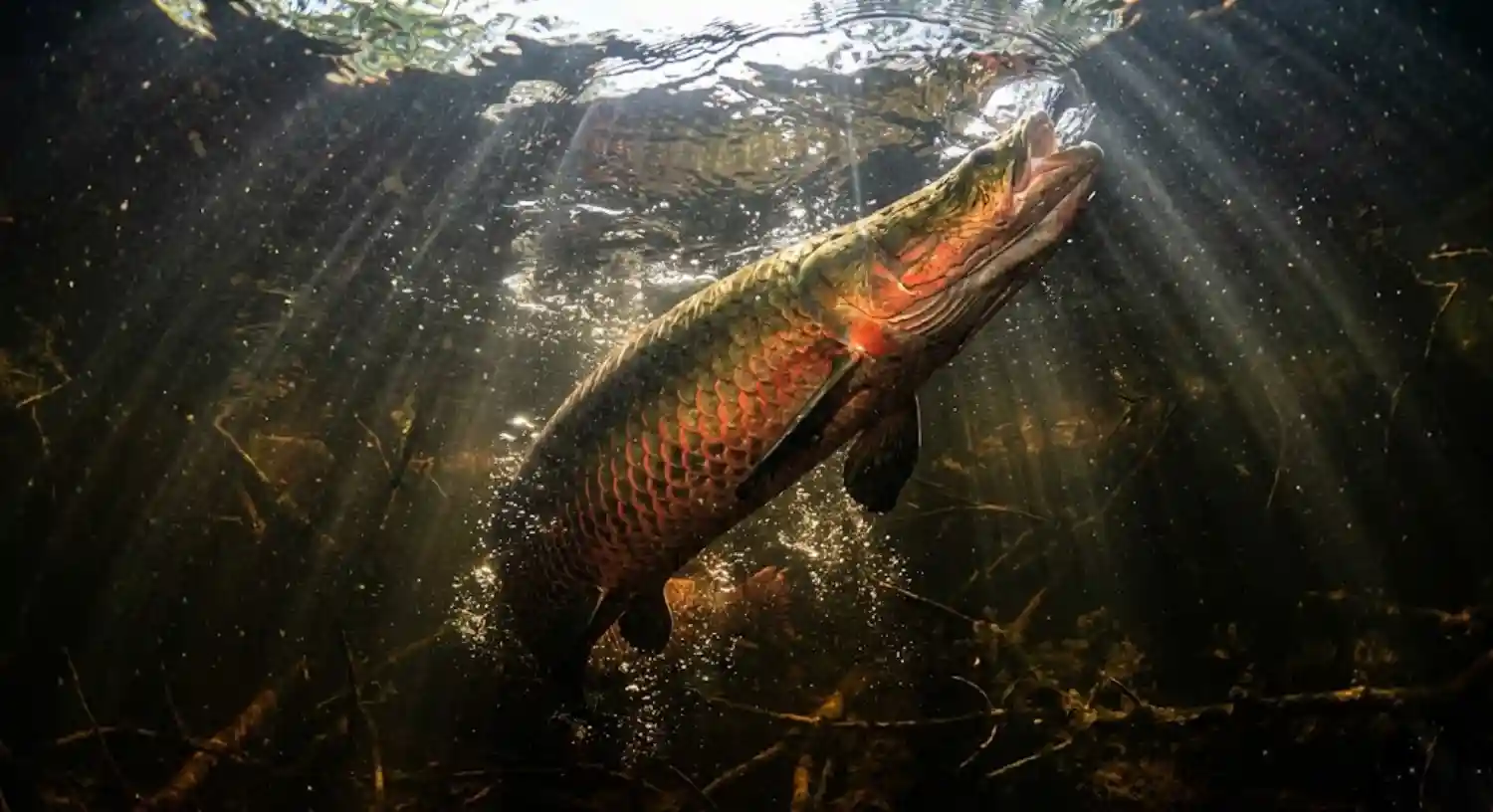
The giant fish that must breathe air
The pirarucu has an extraordinary biological trait that sets it apart from the great majority of teleost fish. It is an obligate air breather, meaning that although it has gills, they are not enough to meet its oxygen demand as the animal grows.
In practice, this Amazonian giant must rise to the surface of rivers and lakes every ten to twenty minutes to take in atmospheric air. Without direct contact with the outside world, it would literally drown underwater, an evolutionary irony for a species that can exceed 441 pounds (200 kilograms) and reach 9.8 feet (3 meters) in length.
This dependence on air is an adaptation to the frequently hypoxic waters of the Amazon Basin. Heat and the decomposition of organic matter drastically reduce the amount of dissolved oxygen, particularly in environments where warm water remains loaded with decaying material.
The natural engineering behind this survival strategy lies in the fish’s swim bladder. In other fish, the organ serves only to control buoyancy, but in the pirarucu it evolved into a primitive lung.
This organ is highly vascularized and has an alveolar internal structure rich in capillaries, allowing rapid gas exchange. That arrangement enables oxygen from the air to enter the bloodstream and supports the metabolism of an animal living in water where oxygen can be scarce.
How the modified swim bladder works
When the fish brings its head above the water, it opens its mouth and performs a vigorous sucking motion. Air enters the modified swim bladder directly, where oxygen is transferred into the blood.
The process produces a characteristic sound, a deep gulping or bellowing noise that echoes along the banks of riverside communities. The sound signals the presence of the giant in the dark depths and has become part of the landscape for people living beside Amazonian lakes and rivers.
Air breathing also explains why the pirarucu’s behavior is so important for understanding the species. The fish cannot remain hidden underwater forever, because it must return again and again for its next breath.
Its need to surface creates a predictable rhythm. The pirarucu’s rise is often both visible and noisy, making the breathing cycle a key detail in the relationship between the animal, fishers and the floodplain environment.
A weakness turned into a conservation tool
This constant need to emerge creates a critical vulnerability for the species. The timing of the ascent is predictable and loud, a combination that historically made the animal easier for fishers to locate.
The gleam of its reddish scales near the surface can reveal the pirarucu’s exact position. Together, the sound, the regular breathing pattern and the visible body made the fish an easy target for traditional harpooning and helped expose it to predatory fishing pressure.
Yet what was once a weakness exploited by fishing has become a fundamental pillar of community-based sustainable management. Science recognizes that visually counting these fish as they breathe is an effective way to estimate their populations.
With those observations, local communities can establish fishing quotas that do not threaten the species’ continuity in floodplain ecosystems. The same behavior that once helped people find the animal can now help determine how many individuals may be harvested without undermining population renewal.
The success of pirarucu management depends on understanding the fish’s breathing cycle and reproductive behavior. Traditional communities used that biological knowledge to reverse the near-extinction scenario that had affected the region decades ago.
Changing gills and an advantage during drought
The pirarucu’s biology reveals remarkable physiological plasticity. Along with its primitive lung, the animal undergoes changes in its gills as it develops.
As a juvenile, the fish can still extract a significant share of its oxygen from the water. As it ages, however, its gill lamellae become shorter and less efficient, forcing the animal to become increasingly dependent on the atmosphere.
Studies indicate that this evolutionary strategy allowed the pirarucu to occupy ecological niches where other large predators cannot survive. These include isolated lakes during the dry season, when the water becomes a warm, oxygen-poor soup.
There, the pirarucu reigns with a decisive advantage. Its ability to breathe air keeps its metabolism active while other fish become sluggish under the pressure of low dissolved oxygen.
This capacity does not separate the fish from its ecosystem. The pirarucu also plays a vital ecological role as a top predator in floodplain areas, where it helps control the populations of other species.
By regulating those populations, it maintains the trophic balance of Amazonian aquatic systems. Its absence would cause a cascading effect, changing the entire nutrient dynamics of the lakes.
A giant that helps protect forests and communities
Pirarucu management in the Amazon is one of the strongest examples of conservation based on a species’ ecology. Protecting the fish requires maintaining healthy lakes and preserving flooded forests.
That work ultimately protects hundreds of smaller species, turtles and aquatic birds that share the same habitat. For this reason, the pirarucu continues to function as a keystone umbrella species, with its conservation helping safeguard a broader community of organisms.
The economy generated by this activity supports thousands of families. The result shows that biological knowledge can be a powerful tool for prosperity in a standing forest, connecting community livelihoods with the regeneration of natural resources.
The fish’s anatomy also includes another remarkable defense. Its scales act as natural armor, flexible enough to allow agile swimming but strong enough to withstand attacks from piranhas.
The scales have a mineralized structure that makes them nearly indestructible under pressure. When that physical protection is combined with the fish’s lung-like respiratory capacity, the pirarucu appears to carry traits from primitive lineages that survived monumental geological transformations.
The pirarucu is not merely a fishery resource or a cultural symbol of the Amazon region. It is also a living record of how nature finds brilliant solutions to environmental challenges.
Preserving this giant means respecting the rhythm of its rise for the next breath. Sustainable management has transformed the sound of its bellow at the surface into a symbol of hope for Brazilian biodiversity.
If the pirarucu must emerge to continue existing in the underwater world, people also need to look toward the surface of science and tradition to find a balance between consumption and regeneration.
The intelligence of the forest appears in every detail of this adaptation. Each pirarucu breath above a mirrored lake is an invitation to understand that life always finds a way when it is given the space and respect it needs to flourish.
Reporting: Anne Silva / Amazonia Mag

Editor, English Edition — Amazonia Mag
Anne Silva is the editor of Amazonia Mag, the English-language edition of Revista Amazônia. She curates, translates and adapts the outlet's science and environment coverage for an international audience, reporting on Amazon wildlife, flora, rivers, climate and research. Every story she edits is grounded in peer-reviewed studies, official data and on-the-ground reporting from the Revista Amazônia newsroom in Belém, Pará, Brazil. More by Anne Silva →