
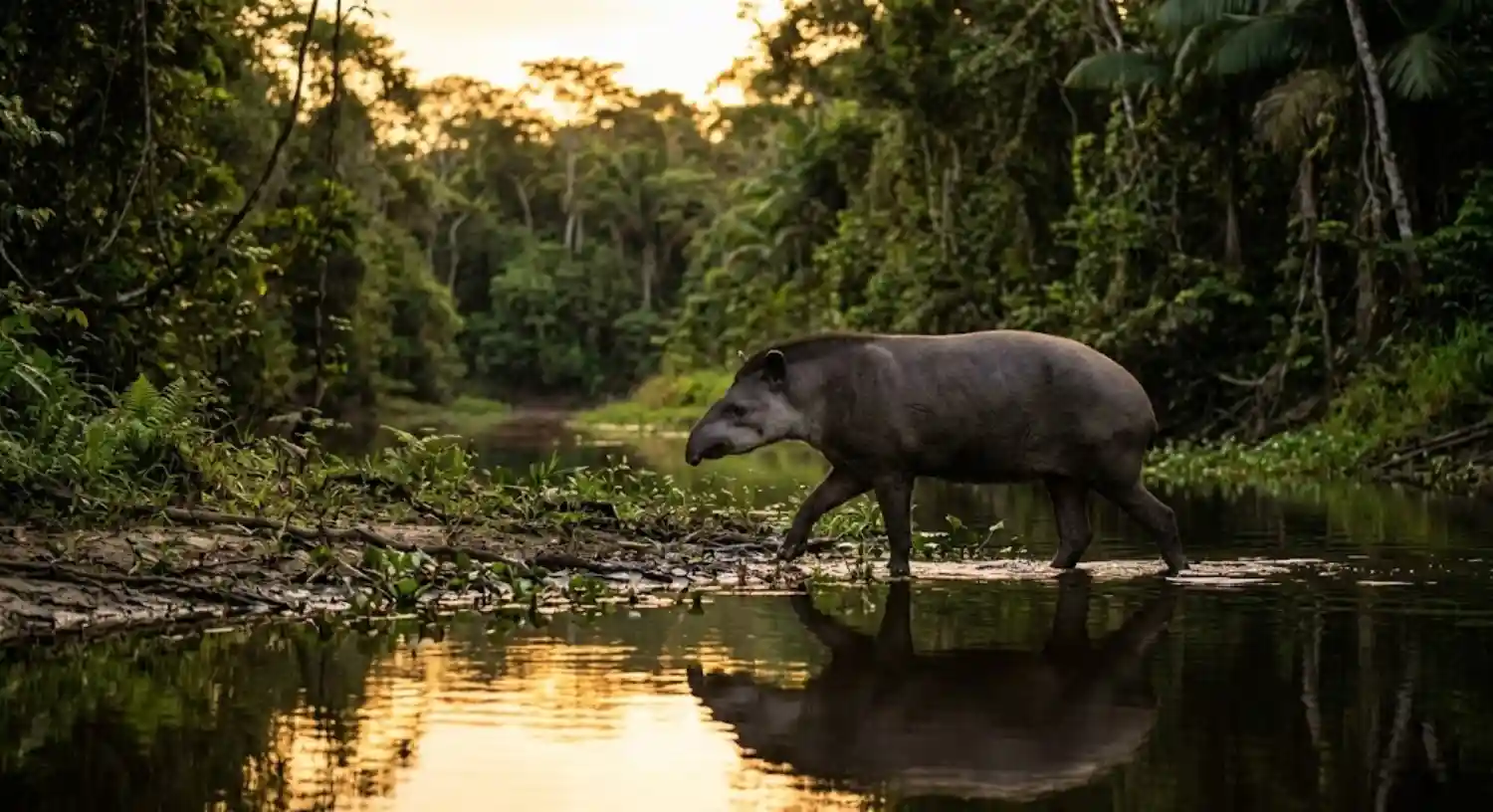
The largest land mammal in South America works as a quiet gardener at the heart of the Amazon. During twilight and nighttime journeys, the Amazon tapir moves through the understory, searches for fruit and shoots, and carries the seeds of future plants inside its body.
Its importance is not limited to its size or strength. The digestive tract of this formidable herbivore has a surprising biological feature: the tapir swallows fruit whole, including fruit with large seeds covered by very hard shells or protected by natural chemical compounds that might discourage other herbivores.
While many smaller mammals grind food until its internal structures are destroyed, or spit out larger pits to avoid the high energy cost of complex digestion, seeds eaten by the tapir pass through its long gastrointestinal system almost intact. An ordinary meal therefore becomes an invisible form of forest engineering.
A body built for the rainforest
Known scientifically as Tapirus terrestris, the species is the largest land mammal on the entire South American continent. Its muscular, sturdy body often weighs more than 550 pounds (250 kilograms), giving it the strength to push through the tangled rainforest understory.
The tapir moves like a gray shadow among immense green leaves. Its flexible, prehensile trunk serves as a highly precise tactile and olfactory tool, allowing the animal to select fallen fruit and hidden shoots among dense vegetation.
The ecological role of Tapirus terrestris goes far beyond being part of the local wildlife. The animal acts as a true architect of its surroundings because it carries plant material to places where heavy seeds would have little chance of arriving on their own.
Moving seeds too large for other animals
The rainforest contains countless imposing trees that produce nutritious fruit with huge seeds, too large and hard to be processed by monkeys, fruit-eating birds or fast-moving small rodents. Without a disperser with the right anatomical capacity, many of these heavy fruits would simply fall beneath the parent tree.
Once gathered on the shaded forest floor, the seeds could rot in the high humidity or be quickly eaten by ground beetles. They would also lose any real chance of germinating because of severe competition for sunlight and nutrients with the adult plant itself.
The tapir solves this botanical problem during long foraging sessions. This powerful mammal consumes an impressive amount of plant biomass and eats hundreds of entirely different plant species as seasonal climate conditions change.
Large fruits filled with pulp create a mobile genetic bank inside its body, one of great value to the biome. Because digestion takes a long time as food moves through the animal’s extensive intestinal tract, the tapir can walk formidable distances before defecating.
The practical result is the safe transport of dozens of future trees for several miles, across dense forest fragments and into remote areas. There, seeds can encounter conditions different from those found beneath the tree that produced the fruit.
Nighttime work beneath the canopy
The species’ instincts make this ecological service even more efficient. Tapirs are predominantly crepuscular and nocturnal, moving cautiously, alone and with remarkable quiet beneath the protection of darkness.
When the scorching sun disappears over the distant horizon, or during the cool early hours of the morning, the large herbivore begins its long feeding route through the understory. Its methodical movements create deep, well-marked trails in the wet forest floor, forming safe corridors that are often used by smaller species.
In this peaceful nighttime quiet, large-scale seed dispersal takes place without disturbance. Passage through the animal’s acidic stomach and long intestines can help some seeds begin the process of germination because gastric juices chemically break part of their natural dormancy and weaken their tougher outer layers.
This scarification prepares the dormant plant embryo to sprout when it reaches firm ground and the first rains arrive. The botanical material is also deposited with a generous amount of nutrient-rich organic matter, creating a fertilized microenvironment around the seed.
It is a complete biological planting package provided by natural evolution. The tapir combines transport, chemical preparation and fertilizer while continuing the daily routine of feeding.
Rivers, refuge and green corridors
The ancient connection between the mammal and the clear or muddy waters of the river basin also shapes the vegetation around winding rivers and Amazonian streams. These robust animals are exceptional and surprisingly agile swimmers, and they spend much of their time immersed in water to cool off in the constant equatorial heat.
They often find relief and safety by depositing organic waste directly into running water or on fertile, muddy banks. This behavior promotes the efficient dispersal of riverside plants, aquatic palms and floodplain shrubs.
The vegetation that develops along waterways forms dense green corridors and helps stabilize riverbanks against the damaging effects of water erosion. Rivers are therefore not only travel routes, but also places for refuge, cooling and seed dispersal.
The tapir’s swimming ability lets it cross long territories and use rivers as safe shelter. Repeated diving helps regulate body temperature during the forest’s intense heat and keeps unwanted insects away, creating periods of deep rest that are essential for maintaining the animal’s demanding nighttime foraging routine.
A foundation for forest renewal
The long-term impact of this process is difficult to overstate. Great hardwood trees, which store enormous amounts of atmospheric carbon in their massive, centuries-old trunks, depend largely on terrestrial megaherbivores to spread their heavy seeds.
In the environmental relationship involving the tapir, continuous forest regeneration and the structural health of terra firme rainforest, the permanent absence of this strong-footed disperser would cause a drastic impoverishment of the original plant diversity. Over just a few botanical generations, the jungle would inevitably lose part of its monumental architecture.
In untouched ecological sanctuaries where these remarkable animals still roam freely and remain fully protected, the enduring cycle of plant life follows a more balanced rhythm of natural growth. Careful observation of large natural areas shows that the abundance of large herbivores is closely linked to the extraordinary botanical richness of a place.
Every soft, silent step on the damp forest floor carries the hidden potential of a colossal new tree. In a prosperous future, that tree could shelter flocks of colorful birds, beautiful collections of orchids and thousands of beneficial insects, while helping purify the air and regulate the vital rainfall patterns of South America.
Recognizing this precise and powerful life cycle can renew admiration for the capacity of wildlife. Peaceful coexistence, careful human respect and rigorous protection of connected habitats can help the Amazon’s green symphony continue to grow in a vigorous, majestic and healthy way.
In modern times, people often seek complex technological solutions to restore fragmented ecosystems. Yet one of the most durable and efficient answers remains the quiet work of a solitary walker, planting tomorrow one firm step at a time on the wet earth.
Reporting: Anne Silva / Amazonia Mag

Editor, English Edition — Amazonia Mag
Anne Silva is the editor of Amazonia Mag, the English-language edition of Revista Amazônia. She curates, translates and adapts the outlet's science and environment coverage for an international audience, reporting on Amazon wildlife, flora, rivers, climate and research. Every story she edits is grounded in peer-reviewed studies, official data and on-the-ground reporting from the Revista Amazônia newsroom in Belém, Pará, Brazil. More by Anne Silva →