
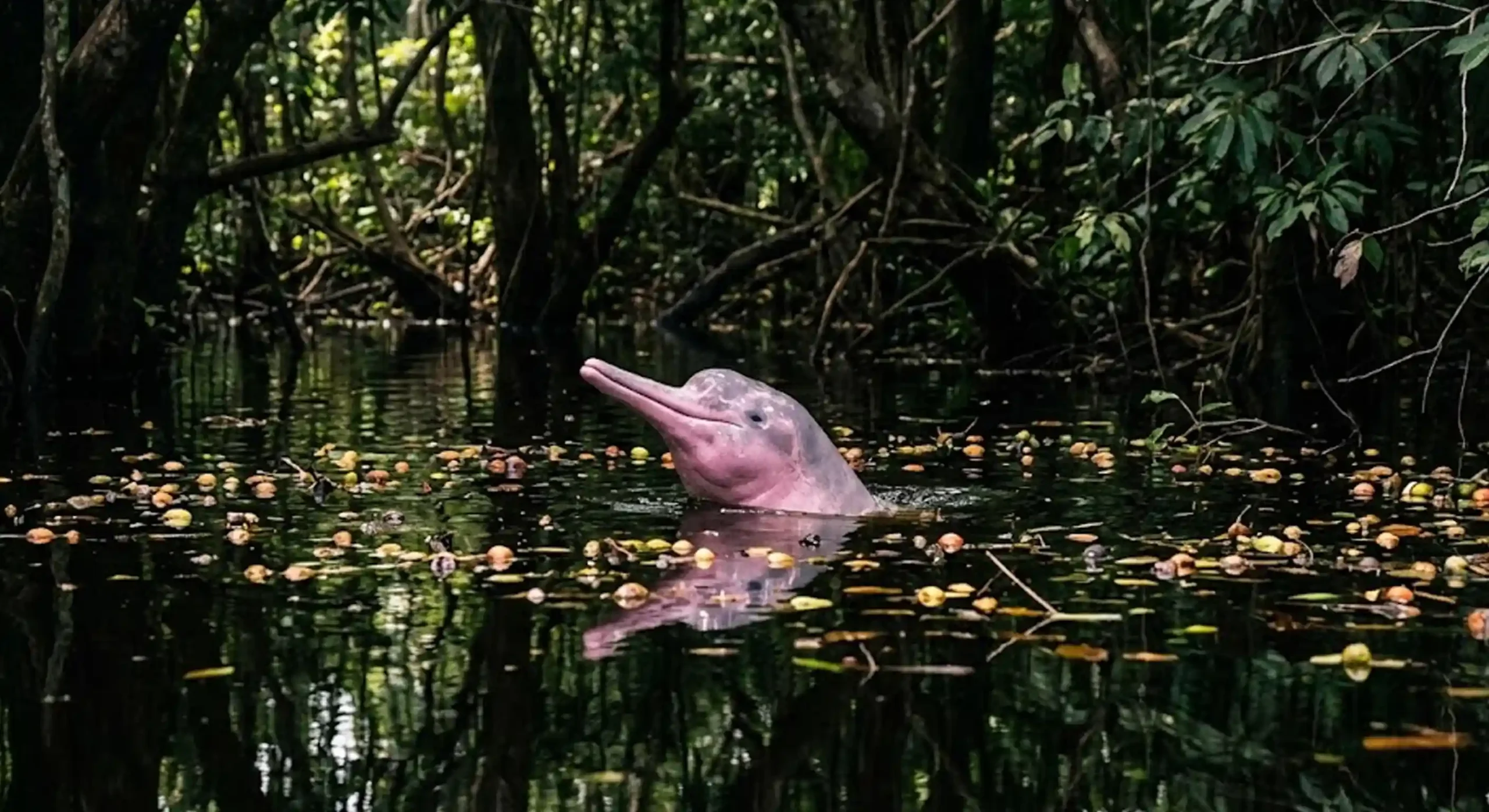
The pink river dolphin can leave the main channel of the great rivers and travel for miles into dense forest during the height of the annual floods. This season of rising water transforms the habitat of Inia geoffrensis, allowing the animal to move through igapó forests where the water reaches the tree canopy.
In that setting, science has documented a surprising departure from the dolphin’s usual carnivorous diet. Rather than pursuing fish alone, the pink river dolphin actively consumes seeds and fruit pulp that fall directly from trees onto the water, revealing an adaptive behavior that few researchers expected to be so frequent.
This feeding pattern is not simply an accidental response to a passing opportunity. The most recent research described here indicates that frugivory is an important nutritional strategy during the floods, when fish spread through the inundated forest and become harder to catch.
A dolphin traveling through submerged trees
When river levels rise, water enters parts of the forest that remain dry for months of the year. In the igapó, treetops stand above a temporary aquatic landscape, and fruit falling from the branches becomes available to an animal that can navigate among submerged trunks, roots and narrow channels.
The dolphin feeds on fruits such as tucumã, javari and those produced by several palm species. By swallowing them, it gains access to pulp and seeds while also beginning a natural transport process through the maze of waterways that crosses the Amazon Basin.
The pink river dolphin has a long snout and tactile bristles that help it search for fruit in flooded habitat. These features are useful in an environment where submerged roots and muddy water make visual detection difficult or nearly impossible.
The animals use biosonar, or echolocation, to detect the vibrations and sounds made by small objects striking the water’s surface. That ability allows them to quickly distinguish an edible fruit from a dry branch, even in turbid water and beneath the roots of flooded trees.
The behavior shows how closely the dolphin’s body and senses are connected to the seasonal forest. It is able to enter spaces that become available only when the water rises, search for food in low visibility and continue moving through a habitat shaped by the annual flood cycle.
An aquatic seed disperser
The most striking ecological role appears after the dolphin feeds. Seeds pass through its digestive tract and are released far from the parent tree, placing the cetacean at the center of seed dispersal in the Amazon’s flooded forests.
Unlike terrestrial animals, the dolphin can carry seeds toward places that will be dry months later. This movement gives new trees a chance to colonize different riverbanks and sandbars, linking areas that may be separated by long stretches of water during the flood season.
Field studies show that seeds passing through the dolphin’s digestive system retain a high germination rate. That finding demonstrates the effectiveness of aquatic transport and supports the importance of the animal in the renewal of igapó vegetation.
Researchers at INPA observed that Inia geoffrensis can carry seeds for more than 31 miles (50 kilometers) before releasing them. This aquatic dispersal role is vital to the genetic diversity of igapó forests and makes the cetacean an unexpected ally in the recovery of degraded areas along river margins.
Food when fish spread through the forest
The dolphin’s feeding behavior during the floods also reveals a tactical response to changing food conditions. As fish disperse through the inundated forest, hunting becomes more difficult because prey no longer remains concentrated in the main riverbed.
Fruit provides an additional source of energy during that period. The most recent research indicates that frugivory helps the dolphins accumulate fat while fish are more widely distributed across the flooded landscape.
Finding fruit requires the dolphins to locate trees in full production within a dense forest covered by water. Their echolocation helps them respond to the vibrations and sounds created when objects hit the surface, while their long snouts and tactile bristles assist with searching in submerged spaces.
Each fruit eaten becomes part of a larger chain. The dolphin receives seasonal nourishment, then carries seeds away from the tree where they grew and releases them through the channels of the Amazon Basin.
This process shows that feeding and dispersal are connected rather than separate events. A fruit that falls into the water can become food for the dolphin and later become the starting point for a new plant in another section of the flooded forest.
Protecting the dolphin and its forest
The discovery changes how biologists plan the conservation of várzea ecosystems. Protecting the pink river dolphin now also means protecting the tree species that provide its seasonal food and preserving the forested margins where that exchange takes place.
There is an intrinsic connection between the health of cetacean populations and the density of forests along rivers. When riparian forest is cleared, the dolphin loses a vital energy source, while the forest loses one of its most agile seed dispersers.
The relationship works in both directions. The trees supply fruit to the animal, and the animal transports seeds to riverbanks, sandbars and channels that may support forest regeneration after the waters recede.
The act of eating fruit also affects nutrient dynamics in the igapó. When dolphins defecate far from the parent tree, they release seeds in distant places and fertilize the beds of small streams with processed organic matter.
That material favors the growth of aquatic plants and the development of juvenile fish that use these areas as nurseries. It is a quiet, continuous ecosystem service that helps sustain fishery productivity on which thousands of riverside families depend.
An environmental engineer in the Amazon
The pink river dolphin is no longer seen only as a figure of folklore. It can also be recognized as an indispensable environmental engineer, one whose movements help maintain the balance of Amazonian waters and the vegetation connected to them.
Watching these animals move gracefully among submerged tree trunks is a way to understand the complexity of evolution in the Amazon. The dolphin challenges rigid biological categories by showing that an aquatic mammal can take part in a process often associated with land animals, the dispersal and renewal of forests.
Its role also shows why the natural cycles of flooding and falling water must be preserved. When the annual rise connects the river to the trees, dolphins find food, seeds travel across new distances and the forest keeps its ability to regenerate.
The Amazon’s biodiversity works as a single mechanism in which water, plants, fish and mammals depend on one another. The dolphin helps plant the forest of the future with every movement through the flooded channels, while the forest supplies part of the seasonal energy required by the animal.
Every swallowed fruit is therefore one link in a chain that keeps the Amazon active and green, even beneath several meters of water. The pink river dolphin carries more than food through the flooded forest: it carries seeds, nutrients and an unexpected connection between the health of river animals and the renewal of the trees along Amazonian waterways.
Reporting: Anne Silva / Amazonia Mag

Editor, English Edition — Amazonia Mag
Anne Silva is the editor of Amazonia Mag, the English-language edition of Revista Amazônia. She curates, translates and adapts the outlet's science and environment coverage for an international audience, reporting on Amazon wildlife, flora, rivers, climate and research. Every story she edits is grounded in peer-reviewed studies, official data and on-the-ground reporting from the Revista Amazônia newsroom in Belém, Pará, Brazil. More by Anne Silva →