
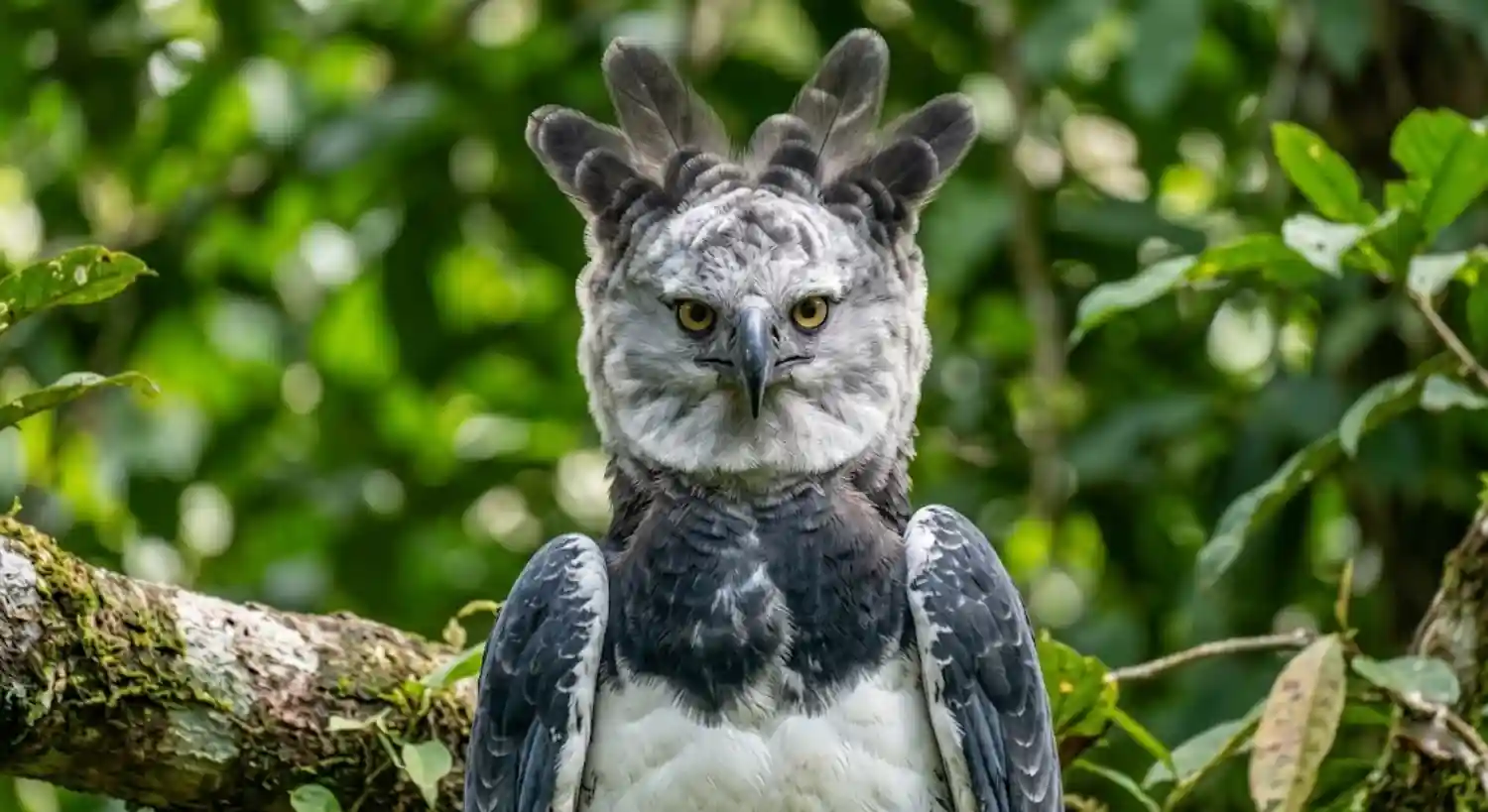
The Harpy Eagle (Harpia harpyja) exerts a pressure of 400 kilograms per square inch with its talons, a force greater than the bite of a gray wolf and one reason it is described as the planet’s most lethal winged predator. At the top of the Amazonian food chain, this eagle is more than a biological spectacle. Its presence serves as a measure of rainforest integrity.
When a Harpy Eagle lives in a region, the ecosystem retains conditions capable of supporting a top predator. When the bird disappears, the environmental structure has already suffered a profound collapse. Its survival can therefore be read as a vital sign of forest health and of the rainforest’s ability to withstand environmental pressure.
That dominance faces an increasingly difficult barrier: the unchecked advance of the agricultural frontier. Unlike other birds that can adapt to isolated forest fragments, the Harpy Eagle requires primary rainforest, with emergent trees rising more than 131 feet (40 meters) above the canopy for nesting.
A predator built for dense forest
The Harpy Eagle’s anatomy challenges expectations about large birds. With a wingspan reaching 6.6 feet (2 meters), it has short, rounded wings, an evolutionary adaptation that allows explosive maneuverability through dense vegetation.
An adult female can weigh up to 19.8 pounds (9 kilograms) and carry prey of equivalent weight. Sloths and primates are among its prey, and the eagle can take them to nests positioned in the crowns of Brazil nut trees and kapok trees, which provide the height and structure required for reproduction.
This combination of strength, size and agility explains the species’ place in the rainforest. The Harpy Eagle is not merely a large bird that occupies an extensive territory. It is also a specialized predator that depends on a forest with tall trees, arboreal prey and enough continuity to sustain viable populations.
The National Institute of Amazonian Research, known as INPA, warns that habitat fragmentation isolates populations and creates a genetic bottleneck. That process could become the final blow to the species in Brazil, because it reduces exchange among individuals and limits the possibility of recovery.
Slow reproduction, high stakes
The Harpy Eagle’s reproductive cycle is one of the slowest in nature. A pair raises only one chick every two or three years, making the loss of breeding adults and active nests especially serious.
Parental investment is immense. During the first months, the male hunts tirelessly while the female protects the nest. This strategy of low birth rates and high investment means that population recovery in degraded areas takes decades, not years.
Brazil’s Chico Mendes Institute for Biodiversity Conservation, known as ICMBio, monitors active nests. Even so, reproductive success drops sharply in areas near the arc of deforestation, where the forest becomes more fragmented and human pressure approaches breeding sites.
Isolation creates additional problems for young birds. After leaving the nest, they need to find mates and unoccupied territory. Without connections between reserves, many cannot establish themselves or pass on their genes, further weakening populations outside the largest forest blocks.
The myth of the livestock predator
Besides the chainsaw, one of the Harpy Eagle’s greatest enemies is a lack of knowledge. Farmers frequently shoot the bird because they fear attacks on domestic animals, even though that fear does not match the profile of most of its documented prey.
Diet studies conducted by the Harpy Project show that more than 70% of its prey are arboreal animals. The eagle rarely comes down to the ground or approaches human homes when the surrounding forest remains intact.
Killing the bird in retaliation or as preventive action removes individuals that may be of breeding age. The effect is catastrophic for a slow-growing species, because every dead eagle represents the loss of a genetic bank that took millennia to specialize.
Environmental education in rural communities is not only an ethical choice. It is also a biological security requirement. Without the Harpy Eagle to control monkey and sloth populations, the imbalance can affect even the dispersal of seeds from the largest trees.
Protecting the species means addressing both the physical loss of forest and the beliefs that encourage persecution. In this context, explaining its diet, behavior and ecological importance can reduce conflicts and prevent the killing of birds that perform an irreplaceable role in the rainforest.
Conservation can support local economies
Protecting the Harpy Eagle creates real economic returns through scientific tourism and birdwatching. A single monitored nest in Mato Grosso or Pará can attract photographers from around the world, willing to pay high daily fees to document the chick’s growth.
That flow of foreign capital helps fund the maintenance of Private Natural Heritage Reserves, known in Brazil as RPPNs, and pays local guides. For some of these workers, the activity provides an alternative to logging, which previously appeared to be the only available source of income.
Citizen science also expands the ability to monitor the species. With support from platforms such as eBird, a Harpy Eagle sighting can become a highly precise scientific record. When an observer documents the bird in the Atlantic Forest, where it is critically endangered and survives in isolated pockets, international conservation protocols are activated.
Institutions such as Nature emphasize that preserving apex predators is the cheapest way to maintain the climate resilience of tropical forests. The logic is direct: protecting the species requires maintaining its habitat, prey, emergent trees and connections, all of which support the wider forest community.
Related coverage includes “Harpy Eagle in Action: 7 Shocking Facts About Brazil’s Largest Bird of Prey” and “The Unlikely Sanctuary of the World’s Largest Eagle in Mato Grosso.” These perspectives reflect the interest surrounding a species whose conservation connects science, local economies and rainforest protection.
The last frontier of resilience
The Harpy Eagle’s survival depends on maintaining large, continuous blocks of forest. Creating ecological corridors is the only technically viable solution for preventing the extinction of populations outside the central Amazon.
Without connections between reserves, young birds leaving the nest cannot find mates or available territory. They die without reproducing and without passing on their genes, while populations become increasingly isolated and vulnerable to the genetic bottleneck identified by INPA.
Brazil holds the largest remaining population of the species. That status gives the country an unprecedented geopolitical environmental responsibility, because the future of the Harpy Eagle depends heavily on decisions made within Brazil’s forests.
The Harpy Eagle is a living symbol that national development must respect the limits of biodiversity. Protecting it means protecting the water, soil and future of the forests that support the country’s economy.
Its survival carries a conclusion that is difficult to ignore: the rainforest does not accept shortcuts. Where a Harpy Eagle survives, there is still a forest with height, prey, space and continuity. Where it disappears, the loss shows that the environmental structure has already been deeply compromised.
Reporting: Anne Silva / Amazonia Mag

Editor, English Edition — Amazonia Mag
Anne Silva is the editor of Amazonia Mag, the English-language edition of Revista Amazônia. She curates, translates and adapts the outlet's science and environment coverage for an international audience, reporting on Amazon wildlife, flora, rivers, climate and research. Every story she edits is grounded in peer-reviewed studies, official data and on-the-ground reporting from the Revista Amazônia newsroom in Belém, Pará, Brazil. More by Anne Silva →