
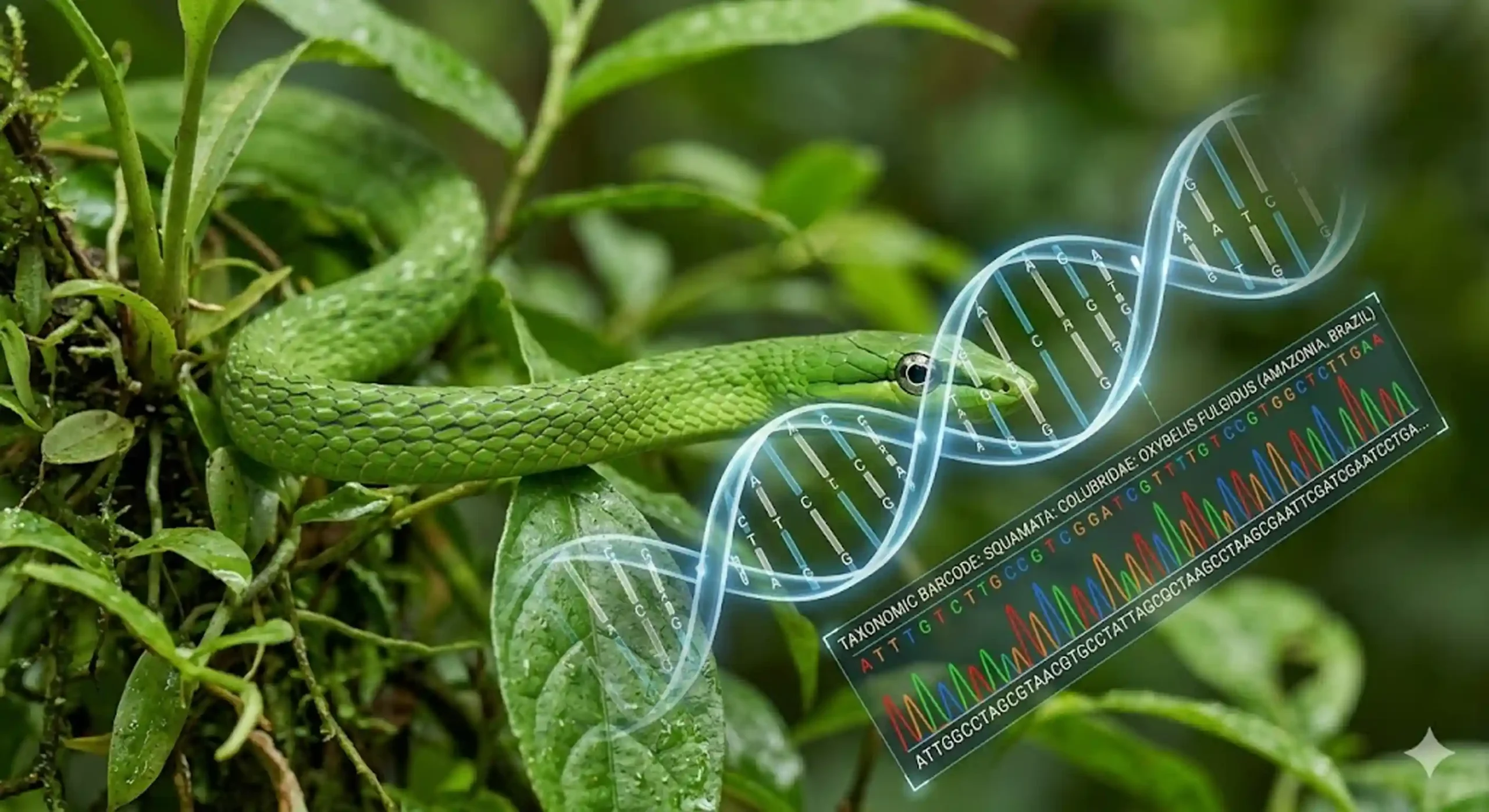
Genetic sequencing technology is revealing that the world’s largest tropical rainforest holds far more secrets than the human eye can notice during field expeditions. In laboratories, tissue analysis is showing that new Amazon snake species are not merely a theoretical possibility, but a reality that can be identified through molecular evidence.
According to Brazilian and international researchers, over the past five years molecular genetics has allowed scientists to identify at least 12 new snake lineages that had previously been classified as a single species. These animals belong to a group known as cryptic species, which share nearly identical external appearances while carrying genetic codes as different as those of a cat and a lion.
The discovery challenges important assumptions in regional herpetology. It also shows that the diversity of the rainforest cannot always be recognized by an animal’s visible characteristics, even when specimens are examined by specialists in the field.
A barcode for reading biodiversity
The progress of this mapping has been made possible by DNA barcoding, a technique that works much like a supermarket barcode scanner applied to biology. Rather than examining the snake’s entire body, scientists focus on a specific fragment of the mitochondrial genome.
This region changes very little within a species, but can vary dramatically between different species. Its analysis therefore makes it possible to compare samples and identify differences that do not appear in body shape, coloration or external patterns.
The method can also be applied to organic remains found in a predator’s stomach or to old skin samples kept in museums. In this way, genetic material can reveal the presence of animals that a biologist has never seen alive.
That precision reduces the human error associated with visual identification. Snakes developed highly effective camouflage over millions of years of evolution, and their external similarity can confuse the classification of animals that belong to separate lineages.
Cryptic species and new conservation priorities
The existence of cryptic snakes makes taxonomy more complex and profoundly changes public environmental protection policies in the Brazilian states of Pará and Amazonas. When scientists believed that one species was distributed throughout the Amazon, its conservation status tended to be considered of little concern.
The situation changes when genetic analyses reveal that this population is actually made up of five different species, each occupying a very small territory. In that case, extinction risk rises exponentially, because the destruction of a specific area can affect an entire lineage.
One of these newly identified species might live only in an area designated for illegal gold mining or agricultural expansion. If that happens, it could disappear before it even receives an official name, turning genetic identification into an early-warning system for conservation.
Genetics can therefore help redefine where extractive reserves and national parks should be established. Environmental protection maps no longer depend only on the apparent distribution of a species. They must also account for invisible differences separating one lineage from another.
The connection between DNA, venom and public health
The effects of this research extend beyond conservation. These scientific discoveries also have direct applications in public health and antivenom production, because a snake’s chemical venom profile is closely linked to its genetic lineage.
Two snakes may look identical while carrying different DNA. In that situation, their venoms are highly likely to trigger different reactions in the human body and require specific treatments, a distinction that is especially important for isolated communities.
By cataloging the true diversity of species, research institutes can develop more effective and personalized antivenoms. The goal is to reduce deaths from snakebite in communities that face greater difficulty reaching medical care and obtaining appropriate treatment.
The creation of venom banks also depends on this level of precision. Correctly identifying each lineage allows researchers to gather representative samples and improve animal management at wildlife rehabilitation and triage centers, ensuring that every group receives appropriate protection.
A new way of seeing the rainforest
The laboratory is now working side by side with the field so that science can keep pace with the speed of life in the rainforest. This new era of genetic taxonomy also highlights Brazil’s biological heritage before the international community.
Brazil leads the volume of publications on the phylogeny of Neotropical snakes, consolidating the country’s position as a biotechnology power applied to nature. DNA barcoding does not replace the researcher who faces mud and heat in the forest, but it strengthens that researcher’s evidence by documenting diversity that cannot always be seen.
In Brazil, DNA barcoding identified the famous boa constrictor as a complex made up of several species with distinct ecological needs. That precision is essential for creating venom banks and for managing animals in triage centers, helping ensure that each lineage receives the protection it requires.
Every new sequence deposited in global databases acts as an invisible shield for the rainforest. The genetic record challenges the idea that humanity already knows everything the Amazon has to offer and demonstrates that the forest continues to divide into forms that are not always visible.
Recognizing that life is hidden in invisible molecular layers requires a new level of respect and technical care when looking at the rainforest. Every preserved inch of soil may be the last refuge of a creature that humanity has only just come to know through the lenses of a DNA sequencer.
Reporting: Anne Silva / Amazonia Mag

Editor, English Edition — Amazonia Mag
Anne Silva is the editor of Amazonia Mag, the English-language edition of Revista Amazônia. She curates, translates and adapts the outlet's science and environment coverage for an international audience, reporting on Amazon wildlife, flora, rivers, climate and research. Every story she edits is grounded in peer-reviewed studies, official data and on-the-ground reporting from the Revista Amazônia newsroom in Belém, Pará, Brazil. More by Anne Silva →