
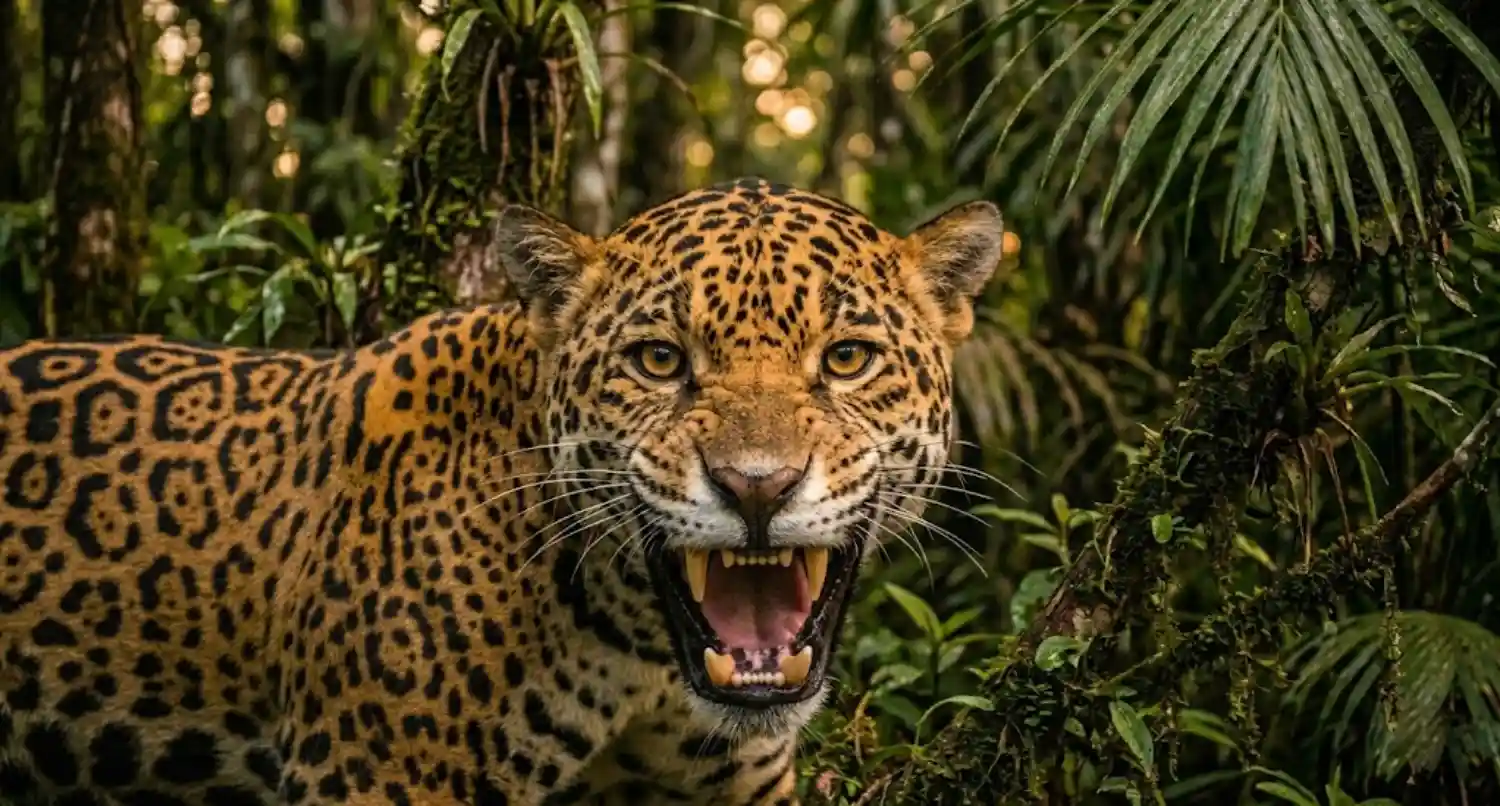
A jaguar’s roar can be far more than a powerful sound moving through the forest. Its frequency is so low and forceful that prey and competitors may physically feel it before their ears process it. For scientists studying the species, the call helps organize space, announce an animal’s presence and reduce the need for constant, potentially lethal physical confrontations.
The sound has been compared with a saw cutting through wood in a rhythmic pattern. Yet behind that harsh impression is coded information about the caller’s identity, sex and reproductive status. In floodplain and dense forest environments, the roar creates an invisible boundary that can extend across a vast area and influence how other jaguars move through the landscape.
A boundary made of sound
A single individual can dominate and protect an area of up to 80 square kilometers, or about 30.9 square miles. That space has no fence and no visible marker for people walking through the forest. Instead, the jaguar’s voice communicates that a hunting ground is occupied and establishes a territorial relationship that contributes to biological balance.
When a male roars, the call warns other males that the space is already occupied. It also tells females that a vigorous animal is present in the region. In practical terms, the roar acts like a sound-based property sign, a mark that remains in the landscape without requiring the jaguar to chase competitors continuously.
The science behind the roar is linked to the vocal cords of these cats. According to the explanation presented by researchers, they contain fibrous, elastic tissue that allows the emission of infrasound waves. Those waves travel more efficiently through the Amazon’s dense vegetation and across the reflective surface of Pantanal waters.
Humidity in the air also helps carry the sound over remarkable distances. In these environments, communication does not depend only on visibility. A jaguar may remain hidden in vegetation or separated by water and still send a signal that reaches prey, competitors and potential mates.
Listening to the forest
Monitoring this territorial communication has become one of the most effective tools for conserving the species. Researchers place highly sensitive autonomous recorders throughout the forest to capture jaguar roars square kilometer by square kilometer. The recordings are then used to build an acoustic map of biodiversity.
Bioacoustics can identify specific individuals through the unique signature of their calls. This makes it possible to estimate population density without stressful captures or the use of satellite-tracking collars on every animal in a group.
The method also reveals information about movement corridors. Field observations showed that a jaguar roaring from its territory often positions itself at strategic points, including river bends and higher ground. From those locations, the animal can maximize the reach of its voice and send the signal farther across the landscape.
Recording analysis has shown a contrast between connected protected areas and places under pressure. In well-connected conservation areas, roars are more frequent and organized, indicating a stable social structure. By contrast, silence in regions historically inhabited by jaguars provides scientists with an immediate warning about habitat fragmentation or illegal hunting pressure.
Why corridors must remain connected
Understanding territorial boundaries is essential when creating sanctuaries that respect the species’ biology. In the Pantanal, jaguar conservation requires management that considers not only physical space, but also acoustic and genetic connectivity between populations.
When a forest corridor is interrupted by a highway or large-scale deforestation, acoustic communication is broken. Individuals may become isolated, and young males may be unable to find new territories. Over time, that isolation increases the risk of inbreeding and weakens the species’ health.
Fieldwork deep in the forest shows, according to conservation teams, that the jaguar is an architect of the ecosystem. By defining its 80-square-kilometer territory through sound, it indirectly protects hundreds of other species living within its domain.
Where jaguars roar with strength, the forest remains alive and balanced. Data collected by conservation teams help persuade landowners and government agencies that protecting large blocks of vegetation is the only way to ensure that the largest cat in the Americas can continue to play its role at the top of the food chain.
A seasonal voice in a changing landscape
The use of artificial intelligence algorithms to process thousands of hours of audio captured in the Amazon has revealed that the roar varies with the season. During flood periods, when firm ground becomes scarce and animals gather in tree canopies or on small islands of land, the roar becomes an even more crucial survival tool.
The sound frequency adapts to the wet environment, helping the territorial message reach its destination despite the constant noise of tropical rains flooding the Amazon Basin. Flooded conditions alter routes and available refuges, but they do not remove the need for communication among the cats.
Preserving the roar ultimately means preserving the quiet that allows nature to express itself fully. Each time a jaguar claims its territory through its voice, it reaffirms wildlife’s resilience in the face of modern challenges.
Bioacoustics and the future of conservation
Understanding this call is not simply an exercise in scientific curiosity. It is also necessary for designing ways to coexist with human development while maintaining some of the planet’s most fundamental ecological processes.
Acoustic monitoring technology allows scientists to identify jaguars without human contact. Each animal has a distinctive roar timbre, much like a sonic fingerprint. By mapping those sounds, researchers can plan sustainable farms and protected areas that do not fragment the cats’ natural routes.
The goal is to keep the species’ gene flow healthy through the coming decades of environmental conservation in Brazil. The survival of this ancestral roar depends directly on decisions made today about how people occupy and respect the natural spaces that remain.
A signal that seems to belong only to one cat therefore becomes a broad reading of the territory. Frequent roars may indicate connectivity and stability, while silence can reveal that the forest has lost continuity. Listening to the jaguar makes it possible to observe processes that are not always visible from the ground, but that shape the future of the entire community of species.
Reporting: Anne Silva / Amazonia Mag

Editor, English Edition — Amazonia Mag
Anne Silva is the editor of Amazonia Mag, the English-language edition of Revista Amazônia. She curates, translates and adapts the outlet's science and environment coverage for an international audience, reporting on Amazon wildlife, flora, rivers, climate and research. Every story she edits is grounded in peer-reviewed studies, official data and on-the-ground reporting from the Revista Amazônia newsroom in Belém, Pará, Brazil. More by Anne Silva →