
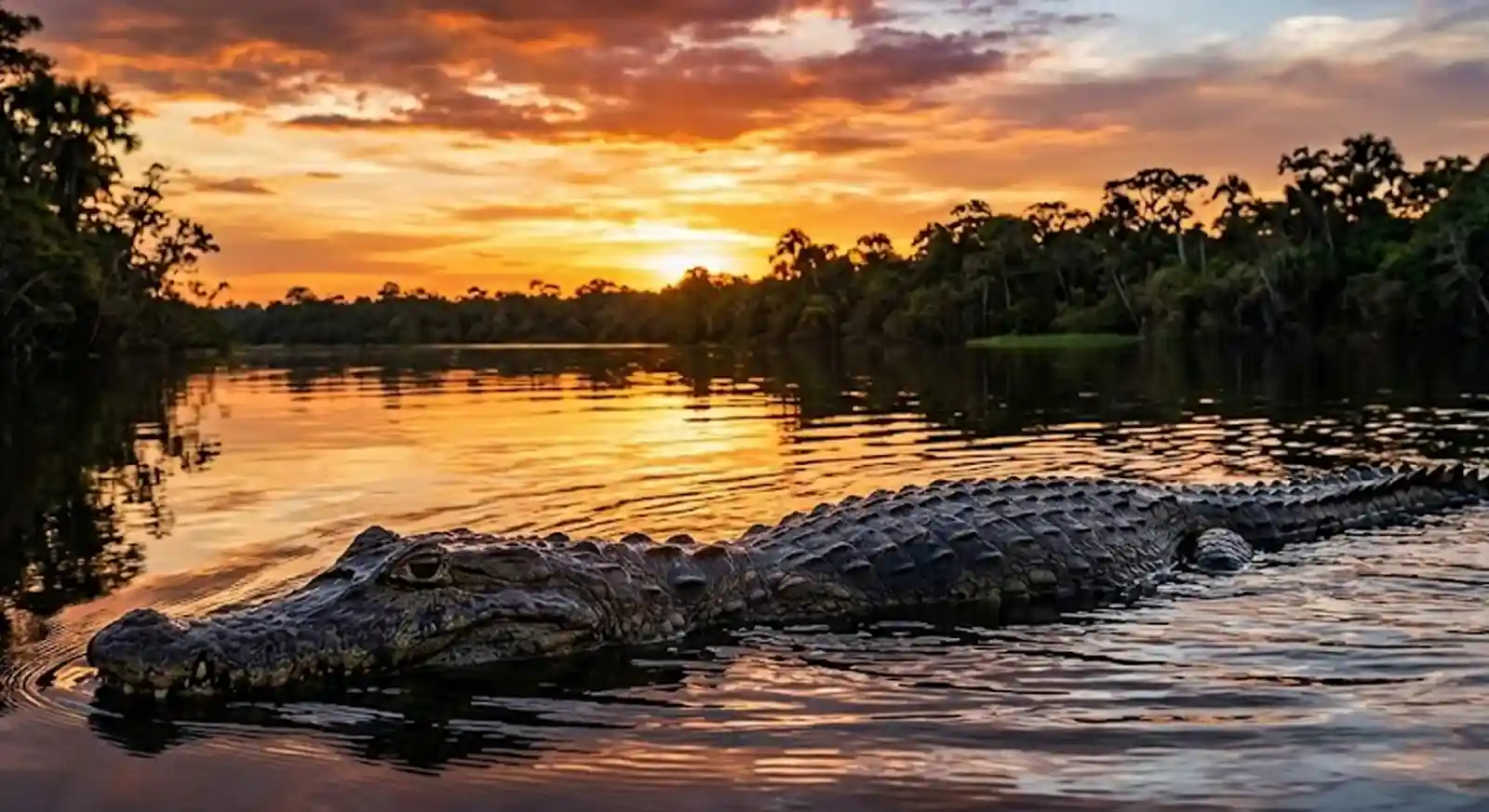
The return of the black caiman to parts of the Rio Negro is revealing a profound change in one of the Amazon’s major river systems. The animal can reach more than six meters in length, or about 19.7 feet, and exert a bite force greater than two metric tons, or about 2.2 U.S. tons.
Acoustic and visual monitoring in blackwater basins shows that the comeback is not only numerical. It is also geographic. Black caimans are reclaiming territories where they had not been seen for more than 40 years, including areas of the Anavilhanas archipelago and other igapó wetlands.
A giant shaped by a difficult past
The black caiman, Melanosuchus niger, once dominated the flooded lowlands of the Amazon. During the last century, however, the species suffered a dramatic decline because of predatory hunting for the trade in fine hides.
That pressure reduced the animal’s presence across different environments and changed the relationship between the great crocodilian and the rivers it inhabited. For years, its disappearance from some places suggested that recovery would be difficult or even impossible.
The phenomenon now being observed by the scientific community presents a different picture. The black caiman’s return to the Rio Negro points to a biological resilience that challenges the most pessimistic projections for local wildlife.
The recovery does not mean that every threat has disappeared. Continued monitoring will be essential to minimize conflicts between people and animals and to make peaceful coexistence the new standard in Amazonian waters.
Technology working with river knowledge
Field researchers have combined high technology with the traditional knowledge of riverside communities. In remote parts of the Anavilhanas archipelago, biologists installed high-resolution camera traps and motion sensors to record the animals’ movements and behavior.
The equipment captured young and adult individuals actively hunting. These records provide more than evidence that the species is present. They also help reveal the age structure of the population and the relationship between different generations in flooded habitats.
Fieldwork is demanding. Researchers must move through dense flooded forest before dawn to carry out counts using spotlights. During this period, the caimans’ eyes reflect the lantern beams, allowing the team to estimate the population’s age structure with precision, according to the monitoring method described by the field researchers.
Riverside communities are central to this effort. When local populations become guardians of the biome, black caiman recovery stops being a statistical goal and becomes something visible in the channels, along the riverbanks and across the igapós.
Expanding beyond fully protected areas
Satellite mapping indicates that the animals are extending their range beyond zones of integral protection. In the process, they are searching for new igapós where they can establish nests and secure the continuation of their lineage.
The strong recovery is linked to the implementation of sustainable management policies and the strengthening of Sustainable Development Reserves. These measures help reduce predatory human pressure and create conditions for the caimans to occupy historical territories again.
The most striking figure from the latest census in the region points to a 25% increase in population density per kilometer of monitored river margin. That result places the Rio Negro once again on the global map as a biodiversity sanctuary for large reptiles.
The population now shows a healthy pyramid structure, with many juveniles. This pattern indicates that post-hatching survival rates increased significantly over the last five years because of controls on predatory human presence.
A top predator with a wider role
The black caiman’s importance to the Rio Negro ecosystem can be compared with that of large cats in tropical forests. As a top predator, it regulates populations of fish and other small animals, helping maintain balance in the food web.
Its movement also affects the physical environment. As black caimans travel through channels and igapós, they help maintain nutrient flows and keep water passages open. Those conditions benefit several other species of amphibians and turtles.
For that reason, the animal’s return is also the return of part of the river system’s environmental health. The black caiman acts as a highly visible indicator that wildlife still has the strength to reclaim what it had lost.
A future among dark waters and flooded roots
The black caiman can exceed six meters, or 19.7 feet, in length. It is a generalist carnivore that eats fish, birds and mammals, can live up to 80 years in the wild, and is currently in strong recovery in blackwater basins.
This quiet renaissance is a reminder that nature has an extraordinary capacity for regeneration when it receives the space and protection it needs. The black caiman’s story on the Rio Negro is no longer only a story of loss. It has become a symbol of hope and conservation success in Brazil.
The future of the dark waters now appears more complete as the guttural roar of large males echoes once again among the roots of macacarecuia trees. Protecting a single animal means protecting the complex web of life that supports the world’s largest rainforest.
The continuation of this return will depend on monitoring, sustainable management and fewer conflicts between people and wildlife. The challenge is to ensure that the comeback of these giants becomes a lasting chapter in conservation history rather than a brief interval.
Reporting: Anne Silva / Amazonia Mag

Editor, English Edition — Amazonia Mag
Anne Silva is the editor of Amazonia Mag, the English-language edition of Revista Amazônia. She curates, translates and adapts the outlet's science and environment coverage for an international audience, reporting on Amazon wildlife, flora, rivers, climate and research. Every story she edits is grounded in peer-reviewed studies, official data and on-the-ground reporting from the Revista Amazônia newsroom in Belém, Pará, Brazil. More by Anne Silva →