
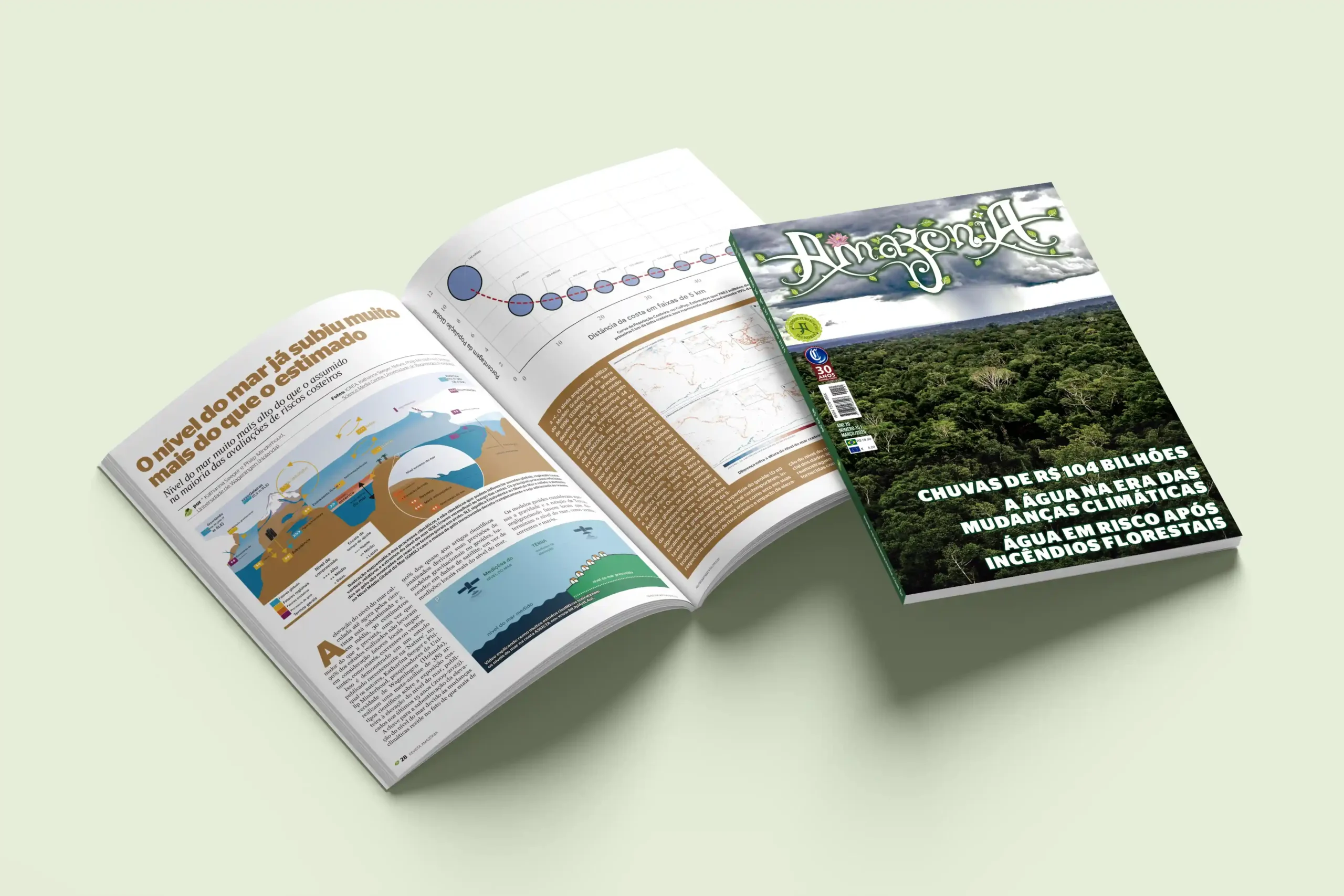
The rainforest we thought we knew is changing before our eyes, and the impact reaches straight to the tap and to the household budget. The March issue of Revista Amazônia dives into the water cycle to reveal an urgent reality: we are entering a dangerous era of transition, in which the climate turns far hotter and droughts far more severe than anything recorded in the past several million years.
Scientists have named the phenomenon the hypertropical climate, and it is more than a technical label for extreme heat. It describes the collapse of the forest’s own defense system.
During extreme dry spells, soil moisture falls so low that trees lose the ability to pump water and capture carbon, suffering what specialists call embolism in the sap. That process raises tree mortality by more than 55 percent, turning what was once a sanctuary of life into a landscape of vulnerability.
What Happens When the Forest Stops Pumping Water
It is worth pausing on the mechanism the issue describes. A standing tree works like a continuous column of water: it draws moisture up through the roots and releases it through the leaves. That pumping is also what allows the plant to capture carbon from the atmosphere at the same time.
When the soil dries out completely, that column breaks. This is exactly what Revista Amazônia describes as embolism in the sap: the transport fails, carbon capture stops, and the tree is left exposed. Multiplied across millions of individual trees, the result is the increase in mortality of more than 55 percent flagged in the issue.
The decisive detail is that the same pumping is what returns moisture to the air. Fewer trees pumping means less vapor available, less rain forming over the forest itself and, in the next step, soils that are drier still. The drought feeds on itself.
The Invisible Value of Rain and the Economy of the Forest
We often forget that the Amazon works as a giant water pump that sustains agriculture and water supply across the entire country. The studies highlighted in this issue show that the rainfall generated by the Brazilian forest alone carries an economic value estimated at around 104 billion reais per year.
Without that free environmental service, the cost of producing food and Brazil’s energy security would be at risk. The figure is best read in reverse: it is not what the forest would fetch if sold, but what it would cost, in cash, to replace something the forest currently delivers for nothing.
The loss of vegetation over recent decades has already started to charge its price. The water yield of rivers has become extremely sensitive to any variation in rainfall, driving arid regions to lose their water sources more quickly and forcing wetlands to face unprecedented risks of saturation. It is a delicate mechanism that, once thrown off balance, affects everyone from the small rural farmer to the great cities.
Fire and Contamination: The Silent Threat to Drinking Water
Another crucial point raised in the March issue is the dangerous link between wildfires and the quality of the water we drink. The problem does not end when the flames go out.
When the first rains arrive after a fire, they carry into the rivers a toxic mix of ash, excess nutrients, heavy metals and even chemicals used to fight the blaze, such as fire retardants. That contamination drastically compromises the quality of raw water, alarmingly raising treatment costs for cities and putting public health at risk.
With global warming tripling the number of days with weather favorable to extreme fires, the synchrony of these disasters across different regions of the world turns the challenge of protecting our water sources into a mission of global survival. The point is logistical as well as environmental: if several regions burn at the same time, crews, resources and treatment capacity cannot simply be shifted from one place to another.
Rising Oceans and the Future of Coastal Communities
The dramatic changes are not confined to the interior of the forest. A new meta-analysis revealed that sea level rise along Brazil’s coasts was underestimated for decades. On average, the waters stand about 12 inches (30 centimeters) higher than earlier projections indicated.
That miscalculation happened because older models ignored decisive local factors, such as winds, tides and the specific ocean currents of the region. With that correction, urban planning and the safety of populations living along the coast need to be reviewed immediately.
The advance of the sea is not a threat for the next century, but a reality that is already redrawing the map of our coastal cities and demands urgent adaptation measures to protect infrastructure and human lives.
Solutions and Pathways for Protecting Water
Despite the challenging picture, Revista Amazônia also presents pathways of hope and technological innovation. The issue highlights how restoring mangroves can act as an enormous carbon sink, while also saving millions in environmental damage.
It also discusses the use of solar and wave energy to oxygenate seawater, safeguarding the health of marine ecosystems in a time of global warming.
In this issue you will also find details on how El Nino could return at full strength in 2026, United Nations reports on the severe hunger caused by drought, and the climate interventions that seek to reshape marine life to ensure the survival of species.
It is a complete guide to understanding why water is the most valuable resource of our time and how each of our decisions affects that vital cycle. Preserving the Amazon is the guarantee that we will have water in the future. We invite you to explore these themes and to see how science and nature are working together to find solutions.
Reporting: Anne Silva / Amazonia Mag
This article is the English edition of reporting originally published by Revista Amazônia. Images: Revista Amazônia archive.

Editor · Amazonia Mag
Anne Silva is the editor of Amazonia Mag, the English-language edition of Revista Amazônia. She curates, translates and adapts the outlet's science and environment coverage for an international audience, reporting on Amazon wildlife, flora, rivers, climate and research. Every story she edits is grounded in peer-reviewed studies, official data and on-the-ground reporting from the Revista Amazônia newsroom in Belém, Pará, Brazil. More by Anne Silva →