
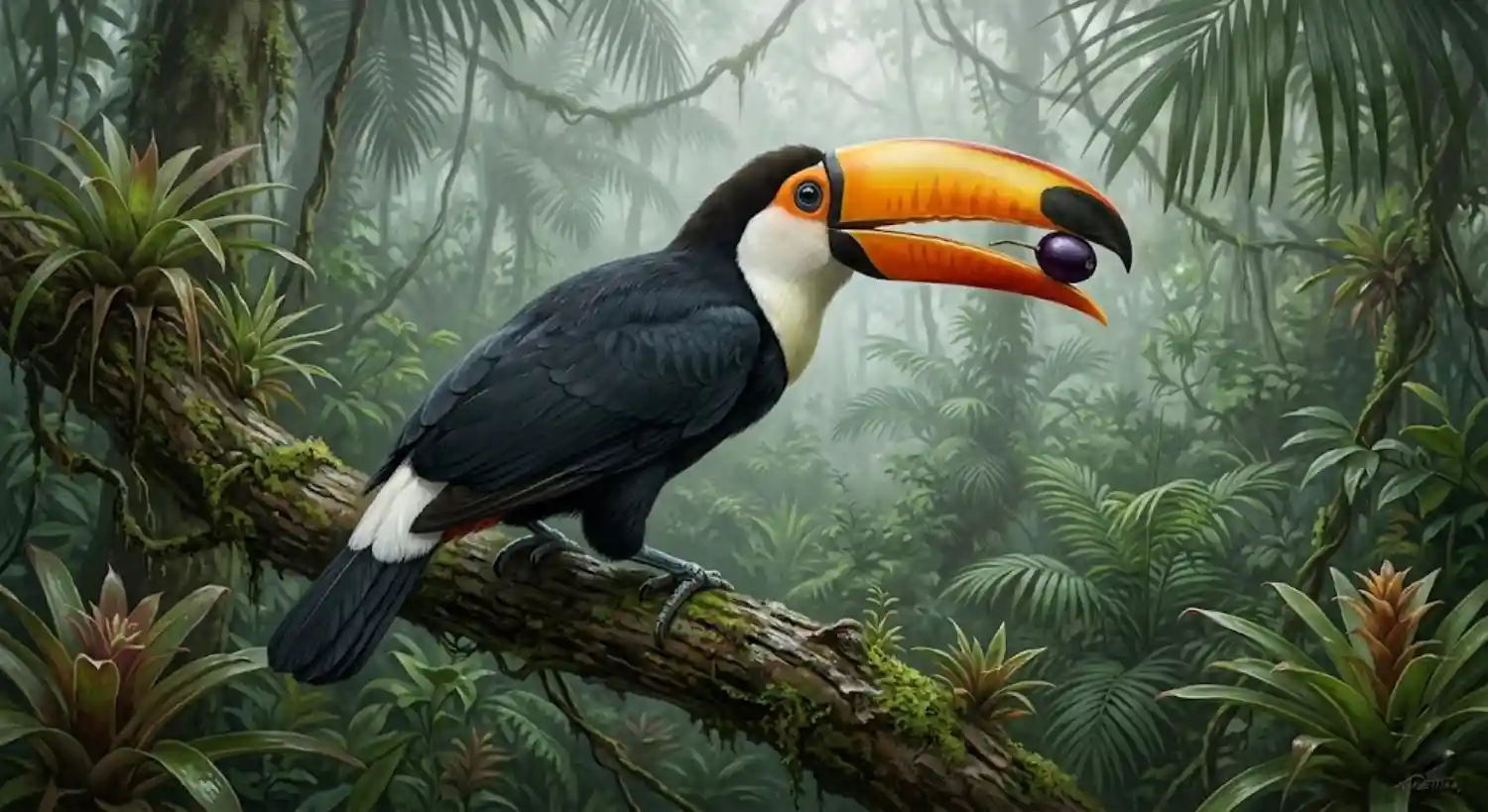
The toucan is far more than a postcard bird. It is one of the most efficient ecological engineers in the Amazon, able to swallow palm fruits whole and carry their seeds to points more than five kilometres away from the tree that produced them. That single habit keeps forest fragments connected when they would otherwise sit isolated. Unlike birds that crush and destroy what they eat, the toucan runs a digestive system that strips only the nutritious pulp and releases the seed intact, ready to sprout somewhere new. Biologists call the process endozoochory, and it is the invisible engine behind the constant renewal of the rainforest.
Endozoochory, the engine nobody sees
The term sounds technical, but what it describes happens every hour in the canopy. A bird eats a fruit, digests the pulp and deposits the seed somewhere else, alive and viable. In the toucan’s case the service runs at a scale few other birds reach. The transit time through the gut is tuned so that the pulp is absorbed without stomach acids damaging the embryo inside the seed. Better still, that passage often scarifies the seed coat, wearing it down just enough for water to get in. The result is faster germination once the seed hits the ground. The bird is not only a courier, it also prepares its cargo for the moment of sprouting.
A bill built to reach the fruit
Toucan anatomy is an evolutionary answer to large scale frugivory. The bill looks heavy, yet inside it is built from spongy bone and keratin, which makes it surprisingly light and remarkably precise. With it, the bird reaches fruits hanging at the tips of thin branches that could never support its weight. Before swallowing, the toucan handles each fruit with the tip of the bill and lines it up so it goes down whole. Açaí, bacaba and patauá fruits travel that route daily, in a gesture repeated thousands of times over a single fruiting season.
That mechanism explains why the toucan fills a role other birds cannot. Reaching the fruit is only half the job, and carrying it far away is the other half. Toucans fly in a direct, undulating line that covers real distance between feeding areas and resting sites. Every one of those trips turns the bird into a moving seed vehicle crossing clearings, forest edges and different layers of vegetation.
Seed rain across many micro habitats
Ecologists have a name for what happens during those flights: seed rain. The larger seeds, too big to pass through the small intestine, are regurgitated. The smaller ones leave with the droppings. Together, the two behaviours create a highly diversified deposition pattern that reaches very different micro habitats, from the sunlit rim of a clearing to the deep shade of the understorey and the disturbed soil beside a fallen tree.
That variety matters more than the raw number of seeds. Each of those spots suits a different plant species, so one toucan, in a single day, can leave behind the right conditions for several species at once. No restoration crew plants that way, because no crew can be everywhere in the canopy at once.
Escaping the shadow of the mother plant
Distance matters for reasons that go well beyond geography. Without transport, seeds would simply fall under the parent tree and compete with one another for light and nutrients in ground that is already occupied. Worse, piling seeds of the same species in one place raises their vulnerability to pests and soil fungi that specialise in that plant and find concentrated, easy food. By crossing clearings and moving between forest layers, the toucan drives gene flow and mixes plant lineages from separate areas. That quiet gardening is what allows natural gaps and degraded patches to be recolonised by climax species, keeping the vertical structure of the Amazon resilient in the face of climate change and environmental pressure.
The bird that sows the bioeconomy
This biological service carries direct economic consequences. Many of the palms toucans help to plant are the same ones that sustain the income of thousands of families, starting with the açaí palm. By guaranteeing natural dispersal and regeneration, the birds keep standing the natural stocks of resources that are later harvested sustainably. Applied ecology studies indicate that the presence of large frugivorous birds in a reserve raises fruit productivity by up to 30% in the long run, purely through the redistribution of seeds and nutrients.
Put another way, conserving toucans is not an aesthetic preference or an environmental luxury. It is an investment in the future productivity of extractive territories, a silent partnership between wildlife and the work of traditional communities in which neither side signs a contract and both come out ahead.
When the big birds disappear
The effectiveness of this dispersal depends on the size of the bird. Large toucans such as the toco toucan (Ramphastos toco) and the white throated toucan (Ramphastos tucanus) are the only ones able to disperse seeds from fruits larger than 1.5 centimetres. When hunting or habitat loss removes them from an ecosystem, large seeded plants enter a cascading extinction, because their specialised dispersers are no longer around to do the work. The trees remain standing and keep fruiting, but nothing carries their offspring away.
Protecting the nesting habitat of those toucans is therefore a way of protecting the future architecture of the forest itself. No restoration programme built on machinery and high human costs can reproduce, at landscape scale, what a healthy population of frugivorous birds does for free, every single day.
Sentinel of a living forest
Watching a toucan in flight is watching the survival of the Amazon happen in real time. Every time one of these birds feeds, it carries the genetic code of the next generation of giant trees. Conservation stops being an abstract idea and becomes a set of measurable biological interactions in which every creature has a vital function.
Without toucans, silence in the canopy would be followed by the premature ageing of the forest, which would lose its capacity to heal and to expand. Valuing these dispersers means recognising that the intelligence of nature works on scales human beings are only beginning to understand, and that protection and coexistence remain the best strategy available towards these small, and quietly enormous, winged gardeners.
Reporting: Anne Silva / Amazonia Mag. Source: Revista Amazônia, Portuguese edition.

Editor, English Edition — Amazonia Mag
Anne Silva is the editor of Amazonia Mag, the English-language edition of Revista Amazônia. She curates, translates and adapts the outlet's science and environment coverage for an international audience, reporting on Amazon wildlife, flora, rivers, climate and research. Every story she edits is grounded in peer-reviewed studies, official data and on-the-ground reporting from the Revista Amazônia newsroom in Belém, Pará, Brazil. More by Anne Silva →