
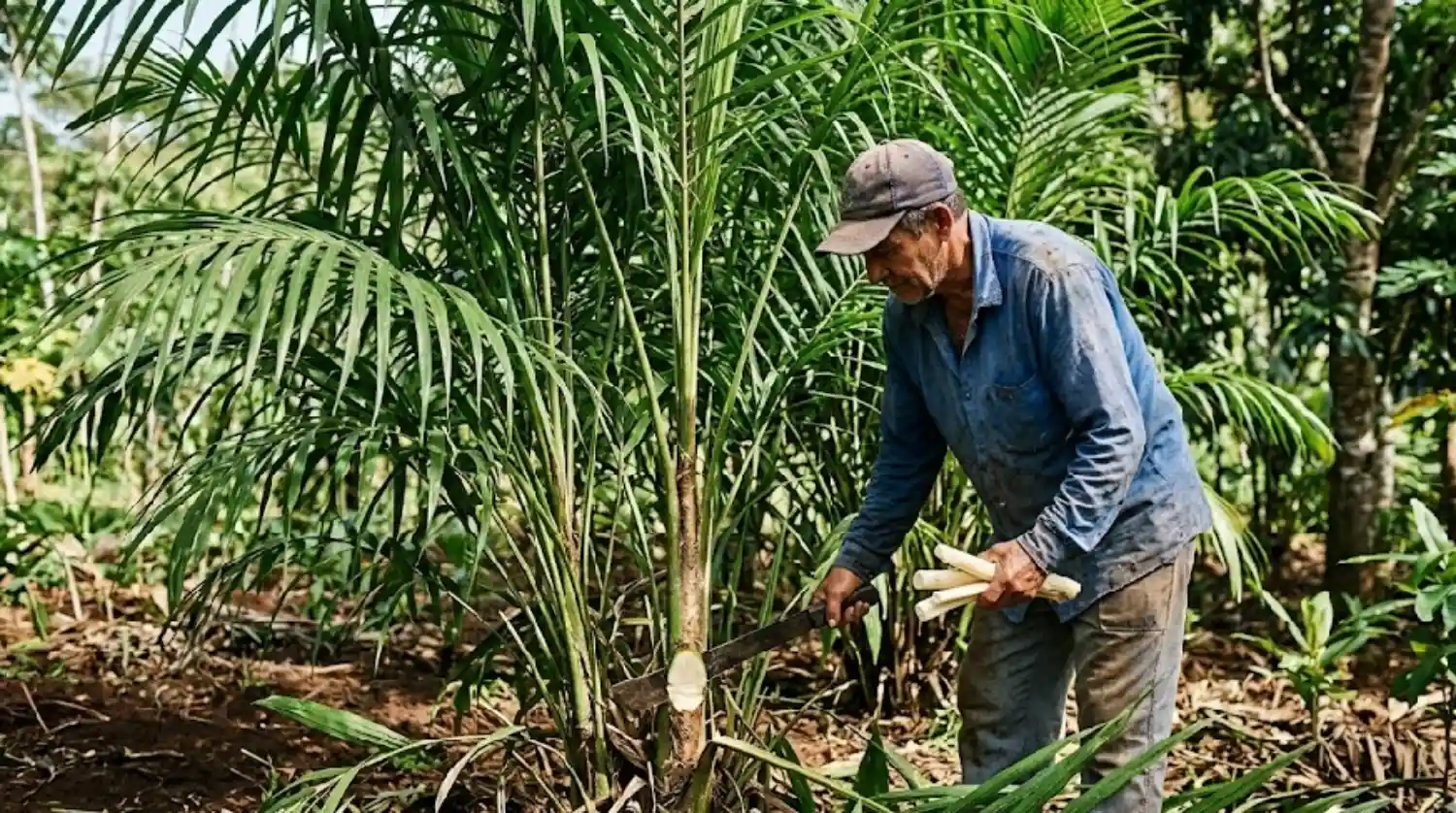
The peach palm, known in Brazil as pupunha and catalogued by science as Bactris gasipaes, is a palm native to the Amazon region that carries a biological trait rarely found among the species grown for palm hearts: it grows back after harvest. Palm heart, the tender core cut from the stem, normally costs the plant its life. That is the case of the juçara palm heart, which reaches the table only when the tree that produced it dies. The pupunha can be cut several times without felling the palm. What looks at first like a small management detail changes the entire environmental equation of the product, and it explains why peach palm cultivation has become one of the most promising agroecological solutions in the sector, including in the Atlantic Forest, far from its region of origin.
A harvest that stimulates the plant instead of killing it
The cut is made on the main stem of the palm, where the tender heart that reaches the consumer is found. Removing that piece, however, does not seal the fate of the peach palm. Science recognises that taking the main stem works as a biological trigger: the plant responds by pushing out new shoots from its base, known as offshoots or suckers. Those shoots grow, develop and become ready for a new harvest in a cycle that studies place at only eighteen months. The result is continuous, predictable and renewable production, which turns the pupunha into a sustainable and economically viable alternative for the people who make a living from the land.
It is worth spelling out what that cycle means in practice. The same clump, the same root system and the same soil, prepared only once, keep delivering harvest after harvest, with no need to clear new areas or to replant from scratch every time the product leaves the field. The plant stops being a resource that runs out with the first cut and starts behaving as a living system that answers the blade by multiplying its own stems. Few tropical food chains bring together, in a single crop, that combination of biological renewal and commercial yield.
The pressure on the juçara palm
The contrast with juçara palm heart helps to measure the gain. Taken from the palm Euterpe edulis, that product requires the death of the plant, which opened the way to predatory extraction and left the species at risk of extinction across many areas of the Atlantic Forest. The pupunha, on the other hand, thrives precisely because of continuous renewal: a single clump can produce palm heart for decades without compromising the integrity of the plant or of the environment around it. By taking over the market space that once pushed harvesters towards the juçara, the peach palm becomes a concrete ally of biodiversity conservation.
Agroecology beyond the palm heart
Growing the crop in agroecological systems, often mixed with other native species, reinforces that sustainable profile. The presence of the peach palm helps to structure the soil, to hold moisture and to form favourable microclimates, and those benefits reach the other plants in the system and the health of the ecosystem as a whole. This is not a monoculture dressed up as a green solution. It is a productive arrangement that gives ecological functions back to the land while still delivering a commercial harvest. It is farming that works with the forest rather than against it.
The arrangement also carries a direct social effect. Sustainable palm heart production generates income for local communities and strengthens family farming, promoting balanced and responsible rural development. For the smallholder, a short regrowth cycle means predictable earnings, something uncommon in crops that depend on a single harvest each year. The peach palm heart is, in that sense, a practical example of how agriculture can walk alongside environmental conservation, offering solutions that benefit both the people who produce and the territory where production happens.
A market learning how to choose
Sustainable peach palm heart is gaining ground in the market and winning over conscious consumers who value products with traceability and a smaller ecological footprint. Quality and flavour, added to that ethical profile, have driven demand in restaurants and supermarkets, creating business opportunities that reward agroecological production and biodiversity conservation. The success of the pupunha reflects a growing awareness of how much food choices matter, and of the value of options that respect the environment and support the communities that depend on it.
The story of the peach palm heart invites a broader reflection on the need to align food production with the conservation of nature. By valuing sustainable products such as this one, the consumer is not only enjoying quality food. The choice also strengthens practices that care for the planet and secure a greener future for the generations to come. The pupunha is living proof that harmony between agriculture and the environment is not merely possible, but essential for collective survival and wellbeing.
Choosing sustainable peach palm heart means betting on a future in which producing food is not a synonym for destruction, but a synonym for renewal and life. Every choice on the plate can contribute to a more balanced world, and few stories show that as clearly as an Amazonian palm that answers the harvest by sprouting again.
Reporting: Anne Silva / Amazonia Mag. Source: Revista Amazônia, Portuguese edition.

Editor · Amazonia Mag
Anne Silva is the editor of Amazonia Mag, the English-language edition of Revista Amazônia. She curates, translates and adapts the outlet's science and environment coverage for an international audience, reporting on Amazon wildlife, flora, rivers, climate and research. Every story she edits is grounded in peer-reviewed studies, official data and on-the-ground reporting from the Revista Amazônia newsroom in Belém, Pará, Brazil. More by Anne Silva →