
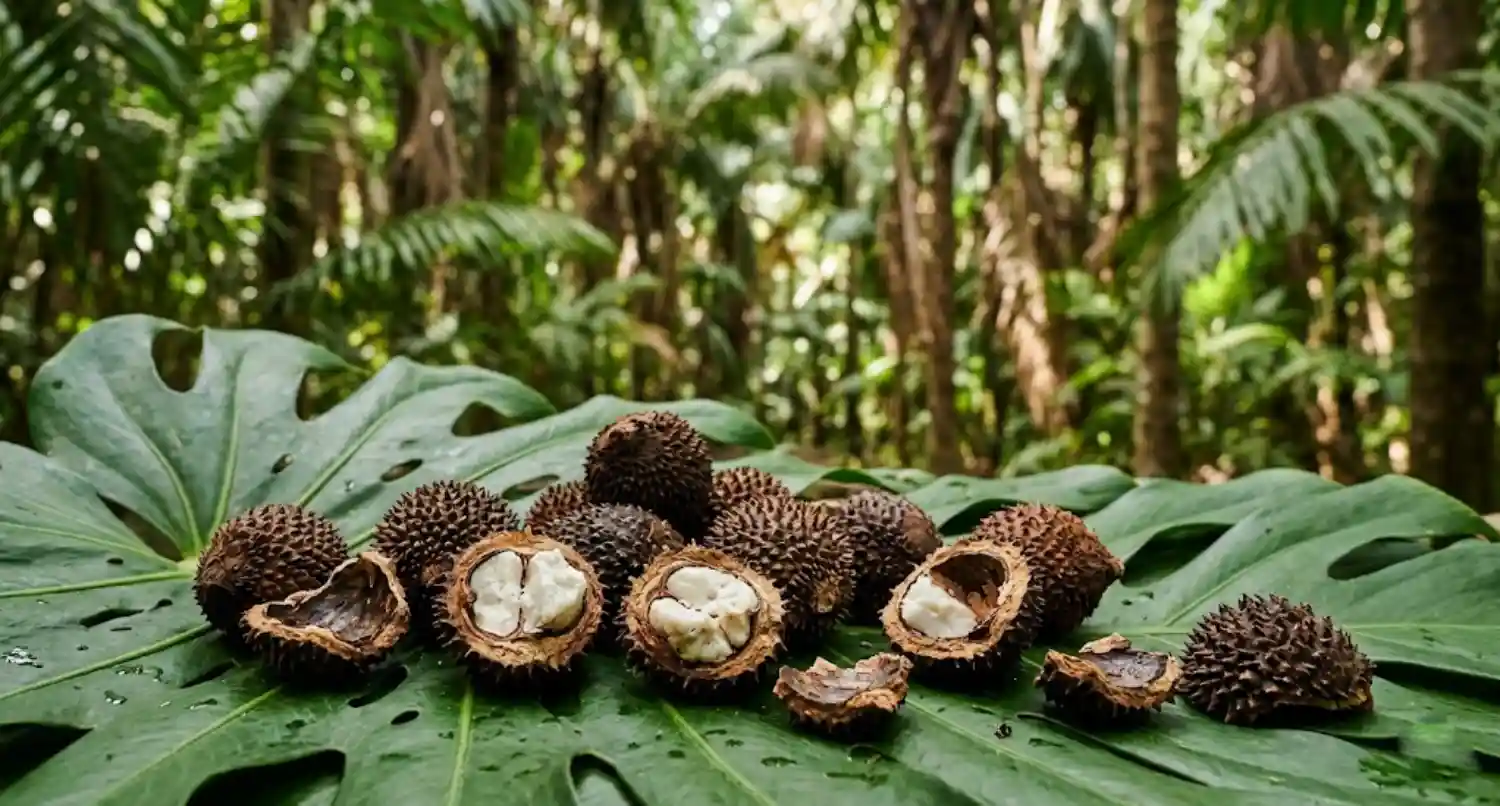
On the dense banks of Amazonian rivers grows a palm that refuses to be touched. Its trunk is covered in long black spines, and its fruit is sealed inside a shell that almost no bare hand can crack. Locked inside that vegetal fortress sits the murumuru kernel, whose fat has a molecular structure strikingly close to the lipids human skin produces on its own. That biochemical coincidence turned what had been, for centuries, a local food source into one of the most sought after raw materials in the laboratories of the European beauty industry.
A palm armed to the trunk
The Astrocaryum murumuru is a native and imposing palm that can reach fifteen metres in height. Its large pinnate leaves shade the understorey, while the spiny trunk works as a natural fortress against large predators. Traditional river communities and Indigenous peoples knew the species long before it appeared on any label: they ate the fruit and used the fronds for basketry and roofing. The industrial treasure, however, was hidden deeper in, inside the small kernel kept under an extremely hard shell.
Cold pressed, that seed releases a rich, dense butter with a mild aroma, loaded with lauric acid, myristic acid and oleic acid, all of them essential to the repair of damaged tissue. This is where murumuru parts company with the other Amazonian products the market already knows. It is not a fluid oil for medicinal use, but a firm fat capable of giving body, texture and stability to an entire cosmetic formula. That physical consistency, and not only the promise of a sustainable origin, is what opened the door of the industry to it.
Taking over from palm oil
For decades the international market leaned heavily on palm oil to guarantee texture and hydration in lotions, soaps and creams. That demand left severe consequences for biodiversity in several parts of the world, especially in Southeast Asia, where deforestation cleared the way for vast monocultures. Against that backdrop of environmental urgency, the rise of murumuru as a replacement reads as a genuine reprieve for the planet, because it performs the same technical role without dragging the same environmental liability behind it.
Extraction in the Amazon is folded into the natural cycle of the forest. Not a single tree has to be felled to obtain the product. Collectors simply wait for the bunches of fruit to ripen and fall to the ground on their own, respecting the timing of the plant and preserving the habitat of countless animal species that also feed on the fleshy pulp. It is the standing forest, not a plantation opened by fire, that delivers the raw material.
A chain that starts before dawn
The impact of this production model reaches far beyond chemistry and ecology, landing directly in the lives of riverside and extractivist families. In communities scattered across the states of Pará and Amazonas, men and women organise themselves into structured cooperatives. Work begins in the earliest hours of the morning, before the equatorial heat becomes oppressive. Families walk the forest trails gathering the fallen fruit, and later, in communal sheds, they use hand tools to break the thick shell and separate the kernel. It is an artisanal process that demands skill and patience, passed down from one generation to the next.
By turning the seed into income, the standing forest proves its economic worth in terms nobody can argue with. For many extractivist women, selling that kernel means financial independence, schooling for their children and a direct improvement in the quality of life of their villages. The money that arrives through fair trade keeps residents from having to fall back on predatory activities such as illegal logging or leasing land for cattle pasture. Every kilo of processed seed acts as a shield for the forest, funding the permanence and the prosperity of the people who guard it.
From the shed to the laboratory
Once the raw material reaches modern factories, chemical engineers and formulators describe the substance as a kind of natural silicone with exceptionally high performance. Unlike many vegetable oils that leave a sticky or heavy feeling on the skin, this butter melts instantly on contact with body heat. It forms an invisible protective film that slows transepidermal water loss and keeps hydration locked into the deeper layers of the dermis. On hair the effect is just as striking, because its structural affinity with keratin allows dry, brittle strands to recover elasticity and shine within a few applications, displacing petroleum derived synthetic compounds with a clean and renewable alternative.
Global appetite for clean ingredients pushed high end European brands to reformulate their most famous product lines from scratch. Where labels once read palm oil or synthetic derivatives, shoppers in Paris, London and Berlin now find the name of this Amazonian species printed in full view. Packaging tells the story of where the product came from, connecting the urban buyer to the reality of the tropical forest. That transparency answers a public that no longer wants cosmetic results alone, but environmental ethics and social responsibility in its everyday purchases.
Nothing gets thrown away
Botanical science keeps investigating other medicinal and therapeutic properties of the plant. Recent studies suggest that the antioxidant compounds in the seed also carry powerful anti inflammatory action, able to calm severe skin conditions such as psoriasis and eczema. The lipid profile helps explain why. Almost half of the butter is lauric acid, and vitamin A concentrations are high, a combination that works on deep cellular restructuring without clogging pores, letting nutrients pass easily into the skin and into the hair shaft.
The shell and the fibrous residue left over from extraction are not discarded either. They become good quality organic fertiliser or biomass for generating energy in the rural communities themselves, closing a circular economy loop in which almost nothing is wasted. It is a detail that matters commercially as much as environmentally, because it removes the disposal cost that usually shadows industrial processing and keeps a second stream of value inside the community instead of exporting it.
With demand climbing steadily, the great challenge of the coming decades will be scaling this production consciously, without repeating the historic mistakes of exploitation that marked earlier economic cycles in the region. Governments, non governmental organisations and private companies will have to work together to strengthen local cooperatives, bring adequate processing technology into the forest itself and guarantee that the larger share of the profit stays with the producing communities. The business model built around this palm shows that safeguarding biodiversity and advancing high technology industry are not opposing goals.
The journey of this kernel makes one point unmistakably clear: the greatest asset Brazil holds is not bare land, but the complex exuberance of its living biodiversity. Every product carried home is also a vote on the kind of future people want to build, and reading the label on a jar of cream may be the first step toward supporting the communities that keep the green heart of the planet beating.
Reporting: Anne Silva / Amazonia Mag. Source: Revista Amazônia (revistaamazonia.com.br).

Editor · Amazonia Mag
Anne Silva is the editor of Amazonia Mag, the English-language edition of Revista Amazônia. She curates, translates and adapts the outlet's science and environment coverage for an international audience, reporting on Amazon wildlife, flora, rivers, climate and research. Every story she edits is grounded in peer-reviewed studies, official data and on-the-ground reporting from the Revista Amazônia newsroom in Belém, Pará, Brazil. More by Anne Silva →