
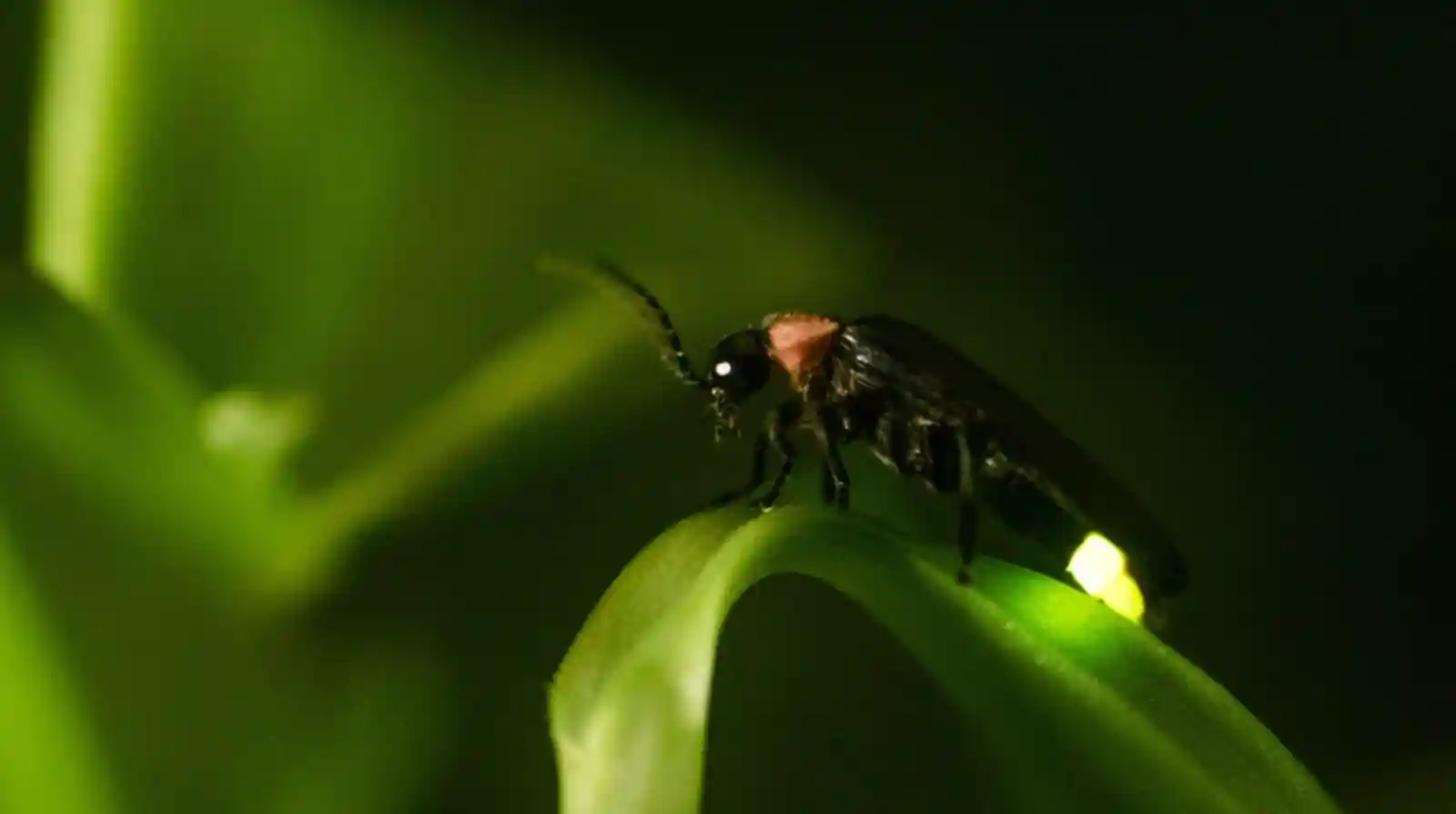
Every night, in the forests of the Amazon, a tiny beetle quietly solves an engineering problem that human industry is still chasing: how to make light without making heat. The firefly produces cold light through an internal chemical reaction that is close to one hundred percent energy efficient, a benchmark that commercial technology has yet to replicate at scale. A traditional incandescent bulb turns only about five percent of the energy it consumes into visible light and throws away the rest as heat. The firefly, by contrast, lights up the darkness without any perceptible warming of its minuscule body. That small detail makes the bioluminescence of these insects one of the most efficient and most captivating phenomena in the natural world.
Precise chemistry inside the abdomen
What we call cold light is the outcome of a sophisticated biomechanical reaction that takes place inside the insect’s abdomen, in specialized light emitting organs. The process mainly involves two crucial substances: luciferin and luciferase. Science recognizes that the enzyme luciferase acts as a catalyst in the presence of oxygen, adenosine triphosphate and magnesium. When the firefly breathes, oxygen reacts with luciferin and releases energy as photons of yellow, green or pale light, with an extremely low rate of heat emission.
That efficiency is not an aesthetic luxury. It is a condition for survival, because it keeps the animal from overheating during its nocturnal activity. A body that small would have no practical way to dissipate the thermal excess that a conventional lamp of comparable brightness would generate. Evolution did not simply make the firefly bright, it made the firefly cheap to run.
A language made of flashes
The primary function of that efficient light emission is tied to communication and reproduction. Each firefly species, among the hundreds that live in the tropical forests of the Amazon, carries its own code of blinks and its own specific flash patterns. This luminous language is essential for recognition between partners of the same species in the dense darkness of the forest, where sound and scent travel poorly and vision depends entirely on a signal the animal manufactures for itself.
Males generally emit specific patterns while in flight, and females, often perched on vegetation or on the ground, answer when they are interested. The result is a silent, efficient luminous dialogue that keeps the species going without wasting energy. Precision matters here. A pattern delivered wrong is an encounter that never happens, which is why evolution tuned both the rhythm of the flash and the remarkably low energy cost of producing it.
The show along the igarapé
Watching bioluminescent fireflies in night flight along the edge of an Amazonian igarapé, one of the narrow forest streams that thread through the region, is an experience that mixes visual magic with biological efficiency. In preserved areas it is possible to see trails of green light cutting through total darkness, with soft reflections on the surface of still water. The spectacle is beautiful, but it is also something more useful: a valuable indicator of the health of the local ecosystem.
Because fireflies are extremely sensitive to light pollution and to the use of agricultural chemicals, an abundant and active population signals a balanced environment with low levels of human disturbance. Where the flashes disappear, something in the landscape changed first. Artificial light scrambles the courtship signals. Poison arrives through the water or the soil. Riverside vegetation is cleared away. Reading the night, in that sense, means reading the condition of the forest itself.
Inspiration for the lighting of the future
The high energy efficiency of these small insects of the order Coleoptera has intrigued researchers for decades and continues to inspire studies in biomimetics. The ability to produce so much visible light with so little energy input and almost no thermal loss is the holy grail of the modern lighting industry. If technology could copy the exact chemical structure of the reaction between luciferin and luciferase, along with its conversion capacity, it would be possible to develop lighting systems that radically transform global energy consumption and sharply reduce energy losses.
The efficiency observed in the firefly is a perfect example of how nature solves engineering problems in an elegant and sustainable way across millions of years of evolution. The answer was not designed in a laboratory. It was refined slowly, generation after generation, in the same humid darkness where it still performs every night.
Protecting the dark night
Protecting firefly habitat in the Amazon is fundamental to preserving not only this fascinating species, but the entire web of biodiversity that depends on dark and unpolluted nocturnal environments. Preserving ecological corridors and riparian forests along rivers and igarapés is crucial so that these small creatures can continue their rituals of light and reproduction. The cold light of the firefly is a subtle but powerful reminder that ecological balance and efficiency can travel together, and that the brightest solutions often already exist in the nature that surrounds us.
Looking at the silent, efficient blink of a single firefly is an invitation to think about how we might also light our own path across this planet more sustainably, without wasting so much heat and so much energy along the way. Almost all of the energy converted into visible light, with minimal heat loss: that process, known as cold light, keeps fascinating scientists who search in nature for answers to global energy efficiency, especially in the field of illumination. Protecting the forests is essential so that these small creatures can keep shining, and keep teaching.
Reporting: Anne Silva / Amazonia Mag. Source: Revista Amazônia.

Editor · Amazonia Mag
Anne Silva is the editor of Amazonia Mag, the English-language edition of Revista Amazônia. She curates, translates and adapts the outlet's science and environment coverage for an international audience, reporting on Amazon wildlife, flora, rivers, climate and research. Every story she edits is grounded in peer-reviewed studies, official data and on-the-ground reporting from the Revista Amazônia newsroom in Belém, Pará, Brazil. More by Anne Silva →