
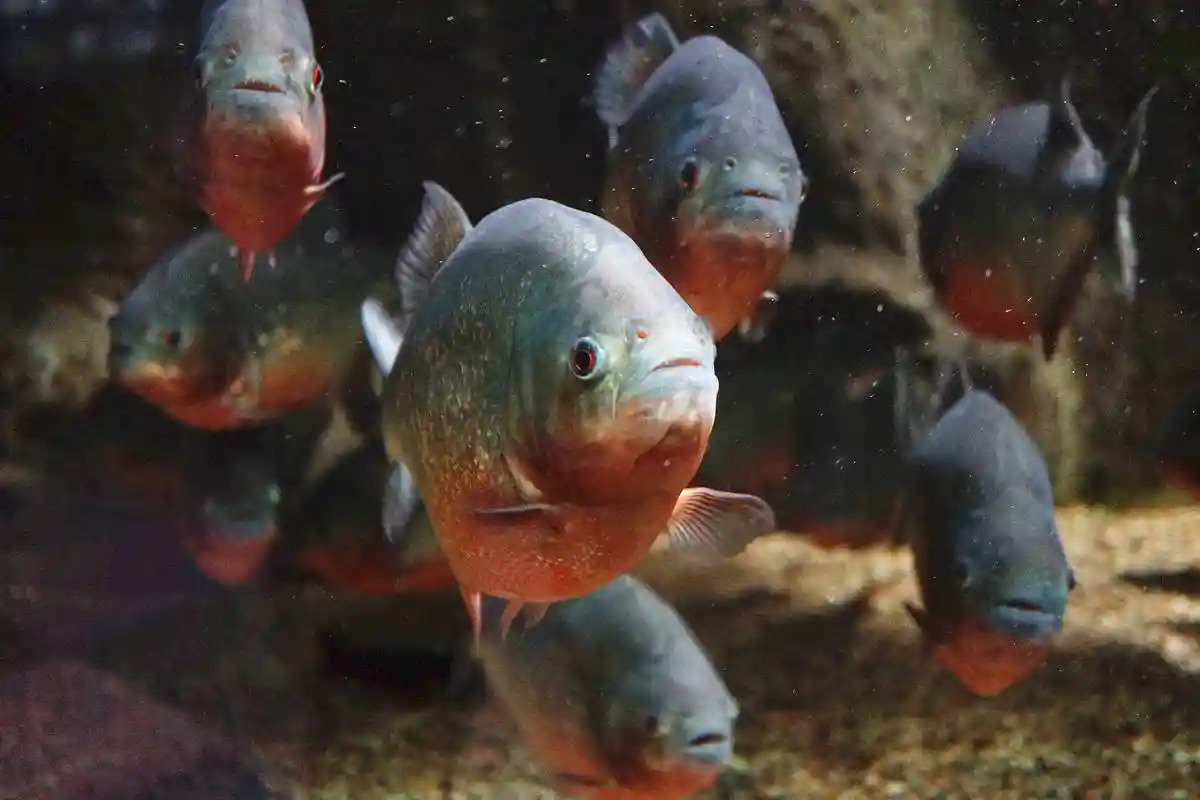
Few Amazonian animals carry a reputation as heavy, and as poorly explained, as the red piranha (Pygocentrus nattereri). For decades, fiction in cinema and in books cast it as an insatiable predator, a fish that supposedly hunts in coordinated packs and can reduce a living creature to a skeleton in a matter of seconds. Science tells a very different story. These fish, icons of the Amazon basin, behave in a remarkably shy way and perform an ecological role far more complex and far more positive than horror narratives suggest. The famous scene of a school stripping a living animal to the bone is, in the overwhelming majority of cases, pure fantasy.
A myth built on the screen
Understanding the biology of these animals is the first step toward dismantling the stigma that follows them. The feeding frenzy shown again and again on screen happens only under conditions of extreme environmental stress, such as severe droughts that trap the fish in shrinking lagoons, with low oxygen levels and a critical shortage of food. In those life or death circumstances, any source of protein becomes a target. Outside that extreme scenario, the everyday behavior of the species is much less spectacular and, for anyone interested in how rivers actually work, far more interesting.
Under normal conditions, red piranhas live in schools not to hunt large prey cooperatively, but as a defense strategy against their own predators, among them caimans, giant otters and large fish such as the piraíba. The group works as a shelter, not as a hunting party. The red piranha is an animal that looks for safety in numbers, not an organized attack force. The claim that it systematically stalks swimmers is a myth already dismantled by field biology, and repeating it only feeds unfounded fear of a biome that needs understanding rather than legends.
The cleaner of the rivers
The real and vital role of Pygocentrus nattereri is to act as the cleaner of Amazonian rivers. These are opportunistic scavengers of very high efficiency, feeding on animals that are already dead. Their sharp, triangular and perfectly interlocking teeth evolved to strip flesh with precision from the carcasses of animals that die in the water from a range of natural causes. That work, unglamorous and almost never told, is one of the pieces holding the aquatic system in balance.
Without the fast and effective action of piranhas, those bodies would enter slow decomposition, releasing pathogens and an excess of nutrients capable of contaminating the water and unbalancing the ecosystem. By removing organic matter quickly, these fish speed up the process of nutrient recycling and make sure that organic energy flows back into the food chain in a healthy way. It is a free environmental service, delivered permanently and almost invisibly to anyone watching the river from the bank.
There is a second service, just as relevant. By preying on sick, injured or genetically weak fish, piranhas play a crucial part in maintaining the health of populations of other species. That behavior helps slow the spread of infectious diseases and parasites among the fish of the river. The natural selection carried out by these opportunistic predators favors the survival and reproduction of the fittest individuals, and in doing so it strengthens the resilience of the whole aquatic biodiversity of the Amazon. Rather than a threat, they operate as guardians of river health.
Many piranhas, many diets
It is also worth remembering the sheer diversity hidden behind a single word. The term piranha covers dozens of different species spread across South America, with widely varied habits. Not all of them are carnivorous. Science recognizes several herbivorous species, popularly known as pacus in some regions, which feed on fruits and seeds falling from the trees and play a decisive role in seed dispersal across the flooded igapó forest. Even among the carnivorous species, the diet is made up mainly of insects, crustaceans and small fish, a long way from the image of a predator of land mammals. Their aggressiveness is heavily overestimated and restricted to very specific survival contexts.
That diversity matters for conservation as well as for reputation. Treating dozens of species as a single dangerous animal flattens real differences in diet, habitat and ecological function, and it makes it harder to explain why some of these fish are effectively gardeners of the flooded forest while others work as its cleaning crew. The word piranha, in that sense, hides more than it reveals.
What actually happens in real accidents
Real accidents involving people do exist, but they should not be classified as predatory attacks by a ravenous school. They are generally single, defensive bites rather than a feeding frenzy. They often happen when anglers handle the fish incorrectly while removing it from the hook, or when bathers approach nesting areas during the breeding season, where the parents defend their offspring firmly. Other episodes appear during extreme droughts, when the fish are confined and opportunistic nipping increases. Harmonious coexistence between people and piranhas is the age old norm in the riverside communities of the Amazon.
The bite itself helps explain the misunderstanding. The powerful jaw and the sharp, triangular teeth of the red piranha are a specific evolutionary adaptation for cutting with precision. That structure is not built to crush bone, but to remove pieces of flesh and scales with ease. In practice it is a perfect tool for the animal role as an opportunistic scavenger within the Amazon forest, and not the weapon of a hunter of large prey.
From villain to indicator of balance
Understanding the biology of the red piranha makes it possible to appreciate the complexity and the natural engineering of Amazonian biodiversity. Instead of villains, these fish are essential components of river health, and their presence works as an indicator of a balanced and resilient environment. Sustainability projects in the region are trying to integrate scientific knowledge about the species in order to promote conscious observation tourism and managed sport fishing, activities capable of generating positive impact for local communities.
Understanding the red piranha is, above all, an exercise in respect for the reality of the forest. It means setting aside unfounded fears in order to value the complexity of a biome where the cleaning and the recycling of life are carried out with precision by these fish. Science teaches us to respect the cleaners of the rivers and to recognize that every creature, however feared, has a fundamental role in sustaining life in the largest tropical forest in the world.
Reporting: Anne Silva / Amazonia Mag. Source: Revista Amazônia.

Editor · Amazonia Mag
Anne Silva is the editor of Amazonia Mag, the English-language edition of Revista Amazônia. She curates, translates and adapts the outlet's science and environment coverage for an international audience, reporting on Amazon wildlife, flora, rivers, climate and research. Every story she edits is grounded in peer-reviewed studies, official data and on-the-ground reporting from the Revista Amazônia newsroom in Belém, Pará, Brazil. More by Anne Silva →