
The rubber tree (Hevea brasiliensis), native to the Amazon basin, produces a milky fluid called latex that, once processed, becomes natural rubber: a material whose elastic and sealing properties no synthetic polymer known to science until the early twentieth century managed to match. That biological trait, which evolved as a defence against herbivores in the dense tropical forest, ended up acting as the catalyst for one of the largest industrial transformations in human history.
The tree that put the world on wheels
Amazonian rubber made the pneumatic tyre possible and, with it, the global mobility revolution of cars and aircraft. At the same time, inside the region, it triggered the Amazon’s first great economic and migratory cycle, which deeply altered the sociocultural landscape of the territory. What factories in Europe and the United States saw as a strategic input meant, for the forest, new routes, new settlements and a forced reorganisation of life along the rivers.
The Amazonian seringal, as the rubber grove is known locally, was never an orderly plantation built on the monoculture model. It was a scattered distribution of Hevea brasiliensis trees growing inside the native forest. Each tapper, the seringueiro, walked winding trails known as estradas de seringa, paths that linked hundreds of isolated trees, visiting them one by one over the course of a working day.
Tapping, a daily surgery on the bark
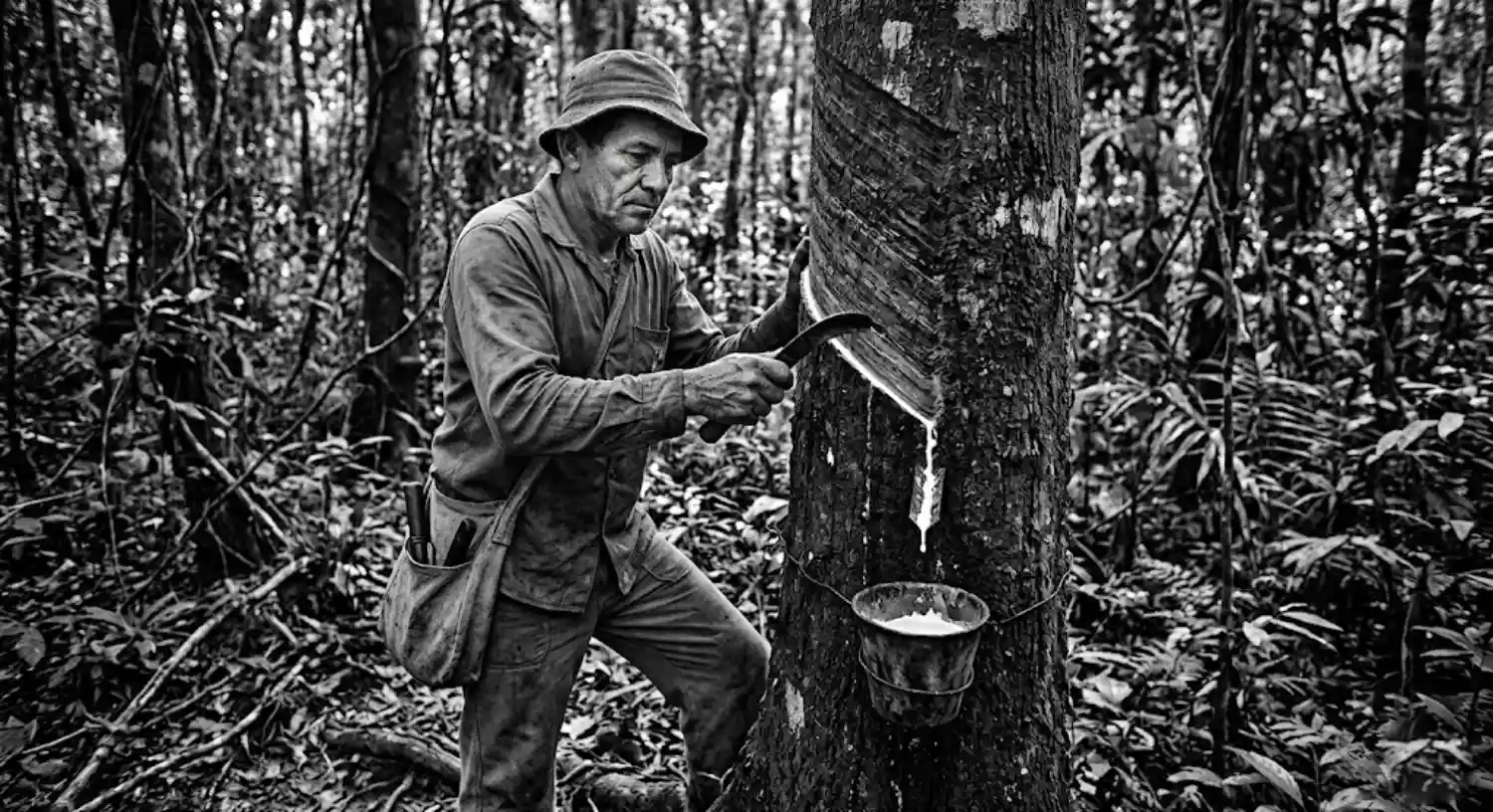
The extraction process, called tapping, demands knowledge and precision. Using a special knife, the tapper opens an almost surgical diagonal cut in the bark, deep enough to break the laticiferous vessels but without reaching the cambium, because that would kill the plant. The thick white latex drips slowly along the cut and is collected in small metal or clay cups fastened to the trunk.
The gesture looks simple and is not. A cut that is too shallow yields nothing, and a cut that is too deep condemns the tree, so the whole economy of a grove rests on a skill that is learned in the field and passed from one generation to the next. It is practical botany carried out at dawn, tree after tree, along kilometres of forest trail.
This sustainable management technique allows the same tree to be worked for decades, and it shows that accumulated biological knowledge and respect for forest cycles can generate wealth without destroying the source of that wealth. In this context the rubber tree is not merely a resource: it is the centre of a singular riverine and forest way of life, with its own calendar, its own vocabulary and its own everyday relationship with the standing forest.
Peak, opulence and collapse
The rubber cycle reached its peak between the end of the nineteenth century and the beginning of the twentieth, driven by explosive demand from the automotive and electrical industries in the United States and Europe. The Amazon became the sole global supplier of this strategic input. Cities such as Manaus and Belem lived through an era of unprecedented opulence, symbolised by lavish opera houses and modern urban infrastructure raised in the heart of the rainforest.
That opulence should not be read as a golden age. The wealth concentrated in very few hands, while the supply chain rested on the exhausting labour of the seringueiros and on the pressure exerted against the Indigenous peoples of the region, who faced debt bondage, coercion and violence along the different frontiers of extractive expansion. Telling the story of the rubber cycle through its theatres and its fortunes alone tells only half of it.
The monopoly eventually evaporated when seeds of Hevea brasiliensis were smuggled out and successfully adapted in monoculture plantations across Southeast Asia. Science recognises that those plantations, free of the fungi native to the Amazon, produced at a far lower cost, which led to the economic collapse of Amazonian rubber. The episode underlines the complexity of historical biopiracy and the fragility of economies built on a single commodity.
The fungus that redrew the rubber map
The fungus Microcyclus ulei, which causes South American leaf blight, remains the main threat to rubber monoculture in the Americas. In the native Amazon, the natural dispersal of trees inside the seringal prevents the devastating spread of the pathogen and keeps the biological balance intact. It is a clear example of how the biodiversity of the tropical forest itself acts as a natural barrier against agents that decimate vulnerable monocultures.
From historical cycle to sustainable bioeconomy
Despite all the reversals of history, the rubber tree remains a strategically vital species for the sustainable bioeconomy of the contemporary Amazon. Studies indicate that natural rubber has superior technical qualities, such as greater resistance to heat and to traction, compared with synthetic substitutes derived from petroleum, which makes it irreplaceable in high performance tyres for aviation and heavy vehicles.
Growing Hevea brasiliensis in agroforestry systems, intercropped with other native species, represents a model of positive impact: it allows degraded areas to be reforested while generating income for local communities. Community management of the seringal inside Extractive Reserves, known in Brazil as RESEX, is a concrete example of how sustainability can join biodiversity conservation to social development, keeping the forest standing and valuing the guardians of that ancestral knowledge.
A living genetic bank
The biological resilience of the rubber tree in its natural habitat is a decisive factor in its survival and its continued relevance. While monoculture plantations are vulnerable to leaf blight, the trees that grow scattered through the native Amazonian forest show greater resistance, protected by the immense biodiversity surrounding them.
Science recognises that the genetic diversity of Hevea brasiliensis in the Amazon is an invaluable biological heritage for the future of the crop. Keeping wild populations healthy and genetically diverse is essential in order to develop varieties that are more resistant and better adapted to climate change, so that latex production remains viable in the long term. The native seringal is not a reliquary of the past: it is an active biological database for future sustainability.
Ecosystem services and the future of latex
The future of the rubber tree in the Amazon is intrinsically linked to our capacity to value the ecosystem services it provides. Beyond rubber itself, the species plays an important role in carbon sequestration and in the regulation of the regional water cycle. A sustainable bioeconomy based on natural rubber offers a viable alternative to deforestation, promoting economic development without compromising the integrity of the rainforest.
Investing in research and development can open new markets for products derived from native rubber, strengthen the sociocultural identity of the Amazon and secure a fairer, more prosperous future for its populations. The trajectory of the rubber tree also invites a wider reflection on the real cost of mobility and technological development, and on how an economy can be reconnected to the vital cycles of nature, because the true wealth of the forest lies in the harmony between nature and society.
Reporting: Anne Silva / Amazonia Mag. Source: Revista Amazônia.

Editor · Amazonia Mag
Anne Silva is the editor of Amazonia Mag, the English-language edition of Revista Amazônia. She curates, translates and adapts the outlet's science and environment coverage for an international audience, reporting on Amazon wildlife, flora, rivers, climate and research. Every story she edits is grounded in peer-reviewed studies, official data and on-the-ground reporting from the Revista Amazônia newsroom in Belém, Pará, Brazil. More by Anne Silva →