
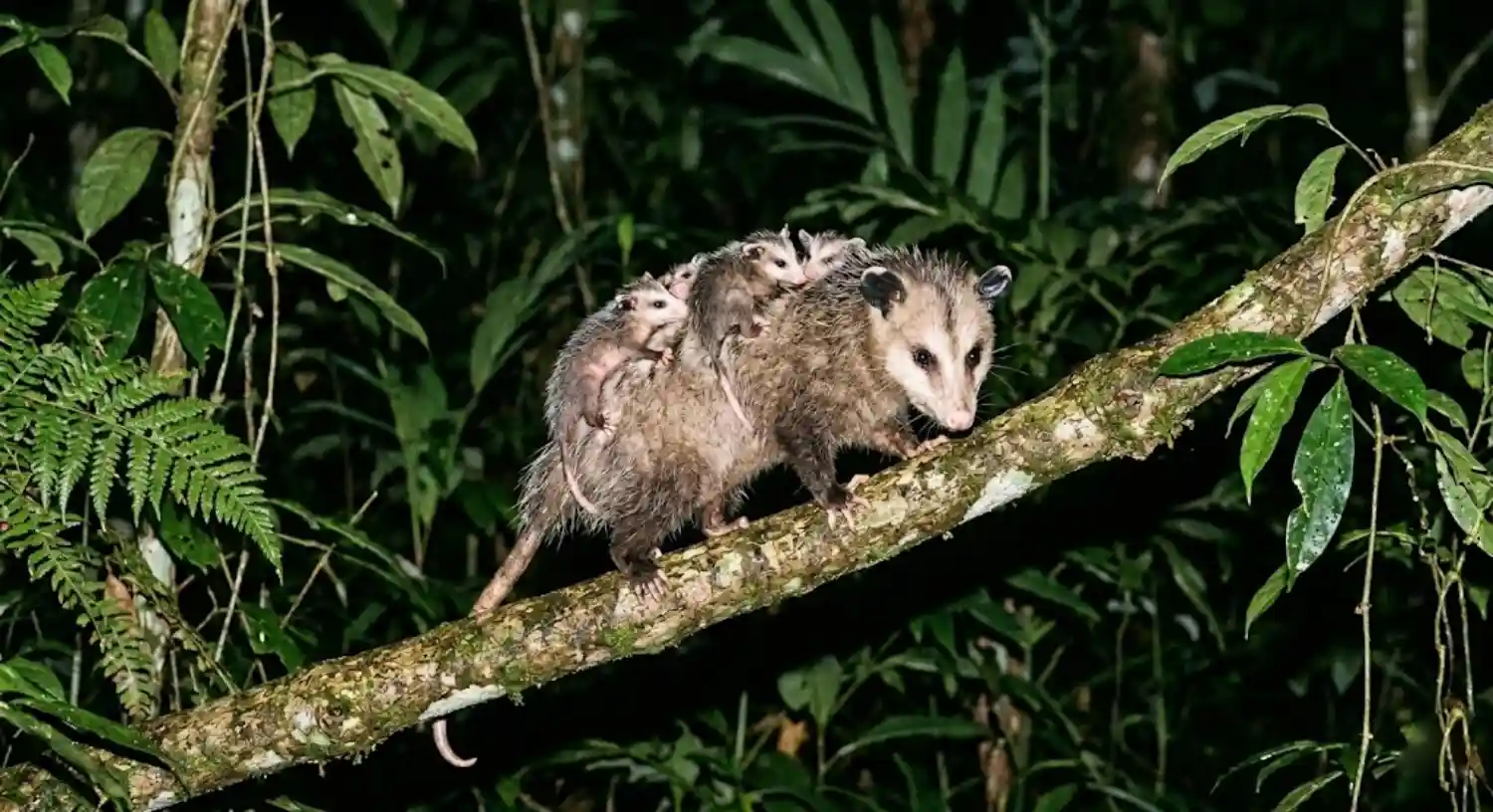
The common opossum (Didelphis marsupialis) carries in its bloodstream one of the most elegant answers evolution ever produced to snake venom. This marsupial is naturally immune to the venom of some of the most dangerous vipers in the Americas, the rattlesnake among them. A bite that would kill another mammal of similar size usually leaves the opossum without serious symptoms, and the animal recovers quickly. Consolidated biological studies indicate that this is no mere curiosity of tropical wildlife, but a complex evolutionary mechanism with a central role in the balance of Amazon biodiversity.
A chemical shield that skips antibodies
The key to the venom resistance of Didelphis marsupialis lies in a refined piece of evolutionary bioengineering. Science recognizes that the secret is not antibody production, the classic route of the immune system, but the presence of specific proteins in the animal’s blood serum. Those molecules, known as natural toxin inhibitors, act quickly and aggressively to neutralize the harshest components of viper venom, above all the phospholipases A2 and the metalloproteinases.
Those enzymes are the ones that destroy tissue, cause severe bleeding and trigger neurotoxicity in most victims. In the opossum, by contrast, the antivenom proteins bind to the toxins and chemically switch them off before they can reach the body’s cells and do damage. It is an innate, efficient chemical shield, permanently on standby, and it needs no previous exposure to the venom in order to work.
Why the venom fails inside the marsupial
To grasp the scale of that defense, it helps to understand how the venom of snakes such as the rattlesnake and the lancehead operates. These venoms are complex cocktails of enzymes and toxins built to immobilize prey and begin digesting it even before it is swallowed. Phospholipases, for instance, break down cell membranes and cause tissue destruction, hemorrhage and extreme pain. For almost every mammal, a single bite amounts to multiple organ failure in a very short window of time.
In the opossum the response is purely biochemical. The binding between the marsupial’s proteins and the venom toxins happens at the molecular level and deactivates the active sites of the venomous enzymes. Studies indicate that this neutralization is highly efficient and specific to the venom of American vipers, which points to an adaptation finely tuned to the environment where the animal evolved. The defense is so robust that the opossum arrives at the encounter chemically prepared, with no need to wait for a slow adaptive immune response.
Millions of years of an arms race
That trait is the product of a long coexistence between opossums and venomous snakes across the American continent. Marsupials of the genus Didelphis have been present in the Americas for millions of years, facing constant challenges to survival. Over that vast stretch of geological time a genuine evolutionary arms race unfolded: snakes kept refining their venom while opossums kept sharpening their defense mechanisms. That continuous interaction shaped the biology of both animals and explains the striking immunity we observe today, a clear illustration of how ecological pressure carves evolution and the biodiversity of an entire ecosystem.
What it means for antivenom research
This is where the scientific interest reaches well beyond natural history. Conventional antivenoms are produced from antibodies obtained through immunized animals, a slow process that depends on specialized infrastructure. The opossum points to a different route: molecules that already exist in nature and that directly block the enzymes responsible for tissue damage and bleeding, without going through the adaptive immune system or waiting for it to react.
Understanding how those inhibitors latch onto phospholipases A2 and metalloproteinases helps to map the vulnerable points of the toxins, the basic information that guides any therapeutic strategy against snake envenomation. Because the neutralization described is specific to the venom of American vipers, the marsupial also works as a biological model tuned precisely to the kind of snakebite that is most frequent in Latin America, where vipers account for the bulk of the severe cases.
There is a second, quieter lesson in that biology. The opossum shows that resistance to venom can be built into the body’s baseline chemistry rather than acquired after an encounter, which is exactly the property a treatment needs in remote areas where a victim may be hours or days away from a hospital. Whatever comes out of the laboratory, the starting point is the animal itself, which makes the survival of healthy wild populations a scientific asset and not only a conservation goal.
A natural regulator of snakes
The fact that the opossum resists venom carries a deep and positive ecological effect. The trait allows it to include venomous snakes in its diet: it does not merely survive accidental encounters, it actively hunts these reptiles. By preying on rattlesnakes and lanceheads, the marsupial acts as a natural regulator and helps keep in check populations that, without efficient predators, could otherwise fall out of balance.
The effect ripples in a cascade through the whole structure of animal communities. By containing those top predators, the opossum keeps the snakes’ usual prey, such as small mammals and amphibians, from suffering excessive predation pressure. That contributes directly to maintaining trophic balance in forests such as the Amazon and in other Brazilian biomes, among them the Cerrado and the Atlantic Forest.
The night cleaner of the forest
Beyond venomous snakes, the omnivorous and opportunistic diet of the opossum turns it into a kind of forest cleaner. It eats rodents, which are disease vectors for humans and other animals, along with large quantities of ticks, scorpions and insects. By keeping those populations down, it plays a fundamental role in the health of the Amazon ecosystem and reduces risks for other species and for the human communities living near the forest. Biological studies indicate that where opossum populations are healthy, the incidence of venomous snakes and of certain pests and diseases is significantly lower.
A misunderstood ally
Because of its appearance and its nocturnal habits, the opossum remains a target of prejudice and hunting. Science, however, increasingly recognizes how vital this marsupial is to the sustainability of the biomes it inhabits. Preserving it is essential to safeguarding natural balance: when we protect the species, we indirectly contribute to a healthier environment for every form of life in the Amazon rainforest.
Its venom resistance stands as testimony to the extraordinary biological engineering that evolution shaped over millennia, offering sustainable solutions for the coexistence of species in complex environments. Looking closely at the biology of the opossum reminds us that every living creature, however plain it may seem, holds ingenious answers for survival and helps weave the complex, resilient web of life in which all of us are caught.
Brazilian marsupials. The opossum is not the only marsupial in Brazil. The country is home to dozens of species, including the cuicas and the catitas. Unlike kangaroos, most Brazilian marsupials do not have a complete pouch. Females often carry their young clinging to their bodies until they grow, like the opossum that ferries its offspring on its back, a display of maternal care that fascinates anyone lucky enough to witness it in the wild.
Reporting: Anne Silva / Amazonia Mag. Source: Revista Amazônia, based on biological studies of the venom resistance of Didelphis marsupialis.

Editor, English Edition — Amazonia Mag
Anne Silva is the editor of Amazonia Mag, the English-language edition of Revista Amazônia. She curates, translates and adapts the outlet's science and environment coverage for an international audience, reporting on Amazon wildlife, flora, rivers, climate and research. Every story she edits is grounded in peer-reviewed studies, official data and on-the-ground reporting from the Revista Amazônia newsroom in Belém, Pará, Brazil. More by Anne Silva →