
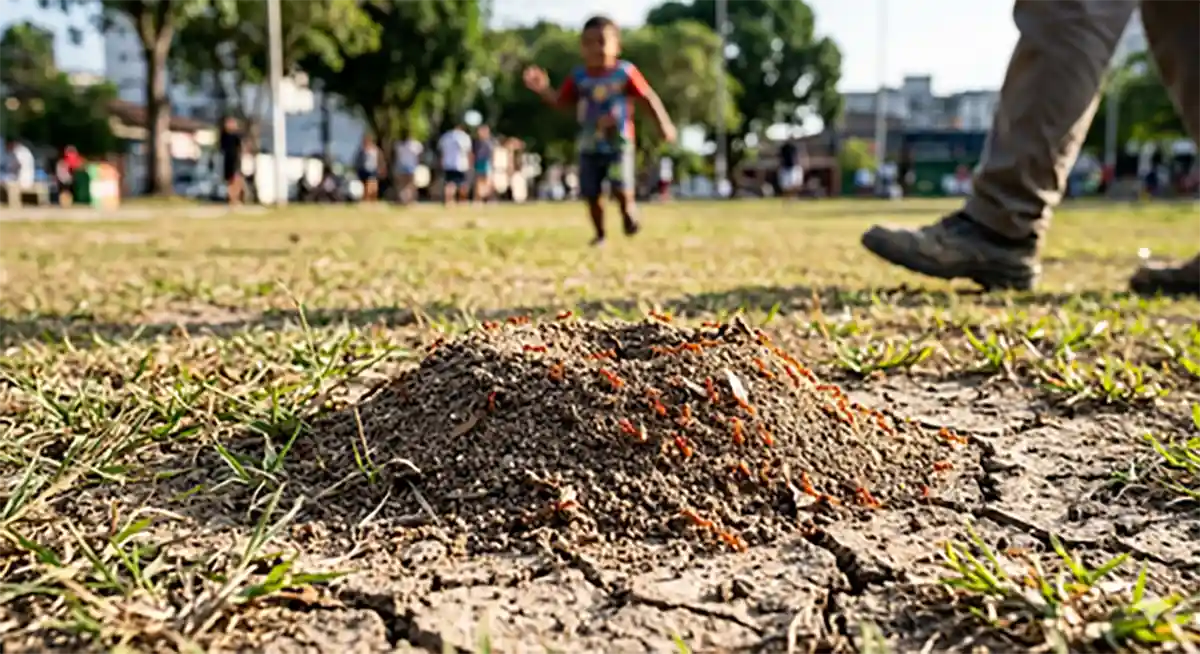
A silent but excruciatingly painful invasion is spreading across Brazil. The advance of fire ants, known scientifically by the genus Solenopsis, has stopped being a purely rural concern and become a public health challenge in urban areas. A wide-ranging study that analyzed historical records from 1900 to 2024 reveals that deforestation and disorderly urbanization are acting as a bridge for the spread of these species.
The research was led by a consortium of specialists from respected institutions, including the University of Mogi das Cruzes (UMC), the University of São Paulo (USP) and the Federal University of Sergipe (UFS). Under the leadership of researchers such as Victor Hideki Nagatani and Dr. Maria Santina de Castro Morini, the biologists examined 4,095 records in biological collections to understand how human impact reshaped the route of these insects over 124 years.
The exodus from the Pantanal and the Amazon
Historically, Brazil hosted these species in well-defined niches. The Solenopsis invicta (red imported fire ant) is native to the flooded plains of the Pantanal. Over the past five decades, however, it began a massive migration toward the coast. Its presence is now confirmed in 11 states, with worrying new records in Espírito Santo, Piauí, Rio de Janeiro and Sergipe.
Meanwhile, Solenopsis saevissima, a species adapted to the forests of the Amazon, expanded its range into the country’s interior. It now occupies 16 Brazilian states, establishing colonies in places such as Alagoas and Rio Grande do Norte. This crossing of natural borders is no accident, but a direct response to the fragmentation of the original biomes.
Why deforestation favors the fire ant
Unlike species that depend on preserved forest, fire ants are generalists and extremely resilient. When woodland is cleared for pasture or real estate, it creates an environment of high sun exposure and bare soil. It is in that degraded setting that they thrive, free from the competition of native ants that lose their habitat to deforestation.
The paper, published in the journal Biological Invasions, notes that urbanization acts as a facilitator. Highway medians, residential lawns and vacant lots become ideal nurseries for these colonies. Where native biodiversity retreats, the fire ant advances, becoming an aggressive invasive species in ecosystems such as the Atlantic Forest.
Health risks
The name is no accident: a fire ant sting burns like a scald. For most people it causes painful welts and pustules that can last for days. In sensitive individuals, however, the venom can trigger severe allergic reactions. The spread of these colonies into urban parks and backyards increases contact with people, turning an ecological problem into a public health issue.
The study reinforces a lesson science keeps repeating: every time the forest falls, it does not leave a void. The space is taken over by the most opportunistic and resilient species, and they are rarely the ones that benefit humans. Protecting the Amazon and the Atlantic Forest is not only about preserving landscapes, but about slowing the advance of invaders that thrive on destruction.
Reporting: Anne Silva / Amazonia Mag. Source: journal Biological Invasions; UMC, USP and UFS.
This article is the English edition of reporting originally published by Revista Amazônia. Images: Revista Amazônia archive.

Editor, English Edition — Amazonia Mag
Anne Silva is the editor of Amazonia Mag, the English-language edition of Revista Amazônia. She curates, translates and adapts the outlet's science and environment coverage for an international audience, reporting on Amazon wildlife, flora, rivers, climate and research. Every story she edits is grounded in peer-reviewed studies, official data and on-the-ground reporting from the Revista Amazônia newsroom in Belém, Pará, Brazil. More by Anne Silva →