
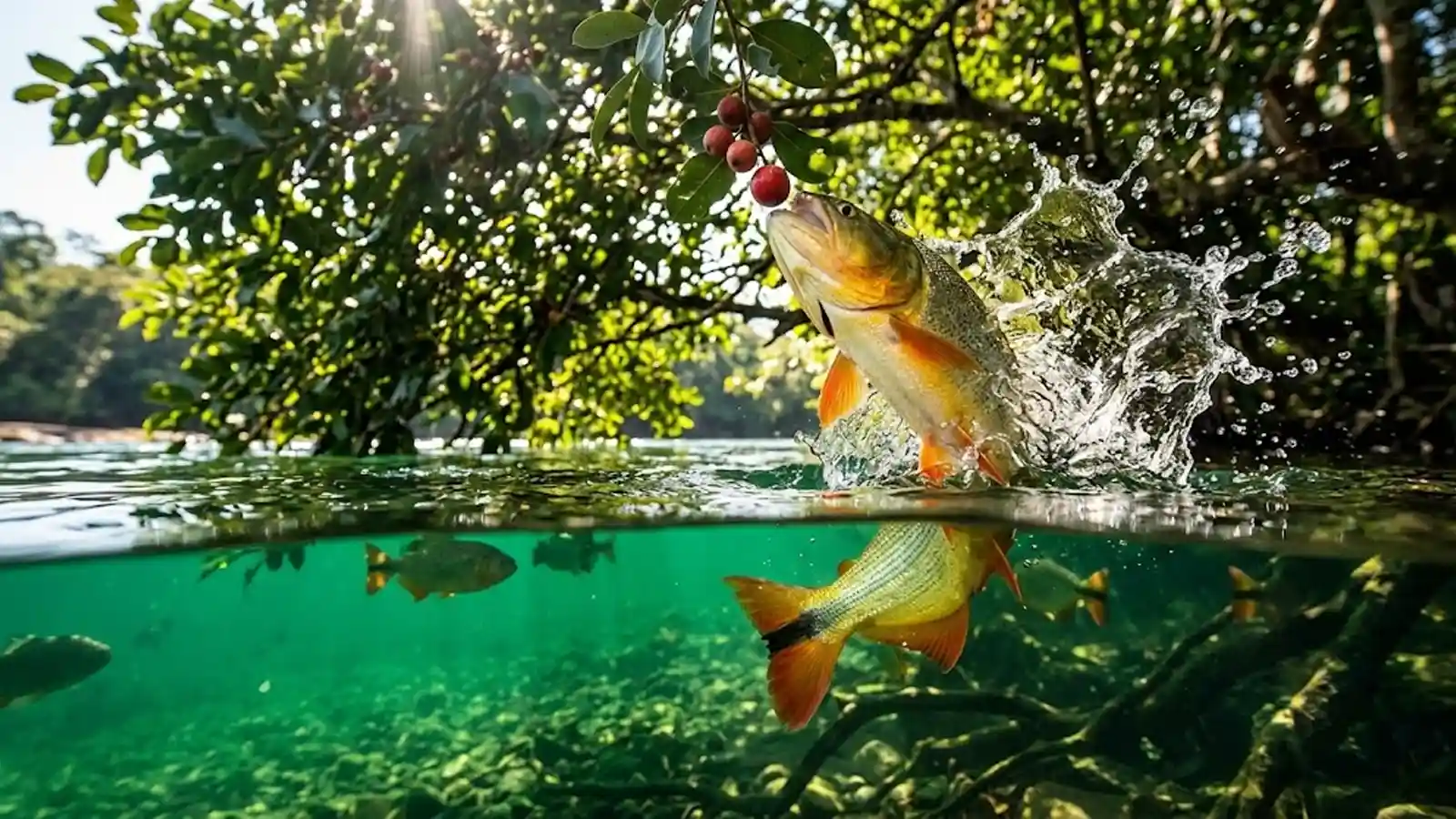
In the crystal clear rivers of the Brazilian Pantanal swims a silver fish with bright red fins that single handedly supports an economic chain worth millions of reais across Brazil’s Center West. Its name is piraputanga, Brycon hilarii to science, and its presence works as a thermometer for the biological balance of the largest floodplain on the planet.
One figure frames every conversation about this species: the Pantanal has lost 15% of its water surface over the past three decades, according to data from MapBiomas. That hydrological retreat directly threatens the reproduction of the piraputanga, an animal whose entire life cycle is synchronized with the pulse of the seasonal floods.
Its biology reveals a sophisticated piece of natural engineering, tuned precisely to the rhythm of flooding and drought that defines the Pantanal plain. The species behaves like an underwater sower, essential to the riverside forests that in turn shade and feed the very rivers that sustain it.
The biological engine of transparent waters
The piraputanga eats fruits and seeds from the trees growing along the banks of the Formoso and Prata rivers, in the Bonito region. By swallowing that food, the fish carries and disperses seeds across kilometers of river, performing a job no other inhabitant of these waters handles with the same efficiency.
This dispersal process guarantees the natural regeneration of Pantanal flora, which is essential to keeping water quality high. Without the piraputanga, the renewal cycle of the gallery forests would simply collapse over the long term, and with it the transparency that made these rivers famous.
Unlike other species, the piraputanga has exceptionally sharp vision and fast reflexes. It detects a fruit falling toward the surface before the fruit even touches the water, then leaps to catch it in midair. That jump, repeated dozens of times in a single morning, is precisely the spectacle that draws photographers and nature watchers.
Scientists at the Instituto de Pesquisas Pantaneiras (IPP) monitor how water transparency shapes that behavior. Excessive turbidity, caused by deforestation, effectively blinds the fish and interrupts its feeding. A cloudy river does not merely stop being attractive to visitors: it stops being livable for the species that gives it meaning.
The economics of fishing and observation tourism
Fishing tourism in the Pantanal attracts thousands of visitors every year and generates direct jobs in hotels and in the floating hotel boats that work the rivers. The piraputanga ranks among the most coveted trophies thanks to its strength and its stamina on the line, a reputation built over decades.
Catch and release has become the standard practice to keep fish stocks stable. The sport fishing market moves resources that exceed traditional cattle ranching in many regions, which turns the fish into an economic asset rather than only an environmental symbol.
Brazil’s Ministry of Fisheries and Aquaculture stresses the importance of keeping catch quotas strictly controlled to prevent the decline of wild Brycon hilarii populations. Without that oversight, pressure on the species would grow fastest exactly along the stretches of river where tourism is most intense.
Anatomy of a brilliantly colored fish
The piraputanga’s coloration comes from a diet rich in carotenoids, natural pigments found in the fruits it consumes. When the environment degrades, the fish visibly fades, and that shift in color works as an early warning sign for anyone who knows how to read it.
Research from EMBRAPA Pantanal indicates that ecosystem health is reflected directly in the brightness of these animals’ scales. Vibrant fish signal clean rivers and preserved forests in the headwaters, while dull specimens betray a system that has already begun to fail somewhere upstream.
The species has a fusiform body that allows fast swimming against the current. That ability proves crucial during the piracema, the spawning migration when shoals move up the rivers to breed in safe areas, a journey that depends entirely on the watercourses remaining connected to one another.
Agribusiness expansion and the water risk
Intensive use of agrochemicals on the plateau areas above the Pantanal plain threatens the purity of the rivers. Sediment runoff causes silting of the riverbeds where the piraputanga lives, reducing the depth the fish needs in order to feed and to move freely.
IMAZON warns that preserving the Pantanal depends on protecting the springs located in the Cerrado. If the water flow is interrupted, the breeding areas of these fish will dry out permanently, with no realistic prospect of recovery in the short term.
Deforestation of riparian forest removes the species’ main food source. Without native fruit falling into the water, shoals either migrate or starve, and the local food chain breaks at several links at once rather than gradually.
The untapped potential of the bioeconomy
The piraputanga holds enormous potential for sustainable aquaculture. Raising the species in captivity for human consumption could ease the pressure on wild river populations and offer a productive alternative to communities that today depend on the natural resource.
Studies published in the journal Nature reinforce that freshwater fish conservation is the top priority for maintaining food security in tropical biomes. Seen in that light, the piraputanga stops being a local curiosity and starts illustrating a continental problem.
The regional gastronomy market already values the firm, flavorful meat of the fish. Even so, the present focus should stay on ecotourism, which yields more per living specimen than per kilo of meat, a calculation few destinations in the world can make so clearly.
Conservation and enforcement strategies
Satellite monitoring and enforcement by IBAMA tackle predatory fishing during closed seasons. The piracema demands absolute protection so the next generation of fish can survive and return to the same stretches of river in the following cycle.
Environmental education projects in riverside communities turn former predatory fishermen into specialized tourism guides. That economic transition protects the species and generates dignified income, replacing an extractive activity with one that depends on keeping the river intact.
Creating private natural heritage reserves along the banks of Pantanal rivers has proved the most effective tool available. These areas protect the wetland and guarantee the shade that shoals require, since the fish avoid waters fully exposed to direct sun.
Climate resilience and the future of the Pantanal
Global climate change is altering rainfall patterns across South America. Extreme drought periods, like those recorded in recent years, strand shoals in pools that dry out quickly, turning natural traps into death sentences within a matter of days.
The piraputanga also faces the challenge of adapting to warmer, less oxygenated water. Scientists are working to understand the thermal limits of the species in order to predict its survival under warming scenarios, research that is now running against the clock.
Investing in green infrastructure and basic sanitation in the surrounding towns is urgent. Domestic sewage dumped into the rivers consumes available oxygen and kills thousands of fish by asphyxiation every year, a silent loss that rarely appears in tourism statistics.
The role of the citizen and the conscious traveler
Visitors who choose the Pantanal should demand sustainable practices from tour operators. Using biodegradable sunscreen during snorkeling floats, for example, prevents chemical contamination of the water along the same stretches where the fish are later watched leaping.
Awareness of the piraputanga’s importance reaches far beyond leisure. It is the emblem of a biome fighting not to vanish under the ashes of wildfires and the disorderly advance of agricultural frontiers pressing in from every side of the floodplain.
The fate of the Pantanal is bound to the survival of its rivers and of the species living in them. The piraputanga is not merely a colorful fish: it is the vital pulse of an entire region, and every leap it makes above the transparent water measures the health of everything around it.
Reporting: Anne Silva / Amazonia Mag. Source: Revista Amazônia, MapBiomas, EMBRAPA Pantanal, Instituto de Pesquisas Pantaneiras, IMAZON, IBAMA and Brazil’s Ministry of Fisheries and Aquaculture.

Editor, English Edition — Amazonia Mag
Anne Silva is the editor of Amazonia Mag, the English-language edition of Revista Amazônia. She curates, translates and adapts the outlet's science and environment coverage for an international audience, reporting on Amazon wildlife, flora, rivers, climate and research. Every story she edits is grounded in peer-reviewed studies, official data and on-the-ground reporting from the Revista Amazônia newsroom in Belém, Pará, Brazil. More by Anne Silva →