
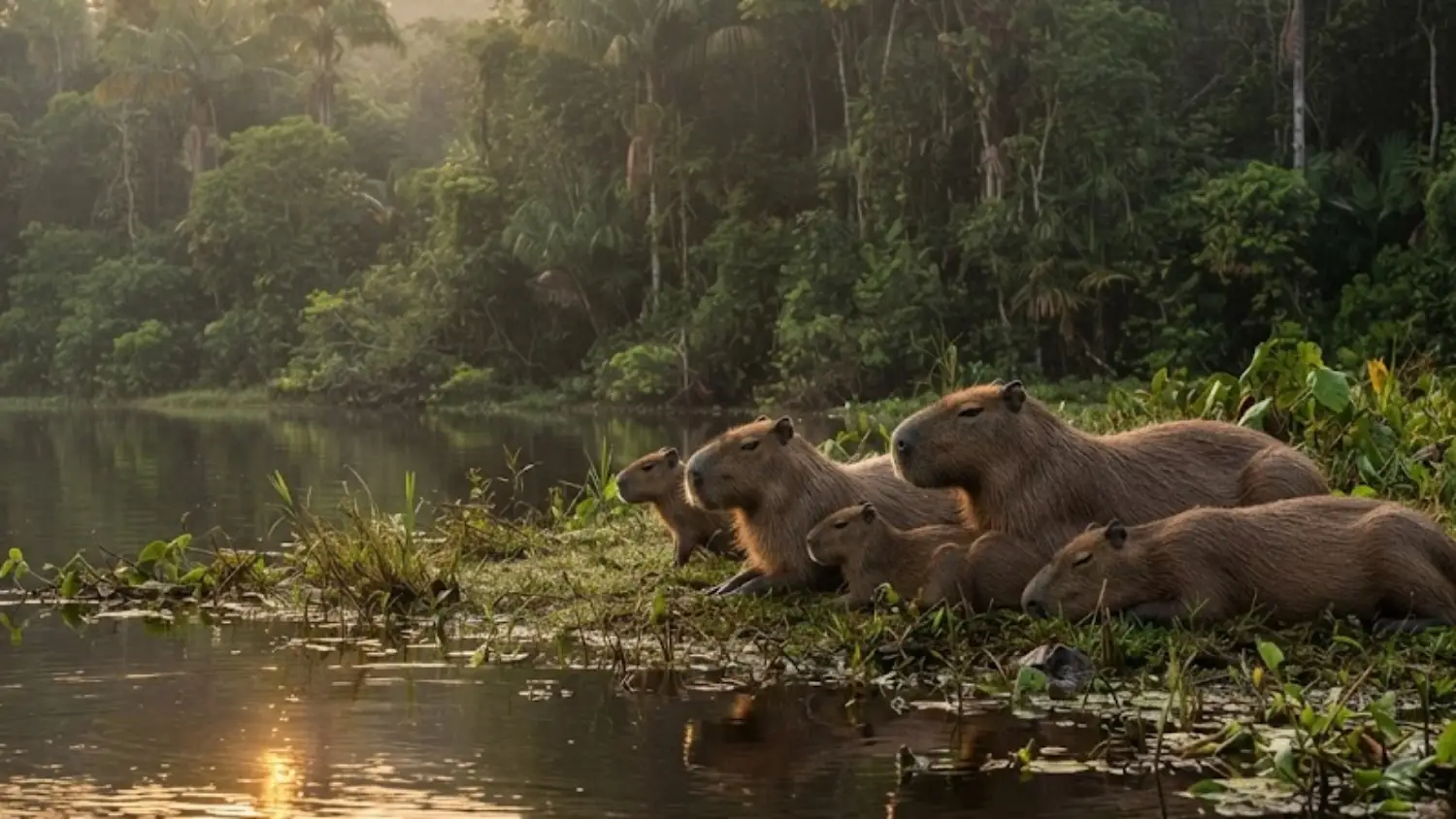
Along the winding banks of the rivers and lakes that shape the planet’s largest tropical forest, life in community demands a refined and efficient system of communication. Without one, it would be impossible to hold together groups that can gather dozens of individuals. The capybara, known to science as the largest rodent in the world, surprises observers and researchers alike by displaying a remarkably diverse repertoire of sounds, ranging from sharp alarm clicks to melodic whistles of constant contact. This web of acoustic signals works as an invisible yet absolutely vital bond, allowing the herd to navigate the daily challenges of the floodplain and to share crucial information about available food or the presence of natural predators nearby.
The species, identified by science as Hydrochoerus hydrochaeris, inhabits the amphibious environments of the Amazon basin, where water sets the rhythm of every routine. There, the voice is far more than decoration: it is a survival tool. Careful observation of these animals reveals that the emission of specific sounds performs well defined social functions at each moment of the day, whether during grazing on the riverside grasses or in moments of collective rest in the shade of the forest.
Whistles that keep the herd together
When the group moves through dense vegetation, whistles function as sound coordinates that prevent the scattering of members and keep every individual aligned with the pace of the march. It is a kind of acoustic compass that orders the collective movement without any need for permanent visual contact. In a landscape of tall grasses, channels and thick vegetation, where seeing one another from a distance can be difficult, hearing one another becomes the guarantee of nobody being left behind.
Clicks, by contrast, play a different and far tenser role. Emitted in situations of risk, they serve as an immediate warning of danger and trigger a coordinated response that guides the herd toward safe refuge in the deep waters, where the animals find protection against land carnivores. That shift in register, from the calm whistle to the alarm click, translates the mood of the group and reorganizes its behavior within seconds.
The voice that recognizes each pup
Sound communication plays an even more delicate role in the relationship between mothers and their young. In the middle of large groups, where dozens of pups live very close to one another, individual recognition becomes a genuine challenge. Through soft and specific vocalizations, the female manages to identify and guide her offspring even in situations of low visibility or during rapid movements through the mud.
This acoustic form of parental care ensures that the pups receive the attention and protection they need during the first months of life. By reinforcing the bond between mother and young from the very base, the species strengthens its entire social structure and secures reproductive success across the Amazonian ecosystems. The maternal voice, barely audible to a distracted human ear, is in fact one of the pillars that sustain the continuity of the population.
The strength of living in a group
Life in large groups offers remarkable adaptive advantages for the giant rodents that inhabit the flooded environments of the Amazon basin. Shared vigilance significantly reduces the risk of individual predation, because the combined attention of many pairs of eyes and ears detects threats well in advance. A single distracted animal may be caught by surprise, but an attentive group rarely is.
Furthermore, social organization favors collective learning about the best foraging routes and the safest places to reproduce throughout the flood and ebb seasons of the rivers. That shared memory, passed along in the daily routine of the group, reflects the notable ability of the local fauna to adapt to the demanding seasonal cycles of the tropical forest, helping to maintain stable populations and balanced ecosystems.
A repertoire shaped by millennia
Every sound in this vocabulary carries the weight of a long evolutionary history. The whistle that keeps a family moving as one, the click that sends the herd rushing into the water, the gentle call that a mother reserves for her pup: none of these appeared by chance. They are the product of countless generations tuning their behavior to a landscape defined by rising and falling waters, by dense vegetation and by predators that never rest. Understanding this helps explain why the capybara thrives where many other animals struggle, and why its quiet conversations deserve far more attention than they usually receive.
Protecting the banks to preserve life
Preserving the riverside habitats of the Amazon is a fundamental condition for maintaining the ecological interactions that sustain the region’s rich biodiversity. Protecting the floodplain areas and the natural ecological corridors ensures that wild species find adequate space to express their complex social behaviors without destructive interference. Every whistle, every click and every maternal call depends on an intact landscape to keep its meaning.
Initiatives focused on the bioeconomy and on sustainable management show that the economic development of local communities can walk alongside the rigorous conservation of natural resources and endemic fauna. Observing the rich fabric of behaviors and sounds that animates the rivers of the Amazon invites us to reflect on our connection with the biosphere. When we understand that each vocalization is the result of millennia of evolution, we realize that protecting this natural sanctuary is also an act of respect for the ancient wisdom of the land.
Reporting: Anne Silva / Amazonia Mag. Source: Revista Amazônia.

Editor, English Edition — Amazonia Mag
Anne Silva is the editor of Amazonia Mag, the English-language edition of Revista Amazônia. She curates, translates and adapts the outlet's science and environment coverage for an international audience, reporting on Amazon wildlife, flora, rivers, climate and research. Every story she edits is grounded in peer-reviewed studies, official data and on-the-ground reporting from the Revista Amazônia newsroom in Belém, Pará, Brazil. More by Anne Silva →