
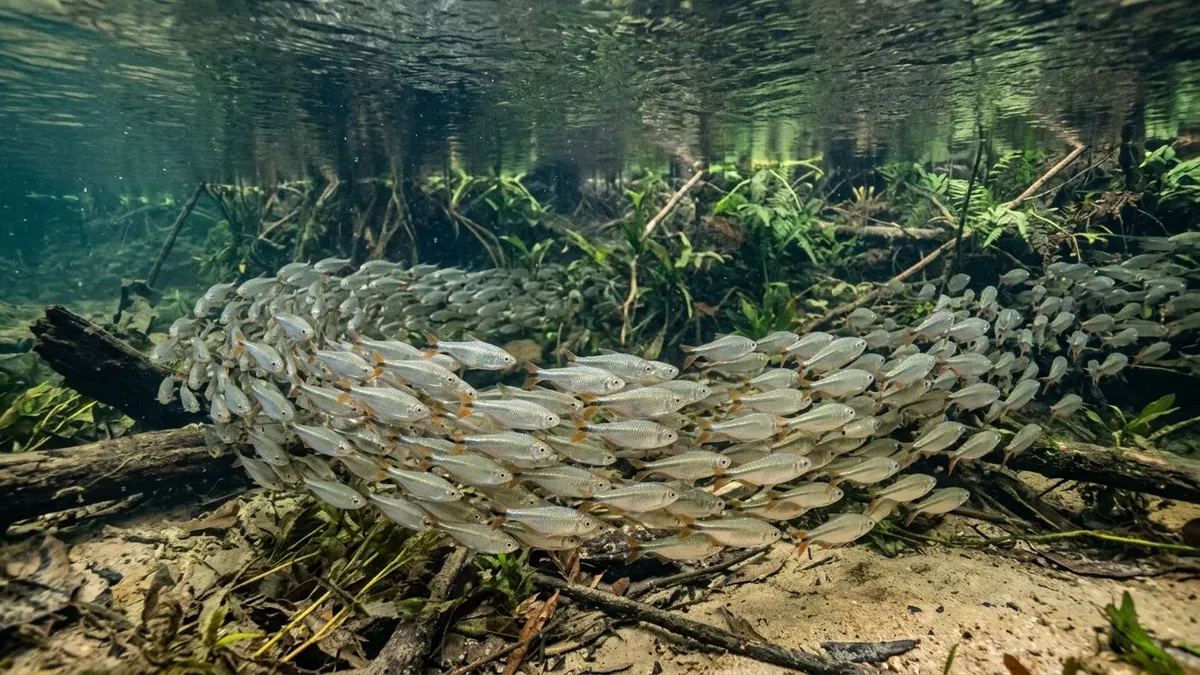
A school of piabas can change direction almost at the same instant without following a fish that commands the group. Coordination comes from local rules: each individual senses the movement of its close neighbors, adjusts its speed and alters its path. The lateral line contributes to this process by detecting changes in pressure and displacements in the water around the body.
When one piaba speeds up, brakes or turns, the flow of water produced by its body reaches the fish nearby. They respond to that signal and trigger new responses in sequence. The result is a curve that crosses the school in a short time, forming a moving mass that makes it hard for a predator to choose and follow a single prey.
The lateral line turns water into a movement signal
The lateral line is a sensory system found in fish, made of structures that perceive displacements and pressure changes in the water. In many species it runs along the sides of the body, either as a visible line or as a series of canals and pores. Inside this system are sensory cells able to respond to water movement caused by currents, obstacles, other animals and the fish’s own motion.
For the piaba, this information complements vision, especially when the school is very tight or when the water reduces visibility. The fish does not need to identify the whole shape of the group to react. It is enough to detect that a neighbor has accelerated, changed the flow around its body or taken a different position.
The lateral line picks up changes that reach the fish through the water itself, while the eyes help track the distance and orientation of the closest individuals. The two senses work together, and neither one alone explains how the group stays in step.
Each piaba follows simple rules instead of taking orders
Collective behavior does not depend on a permanent hierarchy in the school. No central animal needs to send signals to all the others. Each piaba adjusts its position based on what happens in a limited area around it. It tends to avoid collisions, stay close to its neighbors and follow changes in speed and direction that it perceives in the group.
These local responses produce an organization larger than the information available to any single fish. A change that starts in one part of the school can pass from individual to individual as a sequence of adjustments. The first fish turns, its neighbor perceives the change, corrects its own path and passes a new disturbance to those beside it. In this way the group changes direction without any member knowing the whole route or receiving a broad command.
The curve spreads through the school like a chain reaction
When a piaba alters its path, it displaces water with its body and its fins. That movement modifies the flow sensed by nearby individuals. The fish that receive the signal may close the distance, increase their speed or begin a turn. The response does not have to be identical in every animal, because each one sits in a different position and meets neighbors with movements of their own.
The school, then, does not behave like a rigid structure. It compresses, stretches and changes orientation according to the situation. A turn can begin at the edge, in the center or in whatever region received the stimulus first. The combination of sensory perception and continuous correction prevents the change from depending on a single fish. It also lowers the risk of collisions, since each individual keeps its attention on the space immediately around it while following the collective trend.
Fast reactions make life harder for predators
For a predator, catching an isolated piaba means selecting a target, calculating its position and adjusting the attack to the prey’s movement. In a school that turns in a coordinated way, that task becomes more difficult. Many fish accelerate or turn almost together, and the spacing between individuals can change before the predator completes its approach.
The defensive effect lies in the confusion created by collective movement, not in a conscious action by the school to trick the attacker. The multiplicity of bodies and paths produces targets that approach, retreat and cross one another in the predator’s field of perception. A piaba that would have been easy to follow can disappear among its neighbors or stop occupying the point first chosen. The response can also increase the distance from the threat and give the fish a chance to escape.
Group size changes the information available
In a small group, each piaba receives signals from a few neighbors and can keep a more direct relationship with the space around it. As the number of fish grows, so does the amount of movement and pressure change that can be perceived. This does not mean that each animal tracks all the others. Coordination remains based on an immediate neighborhood, with signals that spread through successive contacts.
This organization distributes the tasks of vigilance and response. A fish at the edge may notice an approach before individuals in the center, while another detects the change in flow produced by a neighbor’s escape. Each response adds information to the movement of the whole. The school does not need to form a perfect shape to work as a defense. The ability to adjust distance, speed and direction continuously already creates a mobile, responsive structure, suited to environments where currents and obstacles also vary.
Piaba is a popular name used for several small freshwater fish, so appearance and behavior can vary from one species to another. In rivers, streams and other freshwater habitats, a school has to deal with current, banks, submerged vegetation and changes in visibility. Sensing movement in the water helps each fish keep contact with the group even when the environment does not allow a wide view.
This behavior also shapes ecological relationships. By moving together, the piaba remains available as prey for larger fish, birds and other predators, but it turns capture into a task that demands a fast response. At the same time, its movements are part of the flow of energy in the ecosystem, linking smaller resources to the consumers that depend on them.
Watching a piaba turn together with dozens of others is a way of seeing distributed intelligence, built from sensors, water and simple responses. No fish needs to understand the movement of the whole school in order to take part in it. Coordination arises when each individual reacts to what is near, and that sum produces a defense that belongs to the group. In rivers and streams, the school shows how life can turn local signals into collective action without orders, hierarchy or central planning.
Reporting: Natália Santos / Amazonia Mag

Editor · Amazonia Mag
Anne Silva is the editor of Amazonia Mag, the English-language edition of Revista Amazônia. She curates, translates and adapts the outlet's science and environment coverage for an international audience, reporting on Amazon wildlife, flora, rivers, climate and research. Every story she edits is grounded in peer-reviewed studies, official data and on-the-ground reporting from the Revista Amazônia newsroom in Belém, Pará, Brazil. More by Anne Silva →