
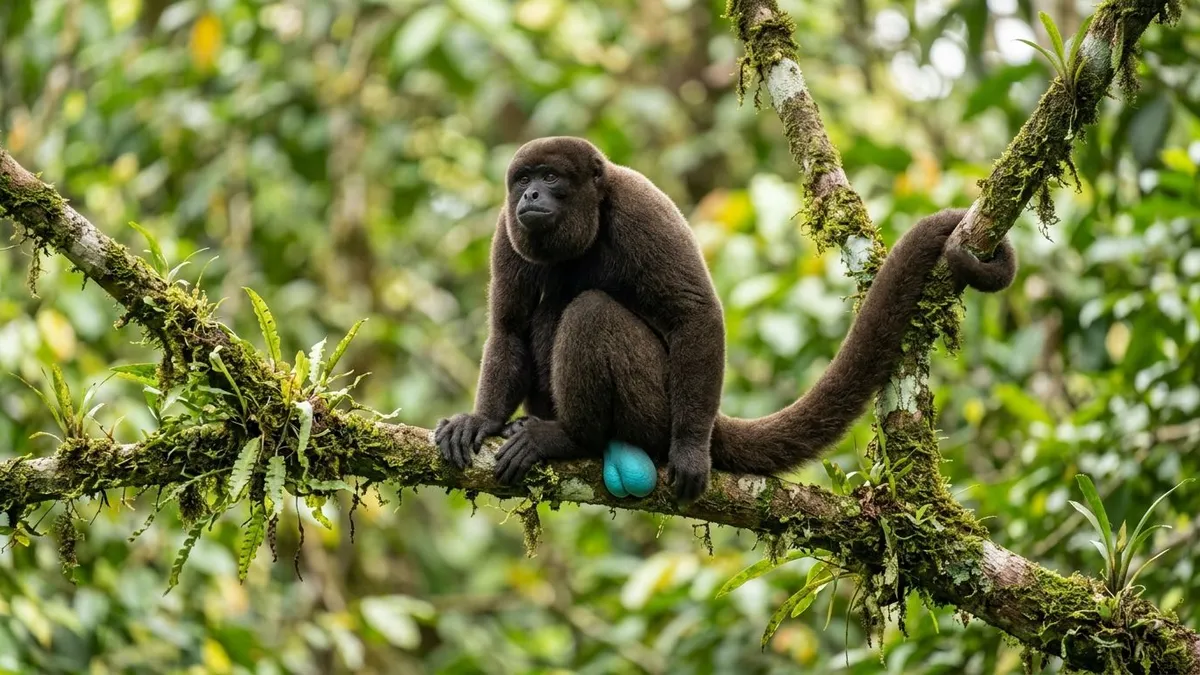
Woolly monkeys, known in Brazil as macacos-barrigudos, belong to the genus Lagothrix in the family Atelidae. According to the Primate Info Net, run by the Wisconsin National Primate Research Center at the University of Wisconsin-Madison, the genus includes four species, Lagothrix cana, L. lagotricha, L. lugens and L. poeppigii, spread across Bolivia, Brazil, Colombia, Ecuador and Peru. In Brazil they occur from the Negro and Tapajós rivers westward.
They are among the largest primates of the New World: males of L. cana average 21 pounds (9.5 kilograms) and those of L. lagotricha average 16 pounds (7.3 kilograms). They are canopy animals that live in large groups, eat mostly fruit and spread seeds through the Amazon forest.
A prehensile tail and a body built for the treetops
According to the Primate Info Net, the woolly monkey’s tail is as long as the head and body together, or longer, and has a pad on the underside of its tip that improves grip. It is used for climbing, for balance and for holding the animal hanging while it picks fruit. A tail like that works almost like a fifth hand.
According to the National Primate Center of the Evandro Chagas Institute, the woolly monkey moves quickly through the trees and makes long leaps; on the ground, it adopts a bipedal posture.
Fruit comes first
The Primate Info Net describes woolly monkeys as predominantly fruit eaters throughout the year. In L. cana, about 80.7% of the diet is fruit; in L. lagotricha, 78.9% is fleshy fruit. Leaves, flowers, insects and other animals complete the menu, and in the dry season, when fruit is scarce, the consumption of foliage, seeds and exudates, the saps and gums that trees release, increases.
The National Primate Center points out that the species mainly uses terra firme forest, the forest that never floods, and in periods of heavy fruit supply it also enters flooded forests.
Long-distance sowers
The most cited study on the subject was carried out by Pablo Stevenson in Tinigua National Park in Colombia and published in 2000 in the American Journal of Primatology. Over a year of observing one group of Lagothrix lagothricha, the researcher collected 753 fecal deposits holding about 50,000 seeds. The dispersed seeds belonged to 112 plant species. At a density of 30 individuals per square kilometer (78 per square mile), the monkeys in the area dispersed more than 25,000 seeds per square kilometer (about 65,000 per square mile) every day.
In the 264 cases where distance could be measured, only 1% of the droppings fell within 49 feet (15 meters) of the parent tree. The most common deposit was between 330 and 1,640 feet (100 and 500 meters) away, and in some cases 0.9 mile (1.5 kilometers). Seeds that passed through the gut usually germinate as well as, or better than, seeds that were not swallowed.
When the species disappears from an area, that long-distance transport of seeds is lost as well. Without woolly monkeys, forests with large-fruited trees lose a dispersal agent that carries seeds hundreds of meters from the parent plant.
Large groups, flexible makeup and slow reproduction
The National Primate Center reports that the woolly monkey forms large groups of 12 to 70 individuals. The Primate Info Net classifies the social system as multimale and multifemale, and gives averages of 44 to 49 animals per group in L. cana and 23 in L. poeppigii. Groups spread out through the forest, keep in touch by calling, and can split temporarily into subgroups that later come back together.
Who leaves the group where they were born? According to the Primate Info Net, female dispersal has been documented in L. lagotricha, at around 6 years of age. Molecular evidence in L. poeppigii, however, indicates that both sexes disperse, with males more likely to stay in their birth group; lone males and groups of young males have also been observed.
In a study of L. poeppigii in Ecuador, published in 2005 in the International Journal of Primatology, Anthony Di Fiore and Robert Fleischer describe tolerant relationships among adult males, with little competition even during mating.
Gestation lasts 7 to 7.5 months, according to the Primate Info Net, and the National Primate Center cites 207 to 225 days for L. cana. A single infant is born, with fur much paler than its parents’. In the first weeks the mother carries it on the front of her body, and later it moves to her back.
A female usually has one offspring about every three years in L. lagotricha, and the National Primate Center records sexual maturity between 60 and 84 months, that is, between 5 and 7 years.
Threats and conservation
The Primate Info Net states that almost all woolly monkeys are threatened, and that only L. lagotricha keeps relatively healthy, widely distributed populations. The main factor is hunting: because they are large, the animals are particularly vulnerable to hunting for meat and medicinal use, and in some places the pressure has been so high that the species disappeared. On top of that comes forest loss to agriculture and mining. The National Primate Center reports that ICMBio, Brazil’s federal conservation agency, classifies Lagothrix cana as Vulnerable (VU).
The combination of intense hunting and slow reproduction makes recovery difficult: a female that has one infant every three years replaces few animals. Hunting and slow breeding add up, and they turn the recovery of populations into a long process.
Reporting: Natália Santos / Amazonia Mag

Editor · Amazonia Mag
Anne Silva is the editor of Amazonia Mag, the English-language edition of Revista Amazônia. She curates, translates and adapts the outlet's science and environment coverage for an international audience, reporting on Amazon wildlife, flora, rivers, climate and research. Every story she edits is grounded in peer-reviewed studies, official data and on-the-ground reporting from the Revista Amazônia newsroom in Belém, Pará, Brazil. More by Anne Silva →