
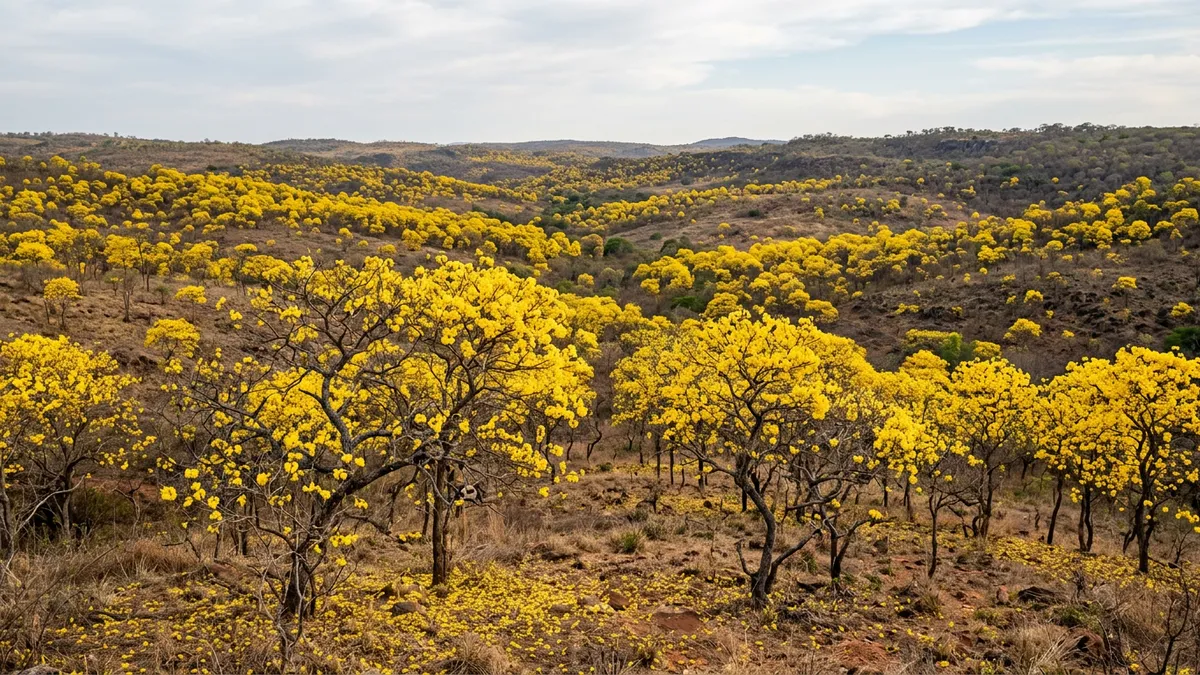
Across a whole region, ipê trees can go from crowns full of green leaves to crowns dominated by yellow in a relatively short time. The flowers are the spectacle, but a step comes first that makes the spectacle possible: the tree loses all of its foliage. Leaves fall to the ground, the branches stand bare, and the crown shows its flowers without the green cover that normally hides them.
The change is not only visual. It marks the plant’s response to a dry period, when the water available in the soil drops and the ipê goes through a condition known as water stress.
The landscape changes once the leaves fall
The sequence runs in a clear order. First comes the drop in available water. Then the tree sheds 100% of its leaves. Only after that do the flowers appear. When many trees respond to the same environmental condition, the landscape seems to change all at once, and the result is flowering synchronized at the regional scale.
That is why the bloom should not be read as an event triggered simply by a date on the calendar. The dry period works as the trigger for the whole chain of events. The yellow catches the eye, but the process begins earlier, when the tree gives up the familiar look of its crown.
Drought, not the calendar, is the signal for flowering
The heart of this behavior is the link between water stress and the reproductive cycle. The ipê does not need a calendar to tell it when to start. The sequence is tied to the conditions that build up during the dry period. By losing its leaves, the tree reduces the green structures in its crown and leaves the flowers more exposed.
That order matters because the blooming happens on a visually different tree, with branches in plain view and flowers filling the space that foliage used to occupy.
The mechanism also helps explain why the same landscape can show trees flowering together, yet not in exactly the same way every year or in every area. A dry period can differ in length and intensity, and ipê species do not respond identically. The general pattern is consistent: total leaf loss, followed by flowering after the drought. But each species begins the process at its own moment. A date on the calendar may coincide with the bloom, but it is not the main trigger.
Flowers open together, and pollination gets a better chance
Synchrony has a direct reproductive consequence. When many trees produce flowers in the same period, the supply of resources for pollinators becomes concentrated in the environment. Flowering stops being the isolated event of a single crown and becomes a broad availability of flowers across the region. That concentration can make it easier for flowers and the animals that carry pollen to find each other, raising the efficiency of the trees’ reproduction.
The advantage does not depend on any intention of the plant. It is the adaptive effect of flowering together after water stress.
Leaf loss reinforces this exposure. With the branches bare, the flowers are more visible and can be found by pollinators without the interference of a crown full of leaves. Synchrony, in turn, means that pollinators find several flowering trees during the same phase. This combination, bare crowns and many flowers on offer, links a climatic event to a reproductive outcome.
It is important not to claim more than the evidence allows. Synchrony favors attracting pollinators, but that does not mean every flower will be visited, or that reproduction will turn out the same for every tree. The availability of animals and the differences between species still matter.
The yellow is not the same in every ipê
The scene is often pictured as one great yellow mass, but how the flowering looks depends on the species. The variation between ipê species prevents the description from becoming a single rule for all trees. What they share is the response after the dry period, with total loss of foliage before the bloom and the potential benefit of synchrony for pollination. The timing, the intensity and the look of the flowering may therefore differ from one group of ipês to another.
That variation also limits comparisons made only by looking at one avenue, one square or one region. One tree may start to bloom before another, even when both went through the same dry period. An area can seem covered in flowers all at once, yet that does not erase the biological differences between species. The event has to be placed correctly: it happens after a dry period, in a region where ipês respond in step with one another, and not on one fixed day that is valid for every tree.
A yellow landscape reveals a strategy tied to water
The whole chain can be read as a simple sequence. The dry period reduces available water, the ipê drops 100% of its leaves, the flowers open on an exposed crown and several trees bloom in synchrony. The reproductive consequence is a concentrated offering of flowers, able to draw pollinators to the region. What looks like a sudden change of color is really the visible result of a plant’s response to environmental conditions. The absence of leaves is not a side detail. It is a step that comes before the bloom.
In Brazil, where the image of ipês in flower often marks the passage between periods of the year, the sight gains meaning when it is no longer treated only as a sign of the calendar. The yellow may coincide with a familiar season, but the process depends on the dry period and on the response of each species.
Even so, the scene offers a precise reading of plant adaptation. Instead of waiting for a date, the ipê responds to the water available and concentrates its reproduction at a moment when synchrony can make its flowers easier for pollinators to reach. The landscape changes color, and it also records the relationship between climate, the leaf cycle and the continuity of the species.
Reporting: Natália Santos / Amazonia Mag

Editor · Amazonia Mag
Anne Silva is the editor of Amazonia Mag, the English-language edition of Revista Amazônia. She curates, translates and adapts the outlet's science and environment coverage for an international audience, reporting on Amazon wildlife, flora, rivers, climate and research. Every story she edits is grounded in peer-reviewed studies, official data and on-the-ground reporting from the Revista Amazônia newsroom in Belém, Pará, Brazil. More by Anne Silva →