
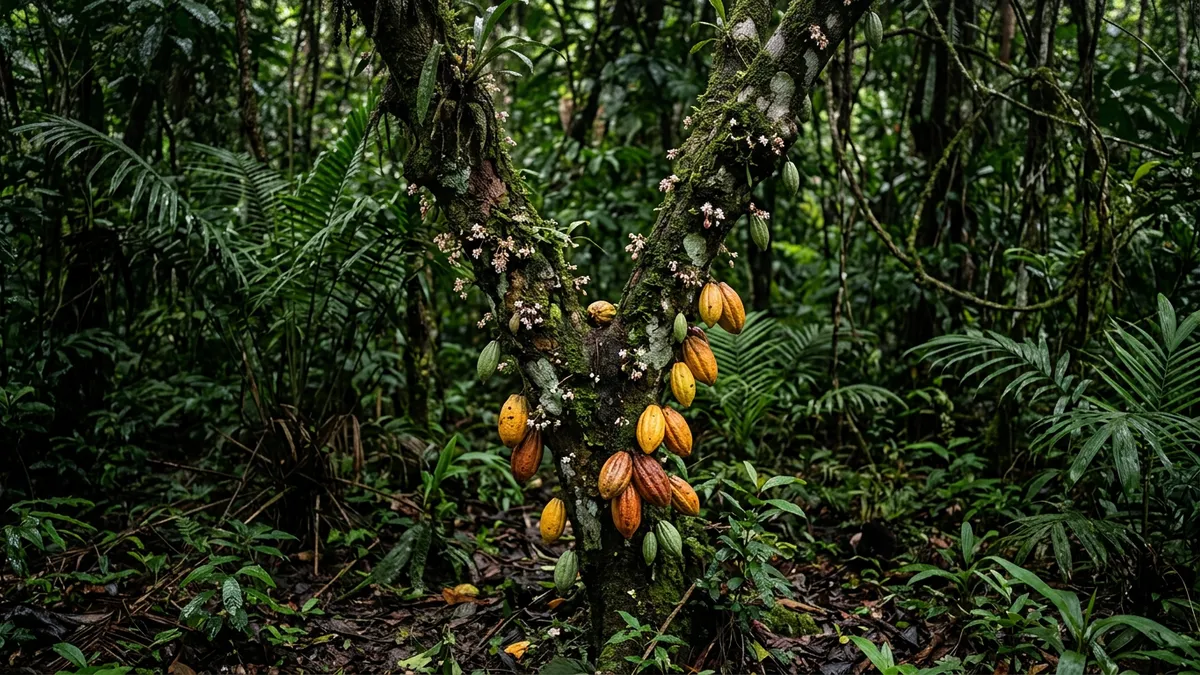
Among the trees of the várzea, the Amazon’s seasonally flooded forest, cacao does not show up as an isolated crop in an open field. It grows in an environment built from vegetation of different heights, with crowns that filter the light, roots that occupy different layers of the soil and periods when water reshapes the landscape. That setting gives native cacao (Theobroma cacao) conditions close to those in which the species developed in the Amazon, under the influence of other plants and high humidity.
In the várzea, cacao grows inside a shaded system
Shade does not mean the absence of light. It creates a light that is spread out, reduces the direct exposure of the leaves and helps keep a microclimate less prone to sudden changes in temperature and humidity. In the várzea system, the cacao tree also lives with the natural dynamics of the environment, which include the rising and falling of the waters.
For that reason, cultivation cannot be understood only by looking at the tree. One has to observe the surrounding forest, the soil, the flood regime and the plants that form the shelter where cacao produces leaves, flowers and fruit.
When the forest is cleared, the plantation has to be run differently
In an open area under full sun, the cacao tree receives far more radiation directly on its leaves, branches and fruit. That change alters the balance that existed in the shaded environment. The plant comes to depend on more careful management of water, soil fertility, the shaping of the crown and protection against conditions that can add stress. Intense light also favors the growth of competing plants, which increases the work needed to keep the area productive.
The contrast does not mean every full-sun crop is unviable or that all shade produces the same result. Performance depends on the planting material, the soil, the availability of water, the climate and the way the crop is run. The central point is that removing the forest cover does not remove the need for management. On the contrary, it shifts to the grower tasks that, in the shaded setting, were partly performed by the structure of the vegetation itself. An open plantation has to control the exposure of the plants better, watch the condition of leaves and fruit, and adjust farming practices throughout the cacao tree’s cycle.
A tiny fly takes part in forming the fruit
Cacao flowers are small and depend on pollinators able to reach their structure. Among the main agents are tiny midges, flies of the genus Forcipomyia, related to the family Ceratopogonidae. They visit the flowers and carry pollen between floral structures. Because the animal is so small, its role can go unnoticed by anyone who watches only the tree and its pods, yet these insects are part of the chain of events that lets seeds form.
Pollination helps explain why a plantation should not be judged only by the number of trees or by the amount of flowers. The environment has to offer conditions for pollinator activity, which depends on humidity, organic matter and shelter at different points of the landscape. Simplifying an area can change those resources.
Still, it should not be said that any shaded system guarantees abundant pollination, or that clearing an area automatically wipes out the insects. The result varies with management and local conditions, and the relationship among vegetation, microclimate and pollinators calls for careful observation.
Witches’ broom changes the fate of branches and fruit
Cacao also faces witches’ broom, a disease caused by the fungus Moniliophthora perniciosa. The name comes from the look produced by the excess of shoots and the abnormal growth of infected branches. The disease can reach developing tissues, reduce the plant’s productive capacity and harm flowers and fruit. Rather than being treated as a side issue, management has to include frequent monitoring, removal of diseased parts when recommended and measures that reduce the sources of infection left in the planting.
The disease is not an automatic consequence of growing cacao in full sun. It is tied to the presence of the pathogen, to environmental conditions, to the genetic material of the plants and to the practices used in the area. However, an open, simplified plantation may face challenges of its own, while an agroforestry system offers another mix of shade, humidity, species and fieldwork. None of these models works without care.
An agroforestry system is an alternative because it brings cacao together with shade trees and other plants, diversifying the area and rebuilding part of the relationships that disappear when forest is replaced by a monoculture. In practice, it is not just a matter of planting trees next to cacao. Compatible species have to be chosen, the layers of vegetation organized, the amount of shade controlled and the competition for water and nutrients monitored. Too much cover can limit the light the cacao tree needs, while too little leaves the plant more exposed. The balance changes with the place, the season, the stage of the trees and the purpose of each component of the system.
The arrangement can bring production and conservation closer together, but it is not an automatic solution to every problem. Other trees do not replace the monitoring of witches’ broom, pruning, cleaning of affected areas or attention to pollination. Nor does keeping the shade erase the effects of floods, droughts or changes in the soil. The gain lies in the chance to combine functions in one landscape, keeping shelter, organic matter and plant diversity around the cacao tree.
What Amazon cacao shows about the cost of simplifying a landscape
The difference between native várzea cacao and full-sun cultivation begins before the harvest. In the first case, the plant takes part in a plant community shaped by shade and by the dynamics of the waters. In the second, the grower has to rebuild, through daily decisions, part of the conditions the forest provided in an integrated way. Light, water, crown growth, the presence of pollinators and disease control come to be followed as parts of a single system.
This comparison helps show why cacao is not just a tree that bears fruit anywhere. Its cultivation depends on relationships among plant, forest, insects, fungi, soil and human management. In the Amazon, preserving or rebuilding those relationships can mean producing without reducing the landscape to a single species. The story of the cacao tree shows that productivity does not lie only in clearing land or increasing light, but also in keeping the quiet conditions that let a tiny flower meet pollen and turn shade into fruit.
Reporting: Natália Santos / Amazonia Mag

Editor · Amazonia Mag
Anne Silva is the editor of Amazonia Mag, the English-language edition of Revista Amazônia. She curates, translates and adapts the outlet's science and environment coverage for an international audience, reporting on Amazon wildlife, flora, rivers, climate and research. Every story she edits is grounded in peer-reviewed studies, official data and on-the-ground reporting from the Revista Amazônia newsroom in Belém, Pará, Brazil. More by Anne Silva →