
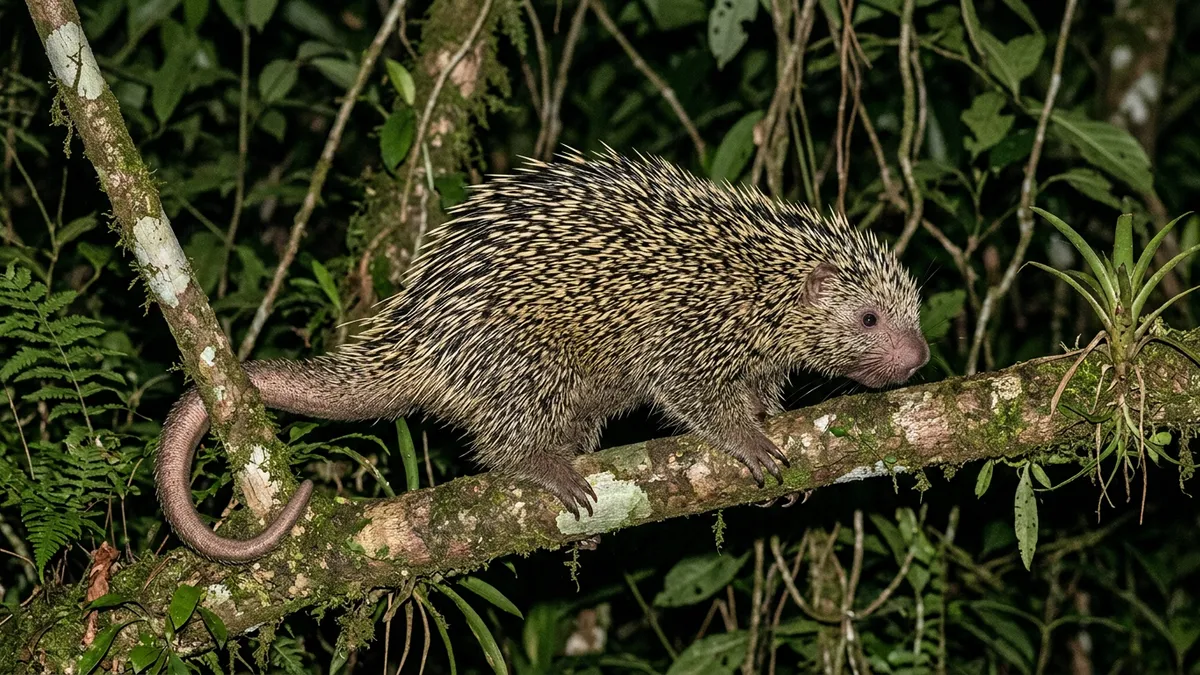
The quills of the Brazilian porcupine (Coendou prehensilis) carry tiny barbs that make them hard to pull out once they touch a predator. This structure is not meant to launch quills at a distance. The defense depends on physical closeness and turns the mammal’s body into a barrier that is difficult to seize.
While its back is protected, the animal uses its prehensile tail to hold on to branches. The bare tip increases contact with the surface and works as an extra support during night-time movement through the trees. Defense and locomotion come together in one body.
How the tiny barbs make quills hard to remove
The tiny barbs on the quills make their surface irregular. When a predator touches or tries to bite the porcupine, some of these structures can catch in its tissue. Pulling back does not remove the quill easily, because the small projections increase resistance to withdrawal.
This does not mean that every contact has the same result, but it creates an immediate difficulty for anyone trying to capture the animal. Quills left in a predator’s skin may also favor infection, especially when removal is incomplete or the wound stays open. The defense works through contact, not through a shot.
A body that concentrates protection on the back
The quills cover mainly the dorsal region, the part that tends to stay exposed when the porcupine is threatened. When reached, the animal can present the attacker with a protected surface, reducing the chance of a direct bite to more vulnerable areas of the body.
The anatomy does not make the mammal an aggressive animal. The quills act as passive protection, set off by the approach of another animal. The predator has to touch the body to be hurt, and that consequence can bring an attack to a halt. The advantage lies in the difficulty created by contact, with no need for a chase or a prolonged confrontation.
The myth of the porcupine that throws its quills
The Brazilian porcupine does not throw its quills. They are not launched like projectiles and do not cross the space to reach a predator. For a barb to take hold, the spiny body has to come into contact with the mouth, paw or another part of the aggressor.
The belief may arise because removal is hard and because quills remain stuck after a brief encounter. In practice, the animal can be touched during a capture attempt while the predator backs away with quills lodged in it. The look of the wound encourages the mistaken idea that something was thrown, but the mechanism is purely physical and depends on closeness.
Clearing up the myth matters because it changes how the animal is understood. A porcupine that fires its quills would be an active attacker. The real animal is a passive defender, one that relies on structure rather than on aggression.
The prehensile tail as a fifth limb
The prehensile tail helps the porcupine stay stable while it moves through vegetation. It can wrap around or hold branches, acting as a fifth limb during climbing and when crossing between points of support. The feature is especially useful for an animal that spends its life in the trees.
The hairless tip contributes to direct contact with the branch. Without a layer of fur at that end, the tail meets the surface more firmly and precisely. The extra support lets the animal spread its weight better, reach for more distant twigs and reduce the risk of losing its grip during night-time travel.
Night life combines movement and defense
Being active at night lowers the porcupine’s exposure while it stays on the move in the trees. Movement takes place in low light, among branches and foliage, where the prehensile tail helps keep its balance. The animal does not have to come down to the ground for all of its journeys.
If a predator gets close, the quills offer an immediate defense, without requiring a fast escape over long distances. The combination fits a tree-dwelling routine. The tail supports the body and helps it move along the branches, while the spiny back raises the cost of any attempt at capture. Each structure answers a different demand of the same environment.
By living in the trees, the porcupine uses a part of the forest that is not occupied in the same way by land mammals. Branches and canopy offer routes of travel, shelter and places for its night-time activities. The prehensile tail lets it explore that space more safely than would be possible with its paws alone.
The barbed defense also shapes its relationship with other species. Predators have to weigh the risk of touching a protected body, and unsuccessful encounters can end attacks. In this way the Brazilian porcupine takes part in the dynamics of the forest without depending on active confrontation. Its presence shows how a feature of the skin and an adaptation for movement can work together in the survival of a tree-dwelling mammal.
The Brazilian porcupine shows that surviving in the canopy is not only a matter of speed. Quills that resist removal and a tail able to grip branches form a solution built on contact, balance and economy of effort. The myth of the shot quill fades when the mechanism is looked at closely. In the forest, a defense does not have to be spectacular to work. It only has to make an attack difficult and give the animal a safe route between the branches, through the night.
Reporting: Natália Santos / Amazonia Mag

Editor · Amazonia Mag
Anne Silva is the editor of Amazonia Mag, the English-language edition of Revista Amazônia. She curates, translates and adapts the outlet's science and environment coverage for an international audience, reporting on Amazon wildlife, flora, rivers, climate and research. Every story she edits is grounded in peer-reviewed studies, official data and on-the-ground reporting from the Revista Amazônia newsroom in Belém, Pará, Brazil. More by Anne Silva →