
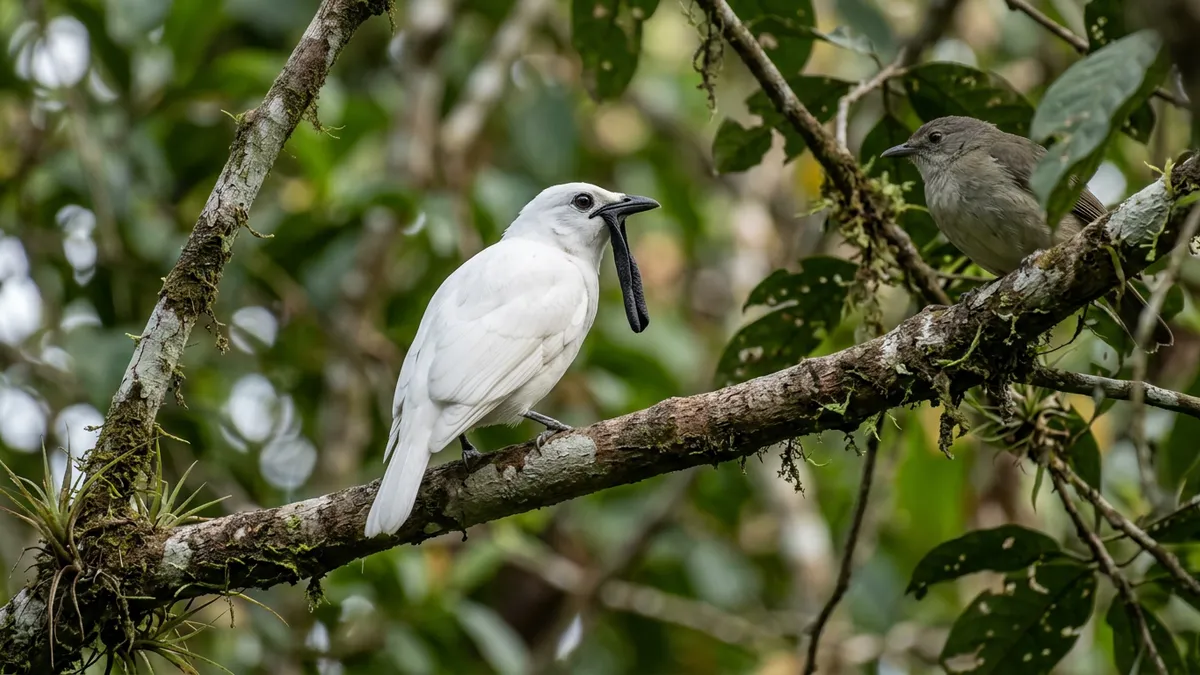
Before the white bellbird sings, it moves. The male of Procnias albus adjusts his position on an exposed branch in the canopy and turns his body toward the female, who is only a short distance away. Only then does he deliver a note measured at about 125 decibels at 3.3 feet (1 meter), the loudest sound ever recorded from a bird.
The sequence is easy to describe and hard to ignore. First the male changes the axis of his body. Then he produces a note of extreme intensity. Research published in 2019 recorded the behavior, and it has become one of the clearest examples of what a small forest bird can do with a precisely aimed voice.
A song that begins with a change of position
The white bellbird lives in forested areas of South America and uses elevated perches to vocalize. In the canopy, an exposed branch works as a signaling post, both for marking territory and for courtship. The bird does not need to chase the female to get its message across. What it does is adjust the direction of the sound when she is close.
That detail matters. The turn of the body is not just a display. Facing the female helps concentrate the sound on the spot she occupies, instead of throwing the call indiscriminately in every direction through the forest. The behavior therefore has two well-defined stages: a shift in posture, followed by the note itself.
Because the singer is perched in the open, the scene is also visible. The male is exposed to the female’s view at the very moment the sound reaches her, so sight and hearing arrive together. The branch, the turn and the call are parts of a single act.
What 125 decibels means, and what it does not
The measurements registered about 125 decibels at a distance of 1 meter (3.3 feet), the highest volume ever measured in a bird. The decibel is a relative unit on a logarithmic scale, which means that a small difference in the numbers is not a small difference in sound pressure. A reading of 125 therefore places the white bellbird’s call among the most intense sounds produced by small land animals.
The number has to be read with care. The intensity recorded depends on the distance to the animal, the equipment, the environment and the angle of the measurement. An observer standing farther away will not hear the level shown in a reading taken at 1 meter. Even so, the figure allows a comparison: most birds produce quieter sounds, or must sing for longer stretches to cover the same area. In the white bellbird’s case, the force of the note lets a short vocalization make itself felt across the canopy.
It also does not follow that every individual of the species sings at exactly the same level. Age, physical condition, position, distance and the behavioral situation can all change the sound a bird produces. The record is a measurement of a specific moment, not a fixed trait that applies in every circumstance.
Chest muscle and a body built to sustain the note
Producing a sound this intense takes more than a structure that lets air pass through. The male uses reinforced vocal musculature and an adapted rib cage to sustain the pressure needed during the call. As in all birds, sound comes from the respiratory system and from the syrinx, an organ located at the base of the trachea. Control of airflow, tension in the vibrating tissues and the shape of the body work together to form the note.
This does not mean the animal has simply enlarged every organ involved. The gain depends on coordination among breathing, muscle and posture. The rib cage takes part in the mechanical support of ventilation, while the muscles tied to vocalization help keep the emission focused. That is why the call should not be described as just a loud shout. It is a controlled sound production, powerful enough to demand specialized anatomy and a steady position on the branch.
Seen this way, the behavior described in the 2019 research links two things that are often studied apart: the anatomy that makes the sound possible and the posture that decides where it goes. The turn toward the female is part of the mechanism, not decoration around it.
The canopy as part of the instrument
The exposed branch serves two functions. It gives the male an open position for visual display, and it allows the sound to be thrown over the mass of leaves and twigs. Height can reduce the obstacles standing directly between the singer and the female, although the real reach of the call varies with wind, humidity, the density of the vegetation and the terrain.
The call, then, is not separate from its environment. It depends on where the bird perches and on how it places its body before singing. In many acoustic signals the message has to reach individuals of the same species, but it can also reveal the sender’s presence to other animals. By turning and vocalizing when the female is near, the male combines volume, location and orientation. The behavior can take part in reproductive communication and in the defense of a territory.
What the record allows us to say
The most solid finding is the combination of three things: the acoustic record, the directed posture and the anatomical adaptations described for the male. The value of 125 decibels was obtained in a close measurement, at 1 meter, and it does not represent the volume heard at any point in the forest.
The 2019 study mattered because it showed that a small bird can combine a vocalization of extreme power with a very specific gesture of orientation. The story does not depend on attributing human intentions to the animal. It is enough to follow the sequence that was observed: the male takes a branch in the canopy, turns his body toward the female at short range, and uses an adapted respiratory and muscular system to produce one of the most intense notes known among birds. In the forest, communication is also the architecture of a body in motion.
Reporting: Natália Santos / Amazonia Mag

Editor · Amazonia Mag
Anne Silva is the editor of Amazonia Mag, the English-language edition of Revista Amazônia. She curates, translates and adapts the outlet's science and environment coverage for an international audience, reporting on Amazon wildlife, flora, rivers, climate and research. Every story she edits is grounded in peer-reviewed studies, official data and on-the-ground reporting from the Revista Amazônia newsroom in Belém, Pará, Brazil. More by Anne Silva →