
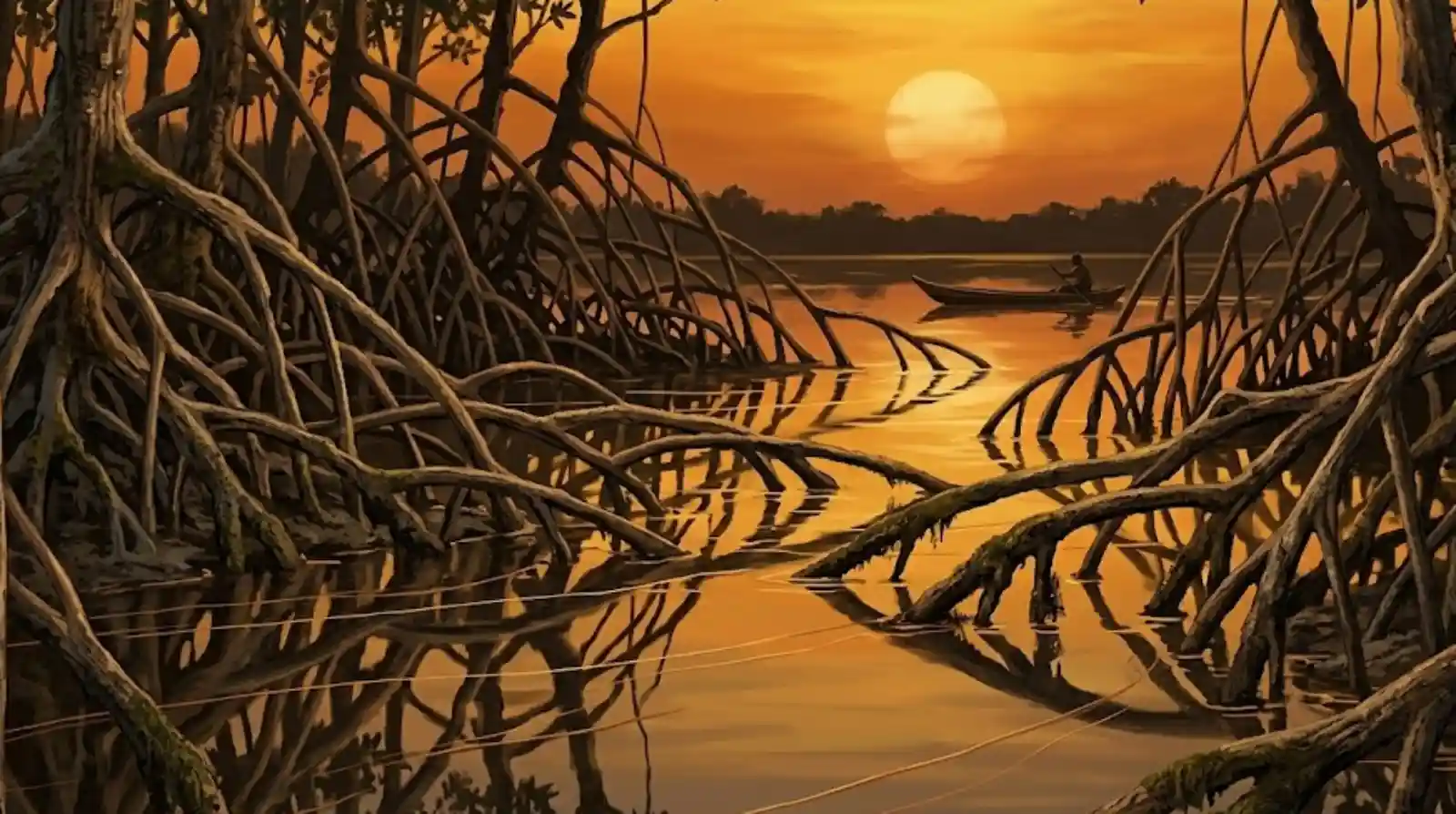
Mangroves can absorb up to five times more carbon per area than terrestrial tropical forests. According to scientific understanding of the ecosystem, they act as submerged lungs along Brazil’s coast and as one of the most important natural defenses against the climate crisis.
This transition zone between land and sea reaches one of its most majestic and well-preserved expressions along the coast of Pará. Aerial roots seem to defy gravity, while muddy, nutrient-rich soil supports a web of life that extends far beyond the beauty of the landscape.
The mangrove is a nursery for marine wildlife, a source of food for communities and a natural infrastructure that protects the shoreline. In this living barrier, tides, winds and storms meet a complex and resilient ecosystem.
A nursery between river and ocean
Science recognizes the mangroves of Pará as one of the world’s largest continuous stretches of this biome. They run for hundreds of miles, hundreds of kilometers, along an indented coastline where fresh river water mixes with saltwater from the ocean.
In this setting, biodiversity thrives under conditions that would be extreme for many other species. Tangled roots provide safe shelter for larvae and young fish and crustaceans, protecting them from larger predators until they are ready to face the open sea.
This nursery function is essential to the reproductive cycle of marine wildlife. The intricate root structure also creates a nutrient-rich maze that attracts animals at different stages of development, linking mangrove health to fisheries across a much wider region.
Mangroves also work as highly efficient natural biological filters. Their roots and sediment retain heavy metals and filter excess sediment carried by rivers before it reaches coral reefs and the deep ocean.
This filtering helps maintain water clarity and quality. It also allows light to penetrate the water and sustain marine food webs that are more sensitive along the Pará coast.
The uçá crab and the local economy
The uçá crab is perhaps the most emblematic resident of this environment. By processing leaves that fall from mangrove trees, it plays a crucial role in recycling organic matter and helps keep the ecosystem functioning.
Studies indicate that the health of crab populations is directly connected to the integrity of plant cover. When trees, roots and sediment remain intact, the mangrove provides the conditions this crustacean needs to complete its life cycle.
Along the coast of Pará, thousands of families depend economically on the sustainable harvesting of the uçá crab. The activity brings together ancestral tradition and food security, showing that the mangrove is not only an environmental heritage, but also the foundation of a regenerative economy that has supported entire communities for generations.
Beyond crabs, mangroves are essential to small-scale fishing for species such as snook, mullet and several kinds of shrimp. Without these habitats, the fishing productivity of the North Atlantic would suffer a collapse, making clear that protecting coastal ecosystems is also an economic survival strategy.
Restoring degraded areas has proved to be a powerful way to bring vitality back to places damaged by disorderly occupation. As the habitat returns, the original wildlife can also come back, strengthening the production that depends on it.
Natural barriers against a changing climate
The importance of Pará’s coastal mangroves goes far beyond food production. Dense networks of roots and trunks dissipate wave energy and reduce the impact of tropical storms, helping prevent coastal erosion and the destructive advance of the sea over villages and cities.
In a world of global change, keeping these ecosystems intact is one of the least expensive and most efficient forms of climate adaptation. The protection provided by a mangrove is something no human engineering project could reproduce with the same precision.
Science also emphasizes the role of these soils in storing so-called blue carbon. Mangrove sediment, which is often anaerobic, holds organic matter for thousands of years and prevents that carbon from returning to the atmosphere.
Protecting Pará’s mangroves is therefore a direct contribution by Brazil to global climate stability. Restoring places where these environments have been cleared brings back local biodiversity and strengthens an invisible but powerful barrier against planetary warming.
Education, management and traditional knowledge
Building awareness of mangrove value is one of the region’s greatest challenges and opportunities for sustainability. These places are often mistakenly treated as dumping grounds or unhealthy environments, even though they are sanctuaries of life.
Environmental education projects in schools along the Pará coast have changed how young people see the ecosystem. They begin to recognize the mudflat as a biological treasure and to understand that tides and plant cycles are part of a system that also supports human communities.
Knowledge of tidal cycles and the biology of plant species such as red mangrove and black mangrove is essential for participatory and effective territorial management. Bringing together harvesters’ traditional knowledge and the rigor of scientific research has produced positive conservation results.
Extractive Reserves, known as RESEX, along the coast of Pará show that natural resource use can coexist with keeping the forest standing. In these areas, harvesting is governed by closed seasons and quotas that respect nature’s timing.
This management model is an international example of positive impact. It shows that human development and environmental preservation can move forward together when there is mutual respect and public policy shaped around local realities.
A cultural heritage that remains alive
The relationship between Pará’s people and the mangrove is deep, appearing in cuisine, handicrafts and music. The mangrove environment has shaped the way coastal residents live and has created a resilient, adaptable cultural identity.
Valuing this ecosystem also means valuing the history of traditional communities, including fishers and quilombola communities that learned to read the signs of the forest and the sea. Protecting Pará’s coast allows this heritage to remain alive.
Future generations can continue to experience the abundance and protection known by their ancestors. Protecting and restoring mangroves is an investment in Brazil’s natural capital: every restored acre means more fish on the table, greater security for homes near the beach and cleaner air for everyone.
Looking at the mangrove with admiration is the first step toward ensuring that its roots keep supporting life. The delicate balance between river and sea teaches that life’s strength lies in welcoming change and turning mud into fertile ground for tomorrow.
Reporting: Anne Silva / Amazonia Mag

Editor, English Edition — Amazonia Mag
Anne Silva is the editor of Amazonia Mag, the English-language edition of Revista Amazônia. She curates, translates and adapts the outlet's science and environment coverage for an international audience, reporting on Amazon wildlife, flora, rivers, climate and research. Every story she edits is grounded in peer-reviewed studies, official data and on-the-ground reporting from the Revista Amazônia newsroom in Belém, Pará, Brazil. More by Anne Silva →