
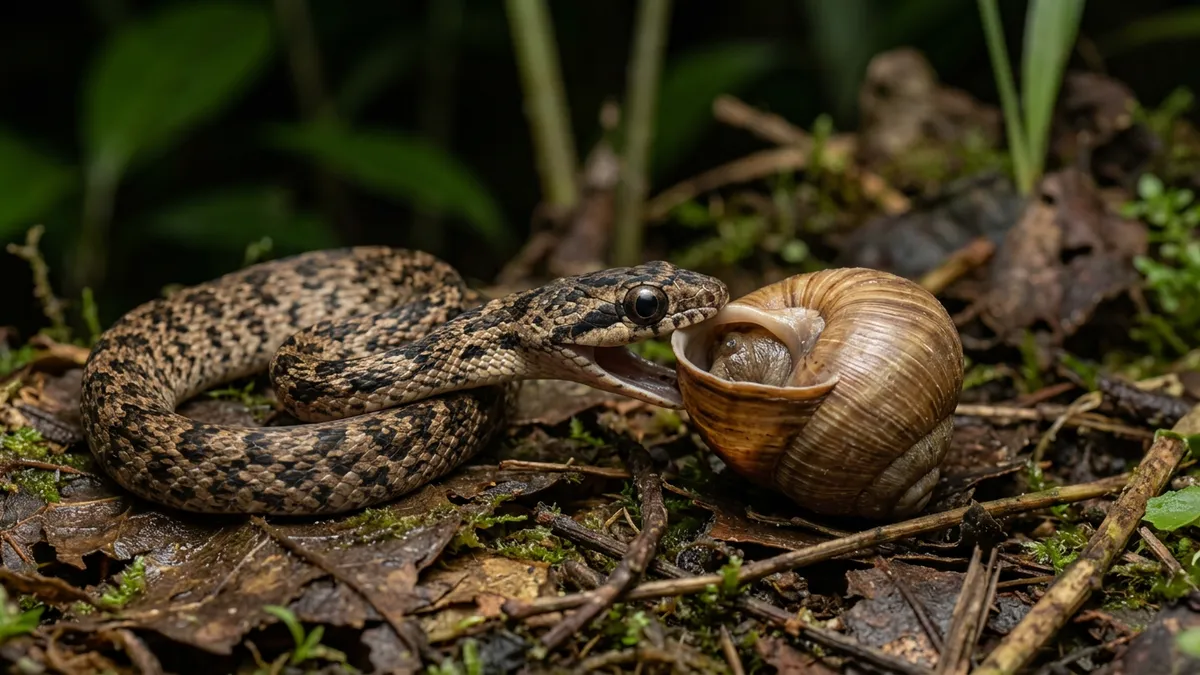
At night, the dormideira, a snail-eating snake of the genus Dipsas, may come across a snail sealed inside a hard shell. Instead of trying to crush the structure or giving up on the prey, the snake uses a long, narrow, asymmetric jaw. That shape lets the tip of the mouth reach the opening of the shell, the very space the mollusk retreats through to protect itself.
The movement is discreet and slow, in keeping with the species’ nocturnal habits. The scene sums up a precise feeding adaptation: the snake’s body does not have to beat the shell by force, because its jaw reaches the animal through a passage that already exists.
A jaw that fits where the head cannot
The asymmetry also helps explain why the dormideira’s head does not work like an ordinary pair of pincers. The parts of the jaw can act in a coordinated way, accommodating the irregular opening of the shell and staying in contact with the snail while it is drawn out.
The mechanism does not depend on a wide bite or on teeth able to puncture the shell. It depends on reach, fit and control of movement. A small, specific structure turns a hard protection into a barrier that can be worked around, and the snail comes out without the shell being broken.
The snail is nearly the whole menu
The diet of the dormideira is almost entirely made up of mollusks, which sets its way of life apart from that of many snakes that take varied prey. For a generalist predator, the head has to cope with food of different shapes and sizes. For the dormideira, feeding favors a more specialized solution.
The narrow jaw answers directly to the kind of prey found in its surroundings, above all when the snail is withdrawn and protected. The snake does not have to turn the shell into food or push through it. Its target is the animal inside.
This specialization helps explain the pairing of slow movements and night-time activity. A snail does not demand a fast chase like prey that bolts away. The dormideira can approach, set its head and work the opening of the shell with controlled moves. The behavior lowers the need for sudden strikes and suits a style of hunting based on close contact.
It also shows that speed is not the only strategy available to snakes. When anatomy is matched to the food, capture can rely more on precision than on force or quickness.
Taking out the snail without turning the shell to fragments
The central point of the feeding is the removal of the mollusk, not the destruction of its protection. The shell works as a rigid capsule built by the snail itself, but it has an opening through which the dormideira’s jaw can enter. Once it reaches the inside, the snake can pull the prey out.
This procedure avoids breaking the shell into pieces and reduces the need to apply force across the whole structure. The mouth works in a limited area, following the shape available at the opening.
It would be wrong to describe the behavior as if the snake simply swallowed the shell whole. The asymmetry of the jaw helps the mouth adapt to the space and keep contact during removal. As in other snakes, feeding involves a mouth able to accommodate prey, but what stands out in the dormideira is the specialized path to the food. The advantage lies in reaching the mollusk where it hides.
A comparison based on function, not on the size of the prey
Snakes that catch active animals have to locate, follow and subdue prey that can escape. The dormideira faces a different problem. Its food is still or sheltered inside a shell, and the main difficulty is getting to the inside.
For that reason, the most useful comparison is not to say that it is stronger or faster than other species, but to look at what the jaw does. A long, narrow structure serves one specific task, just as other snakes have head and tooth shapes suited to different kinds of food.
The contrast also corrects a common reading of the dormideira. Its slow movements do not mean a lack of efficiency. They match a type of hunting in which a careful approach and handling the opening of the shell matter more than a chase. A snake that is harmless to people does not need a quick attack to get its prey, because its anatomy solves a concrete feeding problem.
The jaw is best seen not as a weapon for breaking shells but as a tool of reach, able to enter the narrow space and pull the snail out.
A discreet predator in its environment
By feeding almost entirely on mollusks, the dormideira takes part in a specific relationship in its environment. It looks for snails, finds the opening of the shell and removes the animal without destroying the shell. Each step depends on a combination of behavior and anatomy.
Its nocturnal habit places the hunt in a period of low light, while the slow movements reduce any look of pursuit. For someone who watches only speed, the snake may seem poorly prepared to catch food. Once the jaw is examined, the mechanism becomes clearer.
A nocturnal, slow and harmless snake uses a long, narrow, asymmetric jaw to reach snails inside their shells and take them out without breaking them. The adaptation is a reminder that in nature, efficiency often shows up in movements that are almost imperceptible.
Reporting: Natália Santos / Amazonia Mag

Editor · Amazonia Mag
Anne Silva is the editor of Amazonia Mag, the English-language edition of Revista Amazônia. She curates, translates and adapts the outlet's science and environment coverage for an international audience, reporting on Amazon wildlife, flora, rivers, climate and research. Every story she edits is grounded in peer-reviewed studies, official data and on-the-ground reporting from the Revista Amazônia newsroom in Belém, Pará, Brazil. More by Anne Silva →