
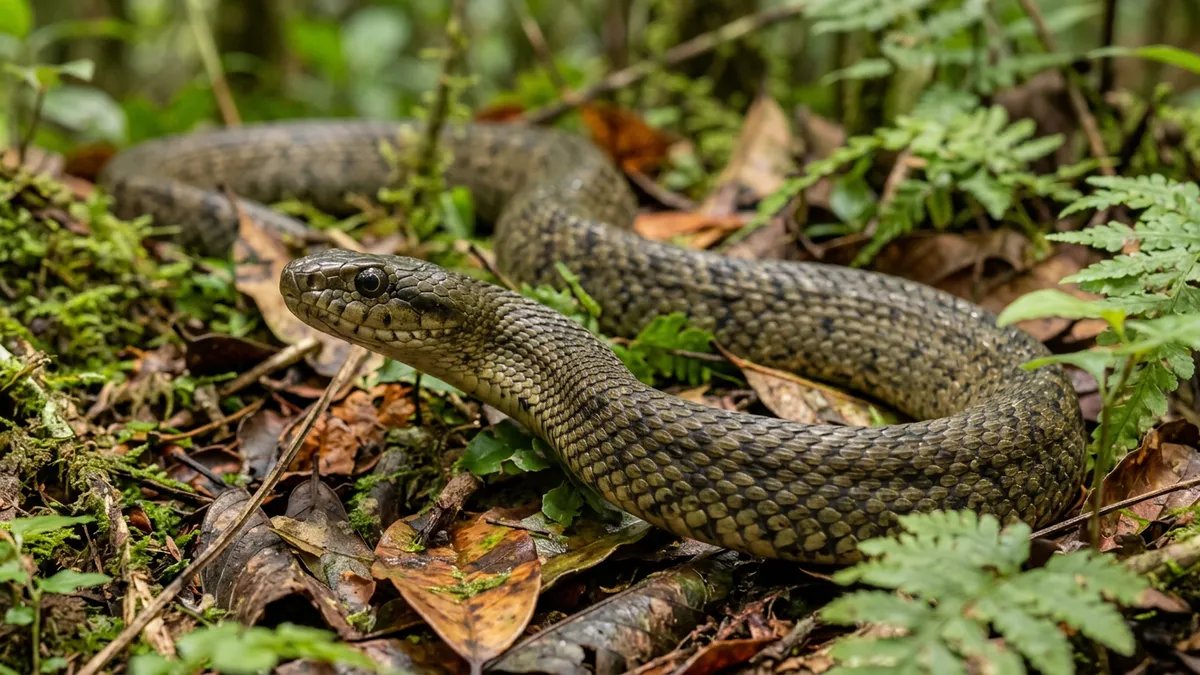
When it feels threatened, the boipeva does not need to lunge to look dangerous. It flattens its neck and also compresses its body, widening its own silhouette in front of whoever approaches. The result is a visibly broader snake with an outline that can recall a viper’s.
The posture depends on neither speed nor direct confrontation. It is a defensive response built on appearance, able to make a predator hesitate before it keeps coming. That matters especially for an animal that does not rely on venom as a defensive weapon. Instead of trying to overpower the opponent, the boipeva changes how it is perceived.
The body changes before any attack
The flattened neck draws attention to the front of the body, while the open mouth reinforces the reading of a threat. Together they turn a snake with no weapon to lean on into a presence that calls for caution.
The boipeva uses the display to defend itself, not to catch prey. Its wider body and gaping mouth form a visual warning that can stop a predator mid-move. The snake does not need to produce a toxic substance to create that effect. It is enough to reproduce signals associated with a species that does pose a risk.
Flattening also changes how distance and size are judged, making the presentation more intense than it would be with the body at rest.
This response should be understood as a sequence of behaviors, not as a permanent feature of the anatomy. Away from a threat, the boipeva does not stay flattened or keep its mouth open. The transformation appears at the moment when defense becomes necessary.
The open mouth completes the act
After widening its silhouette, the boipeva may open its mouth and hold still. The open mouth adds a second signal to the body posture. To an observer, the snake looks ready to bite, although the main message is to keep the confrontation from going further.
Stillness is part of the strategy too. Instead of fleeing at once or attacking, the animal holds an appearance that combines risk with unpredictability.
This behavior is called thanatosis when it involves feigning death. In the boipeva, the open mouth is part of that response and helps make the scene look less like a vulnerable snake. The defense combines stillness, a change in body shape and a display of the mouth. Each element reinforces the others and creates an image that can drive a predator away without the snake spending energy on a fight.
Thanatosis does not mean the boipeva is really dead or disabled. It is a behavioral response to a threat, kept up while the animal sizes up the situation. The snake may look abandoned, but the posture has a defensive purpose.
An open mouth should not automatically be read as proof of aggression, either. In many animals, showing the mouth is a way of warning, not an immediate attempt to attack.
A pattern that recalls a venomous snake
The boipeva’s defense is classified as Batesian mimicry. In this kind of relationship, a species that lacks a dangerous defense imitates another that has it, so that predators may confuse the two. The boipeva reproduces signals associated with a venomous viper, such as the jararaca.
The benefit does not lie in having venom but in looking like an animal the predator should avoid. The imitation depends on the perception of the possible attacker, not on a perfect likeness in every detail. The flattened neck, the larger silhouette, the open mouth and the stillness work together to bring the harmless-looking snake’s presentation closer to that of a dangerous species.
The bluff explains why the posture can work even without specialized fangs for injecting venom. The deception happens in the first moment of assessment, when the predator has to decide between advancing, waiting or backing off.
There is, however, an important limit to the resemblance. The boipeva does not become a jararaca and does not gain the same defense mechanism. The mimicry is behavioral and visual, not a change of species.
None of this makes it advisable to handle the animal, bring a face close to it or test its reaction. A cornered snake may keep showing its mouth and flattened body, and identification from a photograph alone can fail. Imitating a venomous snake does not mean having venom, but it does not turn the animal into a safe object to touch, either. Distance remains the best course with any snake met in the wild.
A frog hunter that also relies on bluff
The same boipeva that borrows a pit viper’s look to defend itself has a diet tied to frogs and toads. That helps place the behavior in the context of the animal’s life. The snake is not just an imitator when threatened. It is also a predator that has to locate, capture and swallow food.
The frog counts as a food resource, while flattening and thanatosis appear in the opposite situation, when the boipeva itself is at risk. The difference between these moments shows that one body can serve distinct functions. In one circumstance, the snake closes in on prey. In another, it changes its shape and stops moving to avoid being attacked. Catching frogs and defending against predators are different processes. One is tied to feeding, the other to survival in the face of a threat.
The case is a reminder that animal defense does not always depend on strength, venom or speed. Sometimes surviving means making the other animal hesitate before a carefully built image.
Reporting: Natália Santos / Amazonia Mag

Editor · Amazonia Mag
Anne Silva is the editor of Amazonia Mag, the English-language edition of Revista Amazônia. She curates, translates and adapts the outlet's science and environment coverage for an international audience, reporting on Amazon wildlife, flora, rivers, climate and research. Every story she edits is grounded in peer-reviewed studies, official data and on-the-ground reporting from the Revista Amazônia newsroom in Belém, Pará, Brazil. More by Anne Silva →