
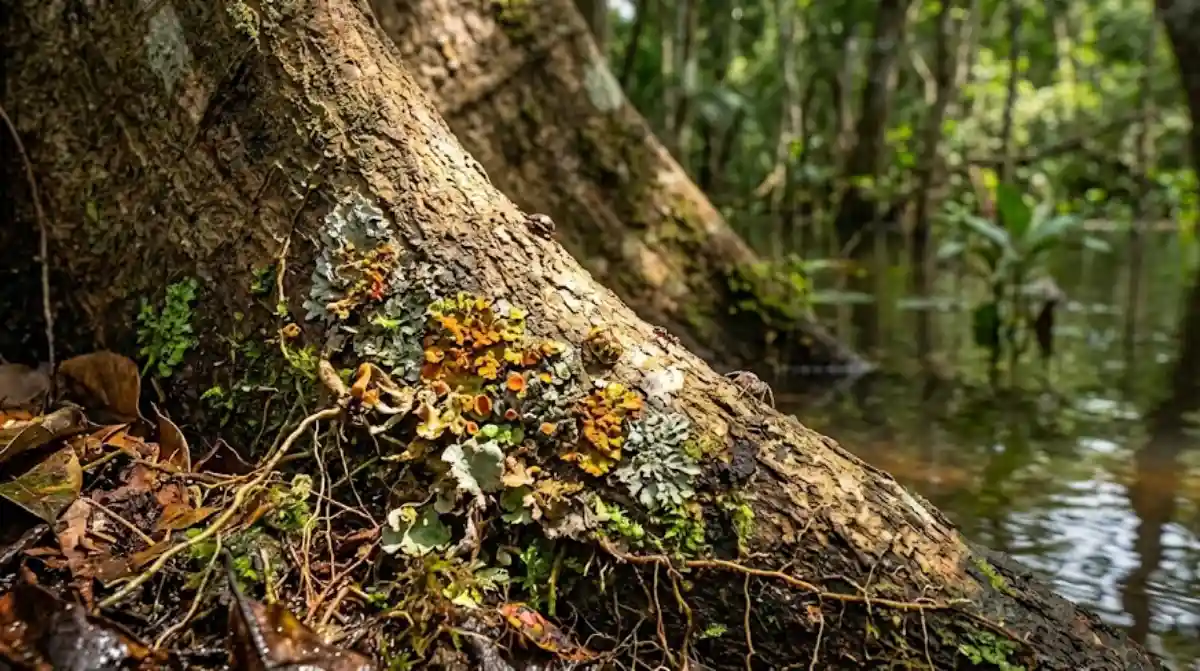
The samauma (Ceiba pentandra) is affectionately known as the Queen of the Forest or the Tree of Life. It can reach up to 230 feet (70 metres) in height, making it one of the most imposing trees in the Amazon. Yet its importance is not limited to what rises above the canopy. Around the base of this giant, a complex environment takes shape, bringing together animals, fungi, bacteria and invertebrates within a relatively small area.
The samauma’s most striking feature is its buttress roots, enormous, plank-like structures that spread horizontally before entering the soil. They help brace the tree against Amazonian winds while also creating protected cavities, crevices and sheltered spaces. According to scientific understanding, the base of a single mature samauma can support, directly or indirectly, a greater diversity of animal species than entire hectares of many other forests.
A natural architecture of shelter
Buttress roots are not merely extensions of a tree’s root system. They are works of natural bioengineering, forming wooden walls, recesses and narrow openings that provide protection from predators and harsh conditions. For animals living on the forest floor, the base of a samauma is a refuge with many levels and possibilities.
Small mammals, including sloths, armadillos and several kinds of rodents, use these cavities as dens. Amphibians and reptiles, including snakes and lizards, find a humid shelter and abundant food there. Because the buttresses make use of both vertical and horizontal space, species with different needs can live alongside one another in a restricted area.
This concentration of structures and spaces is a classic example of the high density of ecological niches in the Amazon. Each crack, wall or shaded section can offer different conditions for protection, resting or feeding. A structure that supports a tree of extraordinary dimensions also organizes a community of organisms around its base.
The roots’ role extends beyond the larger animals that use them. The base of a samauma collects a massive amount of leaf litter, made up of fallen leaves and dry branches. In the shade and moisture of this material, a microecosystem develops around decomposers.
The forest’s quiet nutrient engine
Fungi, bacteria and countless invertebrates occupy the leaf litter and the spaces around the tree. They include ants, termites, beetles and spiders. Working quietly on organic matter, this living community recycles nutrients that are vital to the forest as a whole.
The samauma itself depends on this process. As leaves and branches break down, their nutrients become available again in the environment. The buttress root is therefore more than a shelter for wildlife. It is also a central hub in the nutrient cycle that continually renews the richness of Amazonian soil.
That cycle supports the primary productivity of the largest tropical forest on the planet. The tree’s base connects falling organic matter, the organisms that decompose it and the nutrients that return to the system. In this sense, the samauma functions as an autonomous and vital ecosystem within the balance of the river basin.
The diversity gathered around one mature tree shows why conservation cannot focus only on the canopy. Buttress roots, leaf litter and the small organisms living in the shade are also part of the structure that keeps the forest functioning.
A sacred presence in Amazonian life
For many Indigenous peoples and river communities in the Amazon, the samauma is far more than a giant tree. Its size, longevity and presence in the landscape inspire respect and reverence. Cultures such as the Tukano and Ticuna believe that the samauma is home to protective spirits of the forest and rivers.
Many legends describe its buttress roots as passages to other worlds. They also tell that the sound resembling drums, heard when the plank-like roots are struck, is the voice of the forest itself. These stories show that the relationship with the species is not limited to the usefulness of its wood or its imposing dimensions. It belongs to a broader understanding of the territory.
This spiritual connection also has practical consequences. Religious respect discourages cutting and aggressive commercial exploitation in places of cultural significance. In this way, the worldview of Amazonian peoples helps protect both the species and the environment that develops around it.
Traditional communities also use the samauma in several sustainable ways. The silky cotton surrounding its seeds, known as kapok, is collected to make pillows and mattresses. The fibre is a natural, hypoallergenic thermal insulator, and it is also remarkably light and buoyant.
The bark and roots have medicinal properties known and used for generations. This relationship of conscious use and mutual respect represents a model of sustainable coexistence, in which the forest is valued as cultural and biological heritage rather than only as a resource.
The giant that links forest and climate
The samauma’s importance extends far beyond its immediate surroundings. As one of the forest’s largest trees, it plays a disproportionately important role in regional and global climate regulation. A single mature samauma can pump hundreds of litres of water per day from the soil into the atmosphere through transpiration, equal to dozens of imperial gallons.
This movement of water contributes to the so-called flying rivers that carry moisture to other parts of the continent. At the same time, the tree’s immense trunk and tabular root system store tons of carbon, acting as an important sink in the fight against climate change.
Protecting the samauma means protecting one piece of the planet’s thermostat. Deforestation and changes in the Amazon’s rainfall regime pose growing threats to these giants. Prolonged drought and forest fires can weaken the tree and undermine its ability to support the ecosystem at its base.
For that reason, conserving the samauma is a priority not only for biodiversity but also for global climate security. Protecting this iconic species requires coordinated monitoring and sustainable management, helping ensure that future generations in Brazil and around the world can continue to witness its majesty.
Kapok also shows how conservation can connect with a forest-standing bioeconomy. Historically, the fibre was used in life jackets and aircraft insulation. Today, it can serve as a sustainable alternative for filling textile products, giving value to traditional knowledge and materials that do not require the forest to be cleared.
The samauma is, in the end, more than a wooden giant. Its buttress roots support a community of animals and decomposers, its base participates in nutrient cycling, its uses express a deep cultural relationship, and its body helps store carbon and move water. Protecting the tree and the ecosystem at its base means accepting responsibility for the Amazon, for the present and for the planet’s future.
Reporting: Anne Silva / Amazonia Mag

Editor, English Edition — Amazonia Mag
Anne Silva is the editor of Amazonia Mag, the English-language edition of Revista Amazônia. She curates, translates and adapts the outlet's science and environment coverage for an international audience, reporting on Amazon wildlife, flora, rivers, climate and research. Every story she edits is grounded in peer-reviewed studies, official data and on-the-ground reporting from the Revista Amazônia newsroom in Belém, Pará, Brazil. More by Anne Silva →