
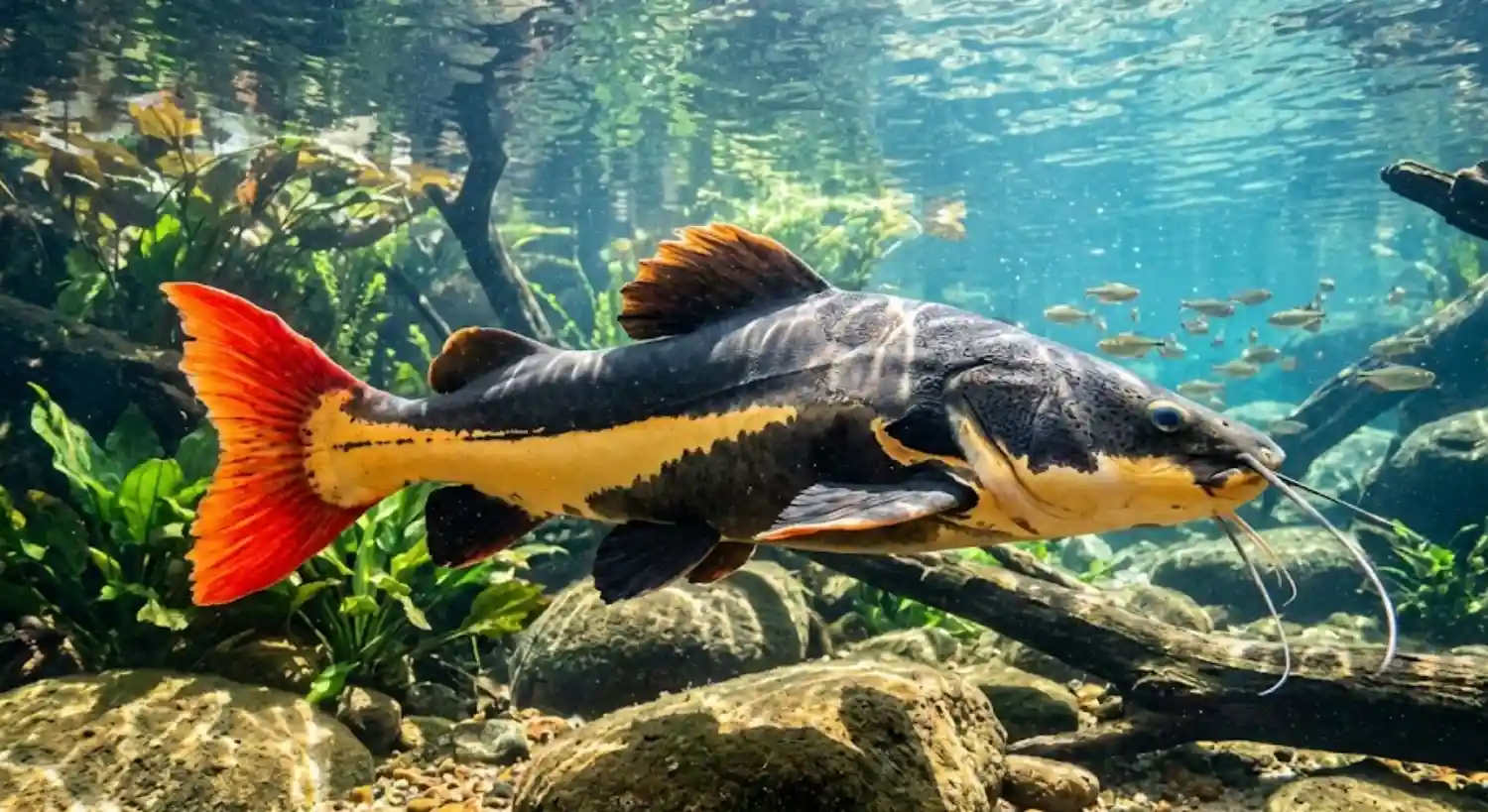
Of all the big catfish in the world, none dresses quite like this one. The back is deep grey, close to black. The flanks and belly fade into a pale yellow. And at the end of the body sits the signature that gives the animal away: a tail fin of blazing red, bright enough that the Brazilian name for the fish, pirarara, was borrowed from the macaws, the loudest colours in the forest. The redtail catfish, Phractocephalus hemioliopterus, of the family Pimelodidae, is not only the flashiest fish in the big Amazonian channels. It is one of the heaviest, too, capable of passing 50 kilos and stretching beyond 1.30 metres.
The colour is not decoration
It is easy to file the redtail catfish away as a pretty curiosity, and that is exactly where the animal gets interesting. Its colour scheme is part of an adaptive biology worked out across two very different settings: the muddy rivers loaded with Andean sediment, and the clear-water rivers that run over ancient soils. A fish that moves between those worlds, from the turbid bottom to the lit margin, does not carry a dark back and a light belly by accident. That pattern is the working uniform of an animal that spends much of its life pressed against the riverbed.
The anatomy of an omnivorous giant
Everything about the redtail catfish is built for force. The head is broad and armoured with an exceptionally tough bony plate, a shield that lets the fish rummage through the river bottom without injury as it works through stones, sunken trunks and sediment. That structure is unusual even among leather fish, and it goes some way towards explaining how the species holds on in places where other large catfish do not.
The second difference is diet. Unlike other catfish, which are strictly carnivorous, this one behaves as an opportunistic omnivore. Research into the stomach contents of the species has turned up a surprisingly broad menu: fish, crabs, and also fruit and seeds dropping from the trees of the várzea floodplain forests during the high water. A giant catfish that eats fruit is already a different kind of animal from the rest of the river’s big predators.
That versatility has consequences that reach well past the fish itself. When the water rises and the forest floods, the redtail catfish moves in among the trees to take advantage of the plant abundance, and ends up acting as a seed disperser for a range of Amazonian species. Its maxillary and mental barbels, highly developed sensory organs, let it find food in zero visibility by picking up vibrations and chemical signatures in the water. It feeds blind, and it feeds well.
Territorial, nocturnal and loyal to one corner
The species is mostly nocturnal, and night is when it hunts. By day it shelters in deep water: the pools that form on river bends, sunken logs, tangles of submerged branches that break the current. It is a territorial animal. Studies indicate that adults tend to hold the same refuge areas for long stretches of time, leaving only to forage nearby.
Its range covers the Amazon, Orinoco and Araguaia-Tocantins basins. In large Brazilian rivers such as the Xingu and the Madeira it finds the depth and oxygenation it needs to reach maximum size. The integrity of those habitats is decisive, because large hydroelectric dams can fragment migration routes and alter the flood and drought regime that governs the fish’s reproductive and feeding cycle.
A fish that comes with rules at the riverside table
For riverside communities in the Amazon, the redtail catfish arrives wrapped in tradition and caution. The flesh is firm and well flavoured, but in some regions a food taboo classifies it as reimoso, a term in popular culture for foods thought to aggravate inflammation or skin conditions because of their high fat content. In those communities people recovering from illness avoid it, while elsewhere it is a valued protein, common in fish stews and roasts.
Beyond the plate, the fish holds its own place in the Amazonian imagination as a symbol of the power of the water. Watching it in the wild has helped drive ecotourism and nature photography, generating income for local guides who once depended entirely on extractive fishing. That shift towards valuing the living animal is one of the pillars of economic sustainability for traditional communities across the basin.
Sport fishing and catch and release
The redtail catfish is one of the most sought-after trophies in world sport fishing. Its stamina during the fight is legendary: once hooked, it heads straight for submerged branches and rocky bottoms to snap the line, which demands heavy tackle and refined technique. Catch and release has become central to preserving the larger specimens, and monitoring studies show that when the fish is handled correctly and returned quickly to the water, survival rates are very high.
Managed sport-fishing reserves have proved an efficient conservation tool. By controlling fishing pressure and banning commercial capture, they let the species reach advanced ages and record sizes while keeping its role as an apex predator in the food web. Protecting these giants amounts, in practice, to protecting the whole river: they help regulate populations of other species and contribute to the genetic health of the aquatic ecosystem.
Mercury, fine nets and cleared forest
For all its toughness, the species faces mounting pressure. Mercury contamination from illegal gold mining is among the gravest problems, because as a top predator the redtail catfish accumulates heavy metals through bioaccumulation, which compromises its health and can render its flesh unfit for human consumption in the worst affected areas. Predatory fishing with fine-mesh nets and the degradation of riparian forest add to the picture, sharply reducing the natural food supply.
Protection therefore requires a systemic approach that combines the fight against water pollution with the preservation of floodable forest. Without the várzea trees, the macaw fish loses its main source of nutrients for half the year. The sustainability of Brazil’s great rivers depends on keeping those connections between land and water intact so that biological cycles thousands of years old are not simply cut off.
What science is starting to track
Brazilian research has made progress on the migration and reproduction of the species. Electronic tags and telemetry have shown that these fish make significant movements between different tributaries in order to spawn. Understanding those routes is essential to creating aquatic environmental protection areas that work as a connected network rather than as isolated islands of preservation.
Biotechnology is also exploring the species’ potential for sustainable aquaculture. Growth in captivity is slow compared with fish such as tambaqui, but the animal’s high market value and hardiness open the way to controlled production that could ease pressure on wild stocks. Even so, the main focus has to stay on conserving natural populations, which are the real genetic bank of the Amazon.
The red flash as an indicator
Preserving the redtail catfish means keeping the chromatic exuberance of Amazonian rivers alive. Every 50 kilo specimen holding a deep pool on the Rio Negro or the Solimões is evidence of how productive these systems can be, and works as a biological indicator of the integrity of the fresh water around it. Defending this fish is defending sustainable fishing and the food security of the people who live from the river. Let the red tail keep crossing the dark water of the forest.
Reporting: Anne Silva / Amazonia Mag. Source: INPA (Instituto Nacional de Pesquisas da Amazônia) and ICMBio.

Editor · Amazonia Mag
Anne Silva is the editor of Amazonia Mag, the English-language edition of Revista Amazônia. She curates, translates and adapts the outlet's science and environment coverage for an international audience, reporting on Amazon wildlife, flora, rivers, climate and research. Every story she edits is grounded in peer-reviewed studies, official data and on-the-ground reporting from the Revista Amazônia newsroom in Belém, Pará, Brazil. More by Anne Silva →