
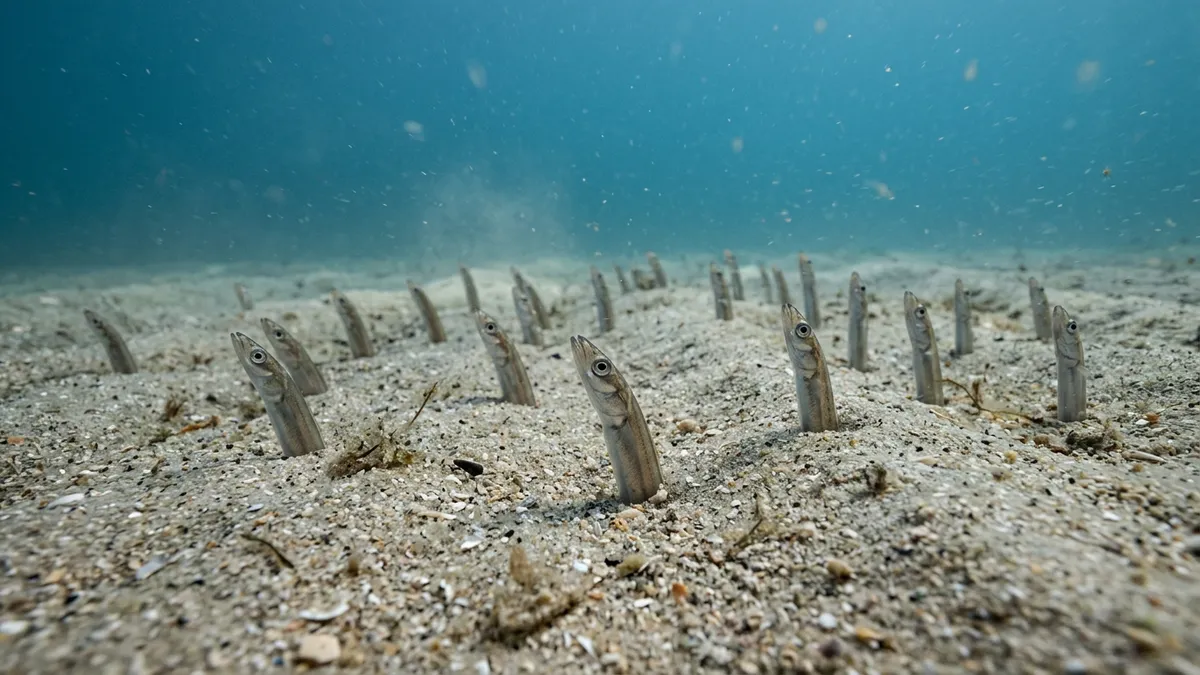
A body that disappears beneath the sand
On a sandy seabed, the garden eel, known in Brazil as the enguia-de-areia, spends its time almost entirely hidden. The body stays in the sediment, and only the head remains outside, turned toward the flow of water. This posture limits how much of the animal is exposed and leaves visible only the part it needs to follow the particles drifting past. There is no continuous swimming and no chase after food. The fish takes one spot on the sand bank and waits.
That position turns the current into a kind of delivery route. Suspended particles travel through the area where the head is exposed, and the eel stays fixed, ready to use whatever arrives. The habit is described as fossorial, which means it is tied to living inside the substrate. The sand is not just a cover. It is the space where the body stays out of view while the head keeps track of the environment above the bottom. The scene looks motionless, yet it depends on constant attention to the flow and to visual signals.
Waiting for what the current brings
The garden eel does not need to leave its hiding place to wait for food. Its strategy consists of keeping the body buried and placing the head in the path of the current. The wait therefore happens in a fixed posture, without any need to travel across the sand bank. The animal lets the flow carry suspended material to its position.
The behavior combines stillness and readiness. While the current passes, the eel stays in the same area with only its head showing. A lack of broad movement does not mean a lack of response. At the slightest sign of a shadow, it pulls back instantly into the sand. The contrast is direct: to wait, it keeps the head out, and when something changes in the light above, it gives up its exposure and disappears into the sediment. The fixed posture is paired with a fast reaction to whatever moves overhead.
One shadow changes the whole posture
The retreat is the fastest moment of the behavior. A garden eel can remain buried while leaving the head outside to monitor the passing particles and the immediate surroundings. When a shadow appears, the animal does not back away slowly or try to cross the bank. It withdraws into the sandy bottom.
Even without revealing what causes the signal, the response shows how much a minimal exposure matters. The head is available during the wait, but the rest of the body is already protected by the sediment. When the visual conditions change, the distance between the exposed head and the shelter is short, and the retreat is instantaneous. The same sand bank holds many individuals in a dense colony, which makes the seabed a space shared by many eels. Even so, each animal keeps its own waiting position and its own reaction to the shadow.
A dense colony on one sand bank
A dense colony changes the usual image of a hidden fish. This is not a single body buried at an isolated spot. Many garden eels occupy the same sand bank, each keeping the burrowing habit and leaving only the head exposed. From the outside, the colony can look discreet, because most of the animals stay under the surface. What a viewer sees is a series of heads placed in the area where the current passes.
The combination of density and stillness creates a scene in which the environment conceals almost all of the activity. Each eel waits for suspended particles, follows the flow and withdraws when a shadow crosses the water. What looks like an empty patch of seabed is in fact a crowded one, and the crowd is only revealed by the small part of each animal that sticks out of the sand.
What the strategy reveals
The behavior brings together three concrete actions. First, the eel buries its body in the sandy bottom. Then it leaves the head exposed and stays fixed while it waits for particles brought by the current. Finally, it pulls back instantly when a shadow appears. This sequence allows the animal to spend long periods hidden without losing contact with the water that carries the suspended material. The efficiency of the posture lies in its economy of movement.
The dense colony adds a collective dimension to the picture. The eels share the same bank, but the waiting, the exposure of the head and the retreat are all behaviors of each individual animal. The final image is not of a fish struggling against the current. It is of many nearly invisible bodies using the sediment as shelter while they monitor the flow. The most striking detail is the instant change between open waiting and disappearing beneath the sand.
Why a quiet seabed is never empty
There is an environmental lesson at this small scale. A sand bank that looks empty can shelter many animals, each almost completely hidden and connected to the movement of the water. The garden eel does not need to dominate a space in order to occupy it. It waits, detects a change and returns to its shelter. Watching this behavior is a reminder that the absence of visible movement does not mean the absence of life.
Beneath the surface of the sediment, the current keeps carrying food, and the colony stays alert to whatever passes. For divers and researchers, the lesson is practical: a seabed that seems barren at first glance may hold a whole community, and it will reveal itself only to a patient observer who stays still, keeps a respectful distance and avoids casting a sudden shadow. For readers far from the ocean, the same lesson applies: some of the most organized habits in nature are the ones that leave almost no trace for the eye to follow.
Nothing in this behavior depends on speed across long distances or on strength against the flow. It depends on position, on timing and on the shelter that the sand provides. The garden eel waits with its head in the current, reads the light above it and retreats the moment that light changes. That simple routine, repeated by every member of a dense colony on one sand bank, is enough to turn a bare patch of seabed into an inhabited one.
Reporting: Natália Santos / Amazonia Mag

Editor · Amazonia Mag
Anne Silva is the editor of Amazonia Mag, the English-language edition of Revista Amazônia. She curates, translates and adapts the outlet's science and environment coverage for an international audience, reporting on Amazon wildlife, flora, rivers, climate and research. Every story she edits is grounded in peer-reviewed studies, official data and on-the-ground reporting from the Revista Amazônia newsroom in Belém, Pará, Brazil. More by Anne Silva →