
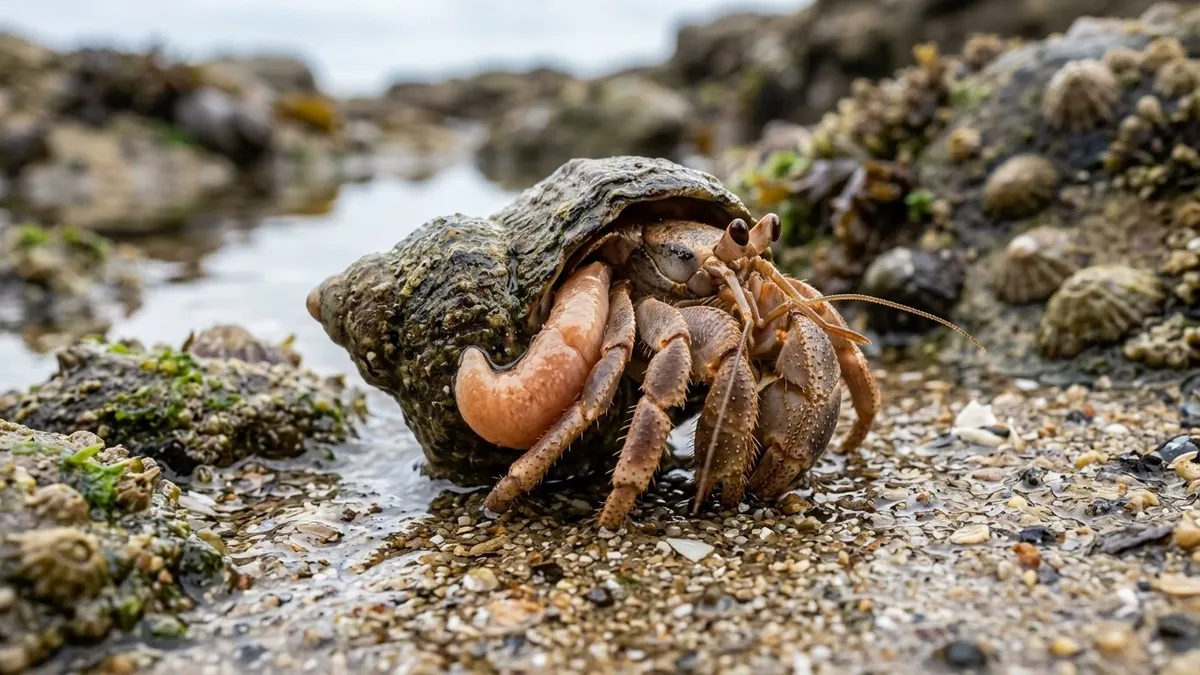
A partnership on a shell
Among the wet rocks left by the tide, a hermit crab can walk along carrying more than its own protection on its back. Some species keep sea anemones on the surface of the shell they occupy, forming a visible association between animals from very different groups. The anemone stays attached to the mobile shelter, while the crab goes about its routine across the shallow bottom, between tide pools, sand and fragments of rock. The meeting is not a casual overlap. The relationship is known as mutualism because both partners can gain advantages from living together.
Sea anemones have tentacles armed with stinging cells, which make it hard for many predators to come close. By carrying them, the hermit crab moves around with an extra layer of defense around its shell. The anemone, in turn, no longer remains fixed in a single place and follows the crustacean to new feeding sites. The movement can also bring it into contact with food scraps and particles suspended in the water. So the animal that provides mobility receives shelter and protection, while the transported organism gains access to a wider environment.
Defense that moves along the shore
The advantage of the partnership shows in the way these animals use the coast. A hermit crab does not stay buried or fixed in one spot throughout its activity. It crosses uneven surfaces, explores crevices and moves across exposed areas when the water recedes. For an anemone, being attached to this movement means reaching a larger area without having to contract its body, detach itself and find another suitable surface on its own.
For the crustacean, the presence of the tentacles creates a barrier that can keep away fish and other animals interested in attacking the outer parts of its body. The crab’s abdomen is protected inside the shell, but its exposed regions still have to deal with the risks of the environment. The anemone is not a perfect suit of armor, and it does not stop every attack. Its contribution is to add a chemical and physical defense to a set that already includes the shelter made of calcium carbonate. The result is a partnership built on different but complementary roles.
When the ride benefits both animals
The relationship also shows how the behavior of one species can change the space available to another. An anemone fixed on a shell that moves reaches areas where the circulation of water may bring food. The crab’s movement also helps renew the water around the tentacles. In this exchange, one partner offers transport and the other offers protection, and each keeps doing what it does best.
This kind of association does not mean the two organisms have become a single animal. The crab remains responsible for walking, searching for food and taking shelter, while the anemone keeps its own body structure and its tentacles. The partnership depends on contact and on staying in the same shelter, but each participant preserves its own anatomy and way of life. This mix of independence and cooperation is what makes the behavior useful for understanding ecological relationships on rocky shores.
A common relationship, but not a required one
Not every hermit crab carries anemones, and not every anemone found on the coast takes part in this association. Whether it happens depends on the species involved, on the conditions of the environment and on the chance of contact between the animals. Some hermit crabs live without this partner, and some anemones stay attached to rocks, empty shells or other surfaces. For that reason, the image of a crustacean always accompanied by tentacles does not represent the full diversity of the group.
It is also worth avoiding the idea that every case of living together produces the same benefit or happens with the same intensity. The protection offered varies with the size, the position and the number of anemones, and the gain in mobility depends on the crab’s ability to carry them. On the Brazilian coast, where rocky shores, beaches and natural pools form varied environments, this partnership is part of the set of interactions that can be observed in shallow water. It happens continuously in the environment and is not tied to a single episode or to a specific date.
Why shallow-water alliances matter
Seen up close, the pair raises a useful question about how animals share space. A shell is first of all a shelter, an empty house that a crab has taken over. When an anemone settles on it, the shell becomes something more: a small platform that serves two lives at once. The crab brings movement, and the anemone brings a barrier of stinging cells. Neither animal gives up its own body or its own way of living, yet the combination changes what each of them can do along the shore.
This is also why the association is a good example for anyone learning how coastal ecosystems work. Rocky shores, beaches and tide pools are not made only of predators and prey. They are also made of arrangements in which one species makes use of the abilities of another. Because the benefits vary from case to case, the partnership cannot be reduced to a simple rule. It is better understood as a flexible arrangement that depends on the animals present, the size of the shell and the number of anemones it carries.
Allies that travel together
By walking with an anemone on its shell, the hermit crab shows that life on the coast is also made of mobile alliances. One animal offers movement, and the other adds defense and access to new currents of water. The scene looks simple, but it brings together an ecological arrangement built through coexistence between different species. Instead of merely occupying a shell, the crustacean turns its shelter into a shared platform, a reminder that, along the margin between land and sea, survival often depends on who travels with you.
Reporting: Natália Santos / Amazonia Mag

Editor · Amazonia Mag
Anne Silva is the editor of Amazonia Mag, the English-language edition of Revista Amazônia. She curates, translates and adapts the outlet's science and environment coverage for an international audience, reporting on Amazon wildlife, flora, rivers, climate and research. Every story she edits is grounded in peer-reviewed studies, official data and on-the-ground reporting from the Revista Amazônia newsroom in Belém, Pará, Brazil. More by Anne Silva →