
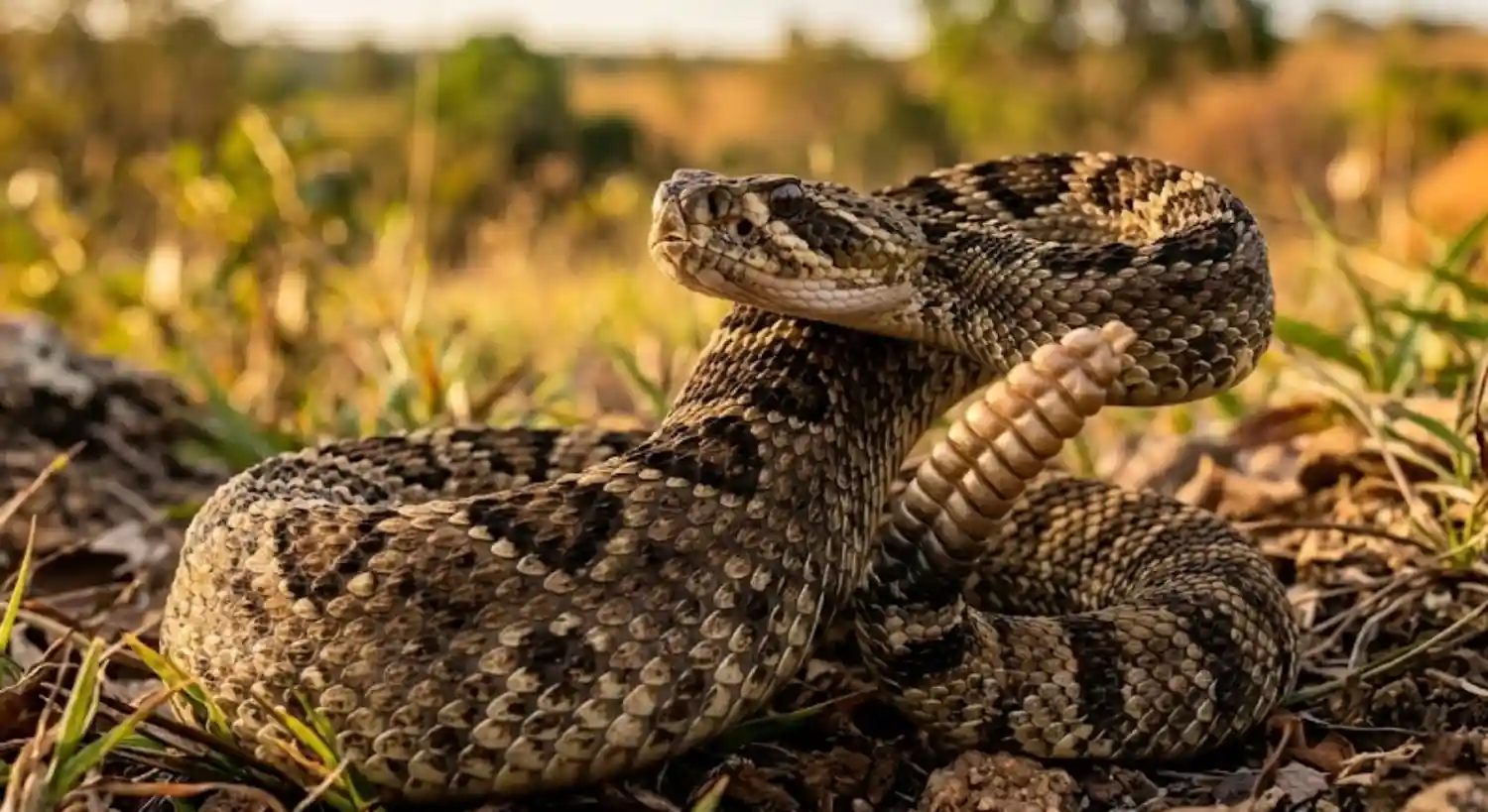
Among all the venomous snakes that live in Brazil, only one announces itself out loud. The rattlesnake, of the genus Crotalus, carries a sound system shared by no other venomous species in the country. While the others rely entirely on camouflage and the element of surprise, this reptile does the opposite: when it feels threatened, it produces a clear, dry, continuous acoustic signal, a warning that comes before any attempt to bite. The sound comes from the rattle at the tip of the tail, a keratin structure that vibrates at a frequency so high that it outpaces the human eye.
A warning that saves venom
The mechanism works as an advance notice built on the economy of energy and venom. Rattlesnake venom is biologically expensive to produce and serves one primary purpose: hunting small mammals. Spending that resource on large animals, which are not food, is a high biological cost with no return. Evolution therefore favored the ability to issue an efficient acoustic alarm, one capable of pushing away potential predators, or anyone about to step on the snake, before the moment of the strike ever arrives.
That detail changes the reading of the encounter completely. The rattle is not the promise of an imminent bite: it is a request for distance. The snake would rather spend muscle contractions than spend venom, and that calculation, repeated across generations, ended up written into its anatomy.
Keratin engineering
Contrary to what common sense suggests, the rattle holds no loose grains or beads inside. The structure is made of hollow keratin rings, the same protein found in human nails and hair. Those segments fit loosely into one another rather than locking into place. When the snake contracts the muscles at the end of its tail, the keratin rings collide hundreds of times per second, producing the dry, continuous sound that carries through the vegetation.
Every skin shed adds a new segment to the rattle. Even so, the number of rings does not reliably indicate the animal’s age, because the tips wear down or break off through constant friction against soil and rock. Young individuals have smaller rattles with a sharper pitch, while adults produce a fuller, deeper sound that can be heard from dozens of meters away in the wild.
High frequency muscle
The speed at which a rattlesnake shakes its tail demands a highly specialized set of muscles. The caudal muscles of this snake rank among the fastest contracting tissues in the entire animal kingdom. They can sustain a steady rate of contractions for long stretches without building up lactic acid or falling into immediate fatigue. That efficient blood supply lets the acoustic alarm keep running without interruption until the danger has fully moved away.
Biological research also shows that the frequency of the vibrations rises as the threat draws nearer. That shift in rhythm creates an acoustic illusion in the mammal brain: the predator, or the human observer, perceives the reptile as being closer than it actually is. The frequency adjustment works as an extra safety mechanism, forcing the intruder to back away quickly, often before the animal has even been spotted by sight.
Venom and biological efficiency
The venom of the species that lives in the Brazilian grasslands and savannas acts on the nervous system and on the blood circulation of its prey. The combination of neurotoxins and hemotoxins paralyzes the muscles and begins the digestive process even before the prey has been swallowed whole. The strike is precise, yet the snake prefers to conserve that vital substance whenever it can, falling back on the sound warning to avoid unnecessary confrontation with large creatures.
After a successful strike against rodents, the rattlesnake uses its loreal pits to track the victim down. Those openings, set between the eyes and the nostrils, work as high precision thermal receptors: they detect the infrared radiation given off by the body heat of warm blooded animals. As a result, even in total darkness, the snake locates the fallen prey a few steps away without spending energy on random searching.
Why sound defines its territory
The distribution of the rattlesnake in Brazil is concentrated in open areas such as the Cerrado, the Caatinga and pasture zones. The preference for these environments is tied to ease of movement and to how efficiently the sound of the rattle travels. In dense, humid forests such as the Amazon, closed vegetation muffles acoustic signals and the constant moisture works against the hardening of the keratin rings, leaving the rattle less effective as a tool of defensive communication.
The presence of these snakes in an ecosystem points to a habitat that is balanced in terms of rodent populations. They act as a natural control over animals that, when they overpopulate, damage vegetation and spread zoonoses. Understanding rattlesnake behavior allows rural communities and researchers to share the same space safely, respecting the limits that the animal’s own tail marks out.
Living alongside the warning
Respecting the signal the rattlesnake sends reflects a mature relationship with the country’s wildlife. Understanding that the rattle is not a threat of imminent attack but a request for distance changes the way society looks at venomous reptiles. Knowledge about the habits and the biological limits of these animals turns fear into practical attitudes of preservation and accident prevention.
There is also a broader lesson in that behavior. An animal that warns before it acts is spending its own energy to avoid a conflict it does not want, and the human response to that signal, stepping back rather than stepping forward, is what determines whether the encounter ends without injury on either side. Most accidents involving these snakes begin where the warning is ignored or never heard at all.
Preserving the natural habitats of venomous snakes ensures that natural selection can keep shaping refined survival strategies. The Brazilian rattlesnake shows how evolution can turn a simple structure of skin into one of the most efficient acoustic communication tools in nature, proving that survival in the wild often depends more on being heard than on attacking.
Reporting: Anne Silva / Amazonia Mag. Source: Revista Amazônia.

Editor · Amazonia Mag
Anne Silva is the editor of Amazonia Mag, the English-language edition of Revista Amazônia. She curates, translates and adapts the outlet's science and environment coverage for an international audience, reporting on Amazon wildlife, flora, rivers, climate and research. Every story she edits is grounded in peer-reviewed studies, official data and on-the-ground reporting from the Revista Amazônia newsroom in Belém, Pará, Brazil. More by Anne Silva →