
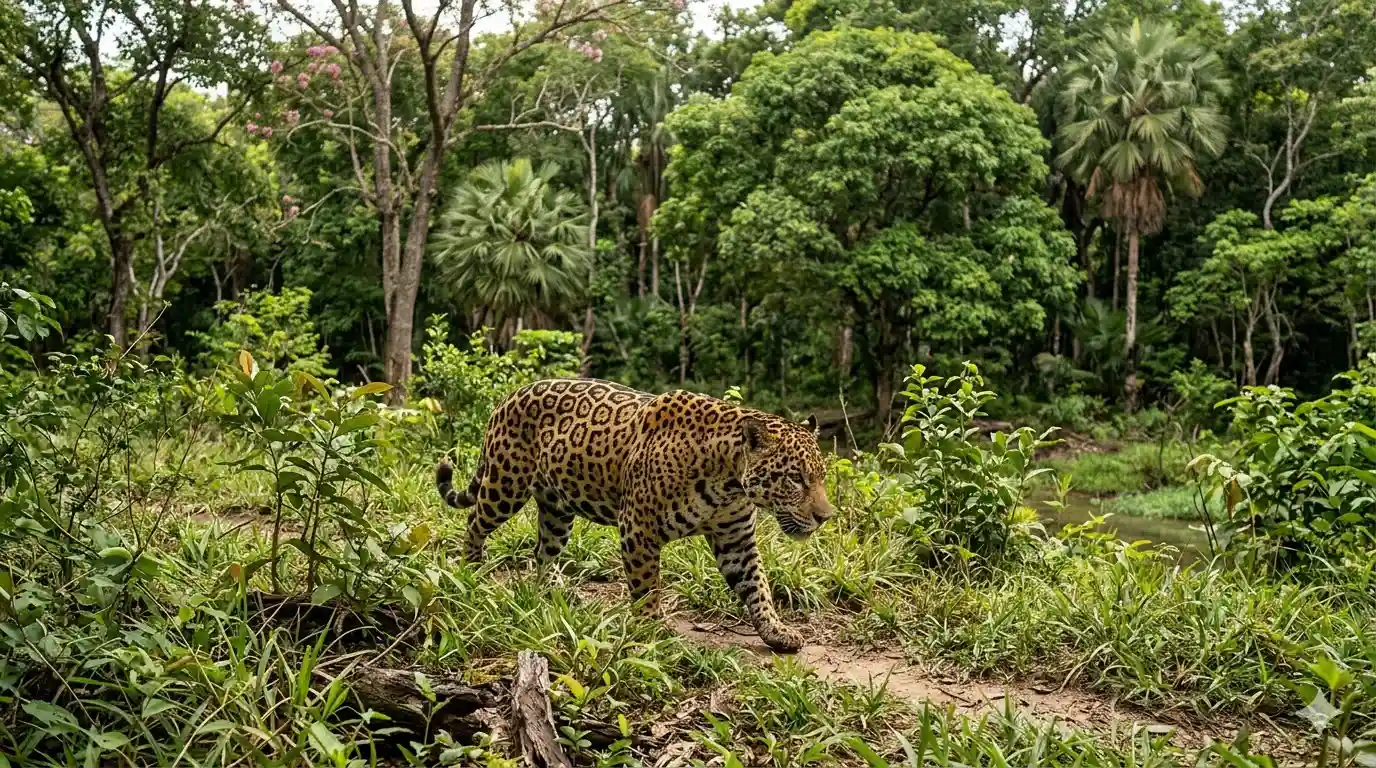
Brazil’s Pantanal has just recorded the return of animals that science already considered locally extinct, a phenomenon that shows how resilient nature can be when ecological corridors are preserved. According to recent camera-trap monitoring, sightings of rare species have risen 40% over the past five years in areas that went through rigorous conservation. The figure places Brazil in a prominent spot on the global map of ecosystem recovery and shows that a cycle of degradation can be reversed with technical management and partnerships between the public and private sectors.
The stars of the comeback
Among the standouts of this return are the maned wolf (Chrysocyon brachyurus) and the marsh deer (Blastocerus dichotomus), which are once again occupying land where the soil was previously dominated by degraded pasture. Ecological restoration allowed native vegetation to resume its role as shelter and food source, reconnecting forest fragments that had been isolated.
Alongside them, the hyacinth macaw (Anodorhynchus hyacinthinus), the great blue bird of the biome, is returning at healthy population densities along the edges of the wetland. Its presence is a key biological indicator: because it depends on specific palms and seeds, its recovery signals that the quality of the local water and seeds is clearly improving.
The engine: private reserves
The main driver of this transformation has been Brazil’s Private Natural Heritage Reserves, known as RPPNs. These are private properties whose owners decided that preservation is worth as much as production, creating refuges where hunting is nonexistent and deforestation has stopped.
On these islands of biodiversity, wildlife finds the security it needs to breed and expand its range. The result is a spillover effect onto neighboring ranches that strengthens the genetic network of local populations and widens the territory available to each species. Bit by bit, conservation stops being an island and becomes a continuous fabric.
The flood pulse and the hunt for mother trees
None of this works against the rhythm of the wetland. The Pantanal is the largest tropical floodplain on Earth, and its future depends on respecting the natural cycle of flooding and drying that fills and empties the land each year. That pulse decides where fish spawn, where herbivores graze and where seeds travel, so restoration projects are designed to work with the flood, not against it.
Part of the effort is a quiet race to find the biome’s “mother trees,” the oldest and most productive individuals whose seeds carry the genetic diversity needed to replant degraded areas. Protecting those trees and their springs reshaped the regional microclimate, boosting humidity and the growth of plants that form the base of the food chain.
When the jaguar returns, the whole pyramid is balanced
When a top predator like the jaguar (Panthera onca) is spotted frequently in new areas, biologists know the entire pyramid beneath it is balanced, from small rodents to the large herbivores that shape the landscape. The jaguar’s presence acts as a seal of health for the whole system.
A live animal is worth more than bare land
The recovery of the fauna also brings direct economic benefits through wildlife-watching ecotourism. Realizing that a live animal is worth more than bare ground, many landowners are converting old pasture into ecological sanctuaries. That model of sustainable development will be one of the major topics at COP30, a practical example of how protecting biodiversity can go hand in hand with generating income and mitigating climate change.
The 40% jump in sightings is more than a feel-good statistic. Camera traps run day and night without disturbing the animals, so a steady rise in records means the wildlife is not just passing through but settling, breeding and raising young. For biologists, that shift from occasional visitor to resident population is the real threshold of recovery, and it is exactly what the Pantanal data now show.
This rebirth proves that restoration is not a distant dream but a reality that takes shape with every fresh footprint left in the mud along the riverbanks. Nature holds a deep memory of its domains: it takes only the first step for it to reclaim what was always its own. And at a time when the Pantanal also suffers from ever more severe droughts and fires, every species that returns is living proof that the course can still be corrected.
Reporting: Anne Silva / Amazonia Mag. Sources: camera-trap monitoring in Pantanal private reserves (RPPNs); COP30 agenda.
This article is the English edition of reporting originally published by Revista Amazônia. Images: Revista Amazônia archive.

Editor · Amazonia Mag
Anne Silva is the editor of Amazonia Mag, the English-language edition of Revista Amazônia. She curates, translates and adapts the outlet's science and environment coverage for an international audience, reporting on Amazon wildlife, flora, rivers, climate and research. Every story she edits is grounded in peer-reviewed studies, official data and on-the-ground reporting from the Revista Amazônia newsroom in Belém, Pará, Brazil. More by Anne Silva →