
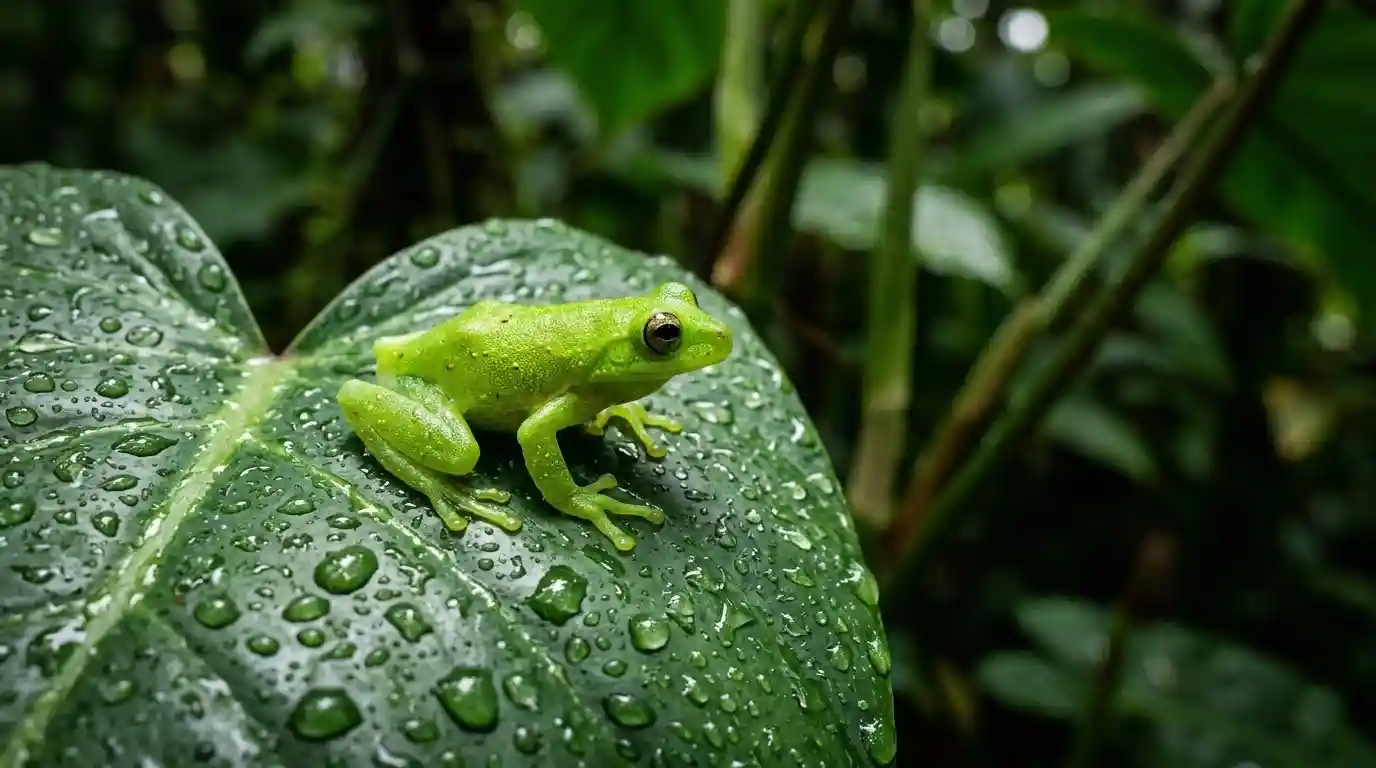
Roughly 25% of all amphibian species on the planet still remain hidden beneath the canopy of tropical forests, and the most recent find in the Alto Solimoes region confirms that time is running out for science. During an expedition carried out earlier this year, a team of researchers identified a small frog with vivid green coloring and unique finger patterns that defies the taxonomic classifications known until now.
The announcement comes at a crucial moment. Portable genetic sequencing technology allowed the team to confirm that this was a brand-new species while still in the field, speeding up a process that would traditionally demand years of exhausting laboratory analysis. What once depended on months of transport and painstaking comparison can now be settled just a few feet from where the animal was caught.
A metallic call that gave away the hideout
The discovery of this emerald frog involved weeks of nighttime forays into igapo areas, the stretches of flooded forest where silence is broken only by biological symphonies. The biologists used high-sensitivity recorders to capture sound frequencies that the human ear often ignores entirely.
It was precisely a metallic, rhythmic call pattern, unlike any record in the national database, that guided the team to the species’ microhabitat. This amphibian lives exclusively in bromeliads perched more than 33 feet (10 meters) above the ground, an ecological niche so specific that it explains why the animal stayed invisible to human eyes for so long. Searching for a tiny creature in the forest ceiling is, in practice, hunting for a needle in a haystack suspended in midair.
The fact that the call matched nothing in the national database was the first sign that the team was facing something unknown. From there, every night of listening turned into a patient hunt, guided by sound rather than sight, until it led to the bromeliads where the small amphibian spends its entire life.
Living thermometers of the forest
The importance of newly described amphibians goes far beyond academic curiosity, because these animals act as true environmental thermometers. Because they have permeable skin and a life cycle that depends on both water and land, they are the first to feel subtle changes in air quality and in the temperature of the forest.
Amazon biodiversity is under constant scrutiny, especially with COP30 drawing near. Finding new life in such a pressured ecosystem brings a breath of optimism for conservation strategies built on real data. Every species described is one more piece for understanding how the largest tropical forest in the world responds to human pressure.
These frogs are more than a scientific novelty. Their permeable skin makes them living sensors, and their disappearance would often be the earliest warning that a stretch of forest is losing the delicate balance of moisture and temperature it needs to survive.
A race against silent extinction
Yet the celebration of the discovery comes paired with an immediate and legitimate concern. Specialists warn that many species are going extinct before they even receive an official scientific name, due to the advance of deforestation and to climate shifts that dry out the microenvironments of extreme humidity.
The habitat of this new amphibian sits in an agricultural frontier zone, which places the newly discovered population in a state of critical vulnerability. Preserving this small inhabitant now depends on the creation of ecological corridors that guarantee connectivity between the fragments of primary forest. Without that link, each isolated patch of woodland becomes an island where life slowly fades.
Knowledge as a tool for protection
Investing in basic science and field expeditions is the only way to map what still remains of the largest tropical forest on Earth. The emerald frog is not just another name on a list: it is a symbol of nature’s resilience. Every time we describe a new living being, we gain a new legal and biological argument to protect entire territories.
Knowledge is the most powerful tool we have to ensure that the cycle of life keeps pulsing in vibrant, unknown ways deep within the forest. Protecting what we do not yet know may be the greatest test of humility and intelligence our civilization will ever face.
Reporting: Anne Silva / Amazonia Mag
This article is the English edition of reporting originally published by Revista Amazônia. Images: Revista Amazônia archive.

Editor, English Edition — Amazonia Mag
Anne Silva is the editor of Amazonia Mag, the English-language edition of Revista Amazônia. She curates, translates and adapts the outlet's science and environment coverage for an international audience, reporting on Amazon wildlife, flora, rivers, climate and research. Every story she edits is grounded in peer-reviewed studies, official data and on-the-ground reporting from the Revista Amazônia newsroom in Belém, Pará, Brazil. More by Anne Silva →