
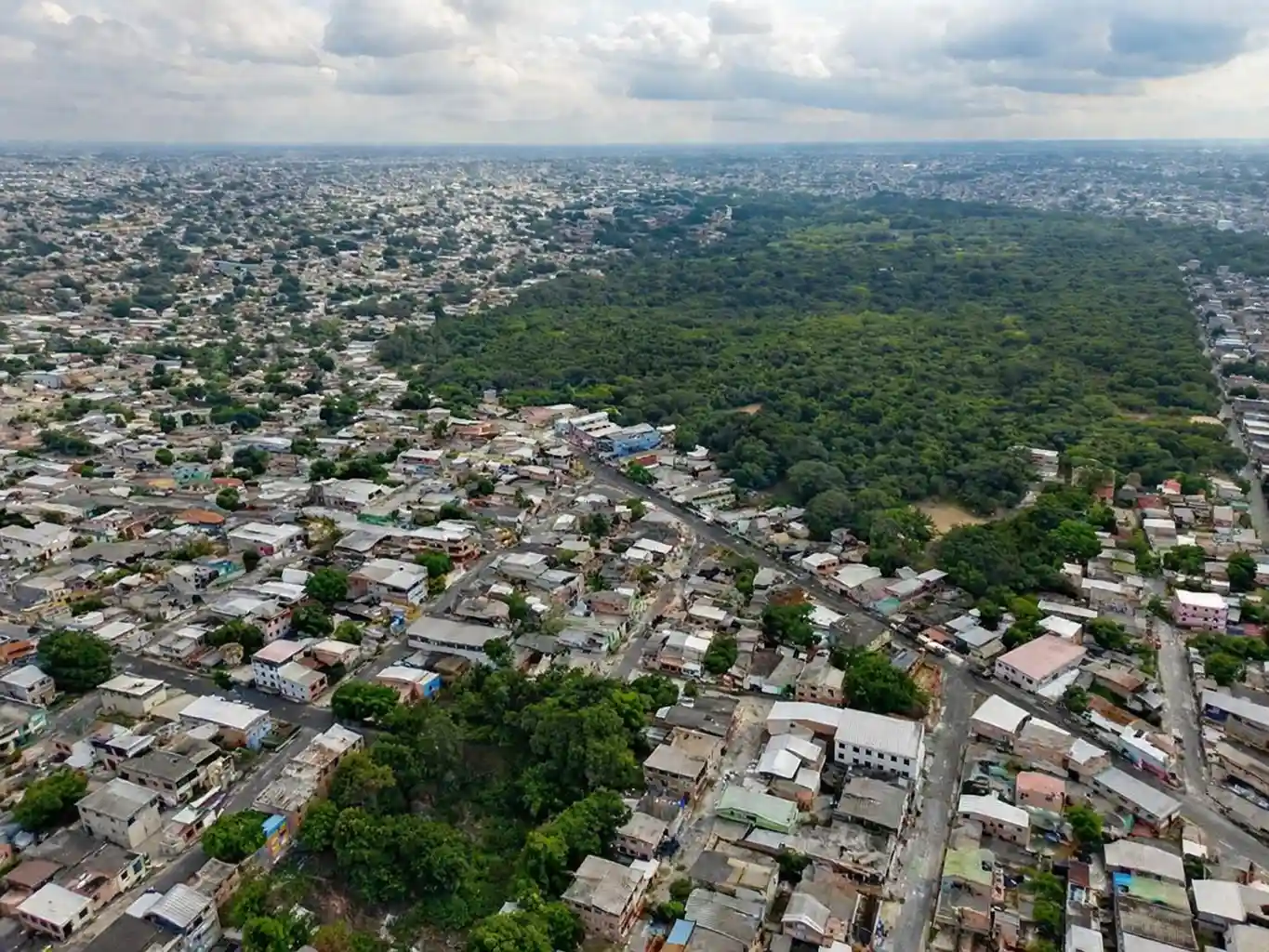
Manaus is on the verge of changing its urban landscape with a project that could redefine the relationship between a city and nature in the Amazon. The so-called Manaus green corridor is designed to connect forest areas within the city limits on a scale considered unprecedented in South America. The proposal responds to the challenge of reconciling urban growth with environmental preservation in one of the most biodiverse regions on Earth.
The plan calls for existing forest fragments to be linked across neighborhoods, creating a continuous system of vegetation through different parts of the Amazonian capital. Rather than treating each green area as an isolated space, the project would make parks, urban reserves and permanent preservation areas part of one ecological structure. Green space would become an essential element of urban infrastructure.
The planned corridor could extend for dozens of miles, connecting areas that already contain forest and have potential for ecological links. Its gradual design is intended to take advantage of places where vegetation can be restored or maintained. In this model, the city would no longer completely interrupt the movement of wildlife between forest fragments.
A connected network for urban wildlife
One of the project’s central goals is to allow local wildlife to move between areas that are currently separated. That connection could help reduce genetic isolation among animals and contribute directly to biodiversity conservation. Small mammals, birds and pollinating insects are among the main groups expected to benefit from the network.
When forest fragments remain separated for long periods, animal populations have fewer opportunities to move, find food and reproduce with individuals from other areas. The Manaus green corridor is intended to reduce that isolation and create safer ecological movement through the city. The expected result is a chain of positive effects across the urban ecosystem, from plants to the species that depend on them.
Urban wildlife, often unnoticed by residents, would have a central role in this transformation. Species that currently survive in isolated fragments could move more safely, increasing their chances of survival. This ecological flow is important for maintaining the balance of ecosystems and strengthening the city’s environmental resilience.
A connected forest network could also support natural processes within Manaus. Pollinating insects depend on vegetation as they move and search for resources. Birds and small mammals may likewise benefit from an urban structure that is less fragmented, with green areas functioning as parts of a broader ecological system rather than as disconnected islands.
Cooling the city and improving well-being
The expected benefits extend beyond conservation. Studies on urban sustainability in the Amazon show that continuous green areas can help lower city temperatures and improve thermal comfort in places exposed to intense heat. In Manaus, where temperatures frequently rise above 86 degrees Fahrenheit, or 30 degrees Celsius, the initiative could bring a meaningful change to residents’ quality of life.
Vegetation can also help reduce urban heat islands, a common phenomenon in developed areas. Trees and forest fragments help regulate air temperature and humidity, creating more comfortable microclimates. In a city located within the world’s largest tropical forest, bringing urban infrastructure closer to forest dynamics is not only desirable but strategic.
Air quality is another central concern. Vegetation acts as a natural filter, capturing pollutant particles and releasing oxygen. In dense urban areas, that effect could help reduce respiratory problems and support public health, while also improving environmental conditions in neighborhoods crossed by the corridor.
Trees and green areas are also directly associated with lower stress and greater psychological well-being. That benefit is frequently underestimated in large urban centers, where residents face traffic, noise, paved surfaces and high temperatures. Connected natural spaces can create a more balanced daily environment without separating conservation from responsible public use.
Public participation, recreation and education
The planned investment involves public funds as well as partnerships with private institutions and environmental organizations. The proposal also creates room for civil society through community reforestation and environmental education initiatives. Schools, universities and residents may take part in restoring degraded areas, strengthening the relationship between the population and the territory.
The project also envisions recreational and gathering spaces along the corridor. Trails, bike paths and viewing areas are expected to be integrated into the natural setting, encouraging people to use and protect these places. This approach reinforces the idea that environmental conservation can move forward alongside thoughtful public access.
Environmental education is another pillar of the plan. By bringing residents closer to the forest, the Manaus green corridor can create opportunities for learning and awareness. Children and young people may experience the importance of biodiversity and conservation in practical ways, helping form a generation more connected to the environment.
Implementation will be gradual and divided into stages that prioritize strategic areas of the city. The first steps are expected to focus on locations with the greatest potential for ecological connections, followed by expansion over the years. This model allows adjustments during the process and is intended to make the use of available resources more efficient.
A possible model for other cities
The corridor could also affect local economic development. Areas with more vegetation tend to become more attractive, which may increase interest in nearby neighborhoods and stimulate economic activity. The challenge, however, will be ensuring that this growth is inclusive, preventing gentrification and making sure the benefits are shared equitably.
The project positions Manaus as a leading voice in international discussions about climate and sustainable urban planning. As global attention returns to the Amazon, particularly with the approach of COP30, initiatives such as this show that urban development and environmental conservation can be combined in practical and measurable ways.
The proposal connects with international experiences in cities that have invested in green infrastructure, but it has one fundamental difference. In Manaus, the project is not simply an urban adaptation. It is an extension of the Amazon forest into the city itself, creating an identity in which urban and natural spaces do not compete but coexist as an integrated system.
Specialists say the Manaus green corridor could become a model for other Amazonian cities and even for urban centers in different biomes. The key is to value local natural resources and adapt solutions to the specific characteristics of each territory, rather than applying the same formula everywhere.
The project’s success will depend on the continuity of public policies and on broad social engagement. Preserving the corridor’s integrity over time will require constant monitoring, enforcement and active participation from residents. Conservation is not a one-time act, but a shared commitment.
In a global landscape marked by increasingly complex environmental challenges, the Manaus green corridor shows that innovative solutions can emerge in some of the planet’s most strategic territories. The Amazon, often viewed as a distant place, also stands out as a living laboratory for sustainable urban development.
Reporting: Anne Silva / Amazonia Mag

Editor, English Edition — Amazonia Mag
Anne Silva is the editor of Amazonia Mag, the English-language edition of Revista Amazônia. She curates, translates and adapts the outlet's science and environment coverage for an international audience, reporting on Amazon wildlife, flora, rivers, climate and research. Every story she edits is grounded in peer-reviewed studies, official data and on-the-ground reporting from the Revista Amazônia newsroom in Belém, Pará, Brazil. More by Anne Silva →