
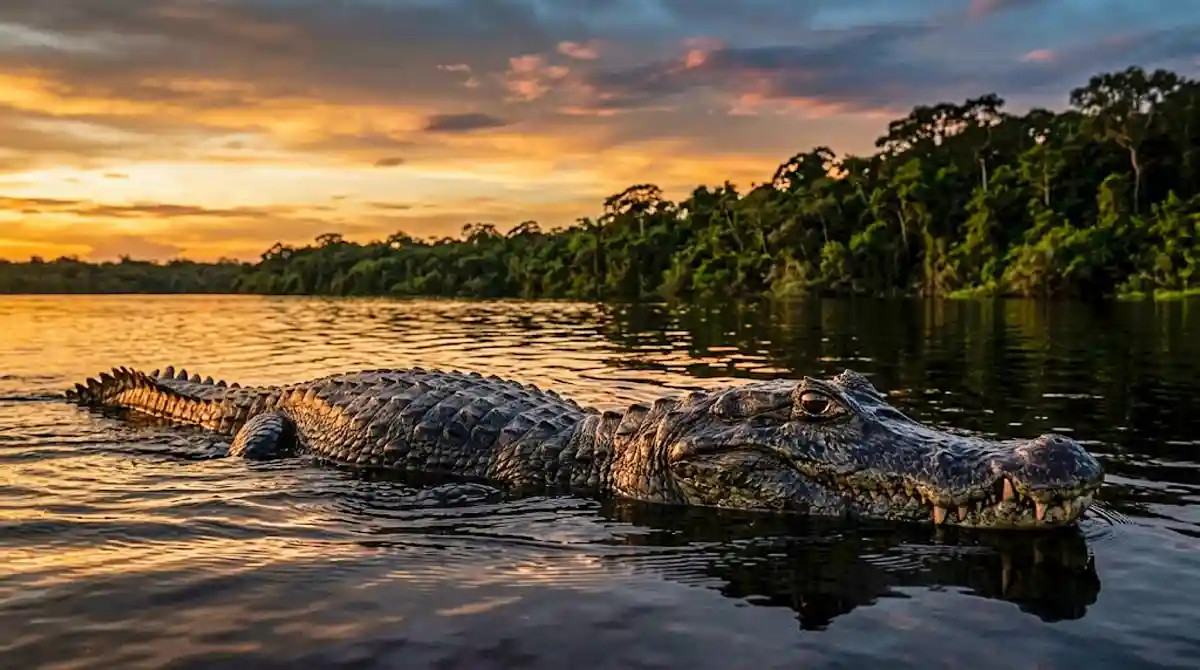
For more than three decades, one of the Amazon’s largest predators disappeared from entire stretches of the Rio Negro. Its absence left an ecological void that was difficult to measure and changed the soundscape along the riverbanks. Now, recent records confirm the black caiman’s return to areas where its presence had been considered lost, offering concrete evidence that Amazonian wildlife recovery is not merely possible, but already underway.
The finding is more than symbolic. In some monitored locations, the species has begun occupying strategic niches in the food web again, indicating that essential ecological processes are being restored. The black caiman is not simply another forest inhabitant. It regulates populations, signals environmental quality, and is one of the pillars of Amazonian crocodilians.
A disappearance that shaped generations
Until the 1980s, black caimans were widely found along the Rio Negro, one of the main tributaries of the Amazon River. Their skins were highly valued on international markets, driving intense hunting that drastically reduced their populations. The pressure was so severe that some stretches of the river went decades without records of the large predator.
River communities recall that, in certain places, silence settled over the banks. Where people had once commonly heard water being cut by large bodies, only memories remained. The disappearance of the black caiman was not just the loss of a visible species. It also changed the relationships among aquatic animals and the environment they shared.
Without the main predator, populations of fish and other aquatic animals began to grow in an unregulated way. That imbalance produced cascading effects and altered ecological dynamics that had remained stable for centuries. The gap left by the caiman showed how strongly a single species can shape the structure of an entire ecosystem.
What changed in recent decades
The black caiman’s return to the Rio Negro did not happen by chance. It resulted from a combination of public policies, scientific research, and active participation by local communities. The creation of protected areas was one of the first steps. Conservation units along the Rio Negro helped reduce hunting pressure and preserved habitats essential to the species’ reproduction.
Stronger enforcement programs also reduced the illegal skin trade. At the same time, environmental education campaigns changed how local populations viewed the animal. The black caiman was no longer seen only as an economic resource. It came to be recognized as a key part of the ecosystem’s balance.
That shift in perception is central to the recovery. Protecting the species depends on understanding its value as an environmental regulator, as well as the need to conserve the river and forest environments that sustain it. The result is a conservation effort that joins territorial protection with a broader understanding of ecological function.
Science confirms the return
The species’ return could only be confirmed through continuous monitoring. According to the researchers carrying out these observations, teams travel through remote stretches of the river at night, when caimans’ eyes reflect flashlight beams and make identification easier.
The expeditions are demanding. They involve long hours aboard boats, changing weather conditions, and the logistical challenges typical of the Amazon. Even so, the results have been consistent. In places with no records for decades, researchers observed both adult and juvenile individuals.
The presence of different age groups suggests more than the survival of a few animals. It also indicates active reproduction. This detail is crucial, because the presence of young caimans shows that the environment is once again providing suitable conditions for the species’ complete life cycle.
Monitoring is not limited to counting individuals. It also tracks environmental variables that can help explain the population’s future. Researchers need to understand not only where the caimans are, but also which conditions allow them to reproduce and remain in the river.
Traditional communities at the center of recovery
One of the most important elements of this process is the involvement of river communities. Local residents participate directly in monitoring activities, working as guides, observers, and guardians of the territory. Their everyday knowledge of the river and its banks strengthens the work carried out by scientific teams.
This collaborative model has proved effective. By combining traditional knowledge with modern science, projects can achieve more accurate and sustainable results. Recovery becomes a shared task rather than an isolated action, linking researchers with the people who live in the Amazonian landscape.
Recognizing the black caiman as a conservation symbol has also created new economic opportunities, including ecotourism. These activities reinforce the importance of keeping the forest standing and connect species protection with the well-being of the communities living along the Rio Negro.
A signal of ecosystem health
Among Amazonian crocodilians, the black caiman stands at the top of the food chain. Its presence directly influences the structure of the aquatic ecosystem. It regulates fish populations, controls opportunistic species, and contributes to the maintenance of biodiversity.
Without this predator, the system loses stability. That is why its return has a broad ecological meaning. The goal is not only to recover a population, but also to restore a function that helps organize relationships among many species.
The black caiman also acts as a bioindicator. Its presence in a particular area suggests that water and habitat quality are adequate. In other words, where black caimans are found, an ecosystem is functioning well enough to support a large predator and complete its life cycle.
The species’ recovery has become one of the most emblematic examples of Amazonian wildlife recovery. In a global setting marked by biodiversity losses, its return shows that degradation can be reversed when protection efforts are maintained.
Specialists, however, warn that the work is far from over. Recovery remains fragile and depends on the continuation of conservation measures. Deforestation, climate change, and illegal activities still pose real threats to the species and to the environment that supports it.
Changes in rainfall patterns and river levels can directly affect black caiman habitats. Reproduction areas depend on specific flooding conditions, and any change in that balance can jeopardize reproductive success. For that reason, monitoring must follow environmental conditions as well as animal numbers.
In recent years, drones, sensors, and georeferencing systems have expanded researchers’ ability to study the species. These tools help map large areas more precisely and identify behavior patterns, movement routes, and priority areas for protection. Fieldwork remains irreplaceable, however. Direct contact with the environment continues to produce many of the most important observations.
The black caiman’s return to the Rio Negro has become a reference for other conservation projects in the Amazon. It demonstrates that strategy and persistence can recover species considered lost from particular regions. The result also strengthens environmental policies and encourages investment in research and biodiversity protection.
Maintaining the black caiman’s presence still requires constant vigilance. History shows that human pressure can quickly reverse gains. Specialists therefore support expanding protected areas, strengthening enforcement, and encouraging sustainable practices.
Local community participation remains one of the pillars of this process. Without it, any strategy is incomplete. The black caiman has returned not only as a species, but also as a symbol of the Amazon’s ability to recover, endure, and reinvent itself.
Its return to the Rio Negro is more than a scientific finding. It is a story of reconnection between nature and society, between the past and the future. In a world that often associates the Amazon with loss, this story points toward another possible path. When a predator absent for 30 years returns to its place, it is not only wildlife that recovers. Hope gains ground as well.
Reporting: Anne Silva / Amazonia Mag

Editor, English Edition — Amazonia Mag
Anne Silva is the editor of Amazonia Mag, the English-language edition of Revista Amazônia. She curates, translates and adapts the outlet's science and environment coverage for an international audience, reporting on Amazon wildlife, flora, rivers, climate and research. Every story she edits is grounded in peer-reviewed studies, official data and on-the-ground reporting from the Revista Amazônia newsroom in Belém, Pará, Brazil. More by Anne Silva →