
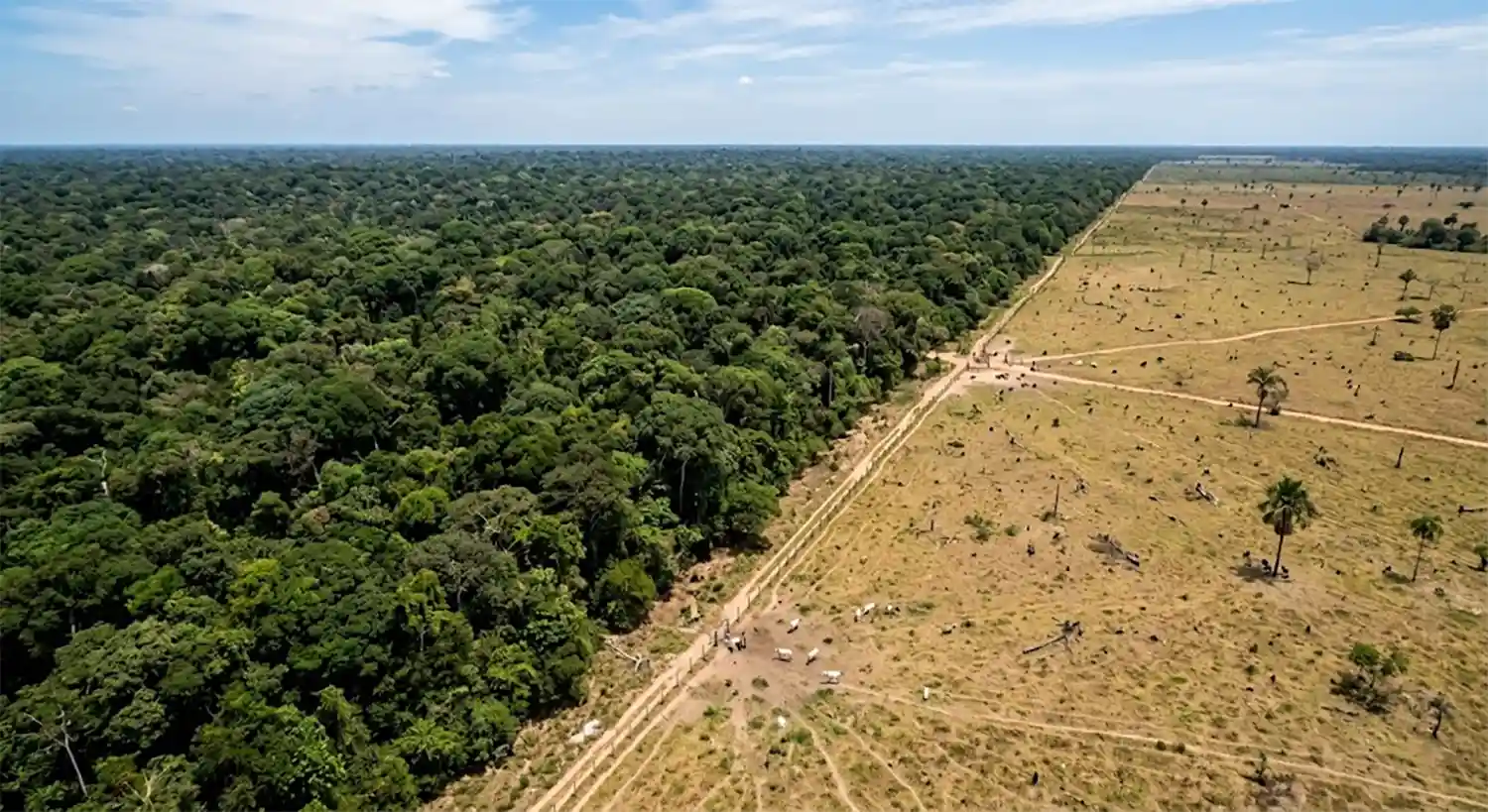
Indigenous lands in the Brazilian Amazon record deforestation rates up to ten times lower than government-managed conservation units. Consolidated data from MapBiomas indicate that these peoples’ territorial management has isolated the advance of the agricultural frontier in critical areas of Pará and Amazonas, where it works as a vital biological buffer.
While national parks face severe budget cuts and weak enforcement, constant village monitoring safeguards 98% of the original forest cover. This physical barrier prevents edge effects from degrading the heart of the biome and helps keep entire ecosystems in a state of biological climax.
Ancestral governance backed by science
Researchers at Imazon monitor the spread of illegal mining and logging along the edges of protected territories through the Deforestation Alert System. Their detailed analysis shows that the governance model of Indigenous peoples acts as a strategic barrier against land grabbing.
Protection does not depend only on boundaries drawn on maps. On Indigenous lands, land use, the presence of guardians and generations of knowledge about rivers, trails and signs of intrusion form a permanent forest defense system.
The basis of this protection is land use focused on a regenerative-impact bioeconomy. Communities use the forest without exhausting it, concentrating on value chains such as native açaí, essential oils and seeds.
According to the report, these practices maintain the water cycle and the thermal regulation essential for rainfall in Brazil’s Center-South. Unlike public areas without effective occupation, Indigenous lands have guardians who patrol rivers and trails, responding immediately to any sign of smoke or a chainsaw.
This visible territorial presence discourages the installation of logistical camps used by organized environmental crime, which prefers so-called no-man’s lands. Daily vigilance turns traditional occupation into a concrete means of containing the agricultural frontier, logging and invasions.
The shield effect and climate protection
Over the last thirty years, Indigenous lands have lost only 1% of their vegetation, compared with devastation that has already consumed nearly 20% of the entire Amazon forest in undemarcated areas. Satellite monitoring shows that these territories act as vital carbon filters, sequestering gigatons of CO2 that would otherwise be in the atmosphere.
Renowned institutions such as the journal Nature publish studies supporting the thesis of a forest climate generated by these preserved green strongholds. Continuous vegetation is not only a protected landscape. It also plays a role in the moisture, temperature and atmospheric circulation described in the analysis.
Without these territories, the average temperature in the Northern region would rise by up to 2 degrees Celsius in a single decade. According to the report, that scenario would make the mechanized agriculture pressing against the forest edge itself unviable by worsening the environmental conditions that support production.
Evapotranspiration in these areas feeds the so-called flying rivers, air masses loaded with moisture that cross the continent. Without the Indigenous barrier, southeastern Brazil would face prolonged droughts and a collapse in its electricity and human water-supply systems.
For that reason, the shield effect is not limited to the interior of demarcated lands. Preserving forest cover in these territories is connected to climate processes that reach other parts of Brazil and to the continent’s water stability.
Technology and monitoring on the front line
Forest protection now requires geospatial intelligence combined with traditional knowledge, so invaders can be intercepted before clear-cutting becomes established. Indigenous associations use high-precision drones to report environmental crimes to IBAMA in real time, creating a digital protection belt.
This combination expands the ability to respond without replacing community monitoring. Technology can identify signs and document reports, while territorial presence provides direct knowledge of rivers, trails and the areas where an invasion may begin.
Strengthening the financial autonomy of these villages is more efficient and less expensive than deploying federal troops to contain uncontrolled fires. The cost of keeping one hectare of forest standing through Indigenous protection is a minimal fraction of what the government spends restoring degraded areas or carrying out Law and Order Guarantee operations, known as GLO.
INPA highlights that biodiversity in these areas is up to 30% higher than in buffer zones near major highways. The difference reinforces the importance of preserving continuous territories instead of limiting protection to isolated fragments or spaces with intermittent enforcement.
Conservation now depends on the unshakable legal security of these territories against doctrines that weaken land possession and encourage invasions by third parties interested in mining. The INPA Biodiversity Report is cited as a reference for defending territorial integrity.
Bioeconomy and the future of the biome
The sustainability of Indigenous lands depends on generating income while respecting the integrity of the forest. Carbon-credit projects and the sale of socio-biodiversity products allow villages to buy monitoring equipment and improve internal health care without resorting to timber sales or leasing land for pasture.
These activities connect conservation with autonomy. When the local economy is based on products that depend on a living forest, the territory retains its ecological function and can also support investments in monitoring, health and community protection.
Feasibility studies show that standing forest generates more revenue for the country in the long term than converting the soil to monoculture. Indigenous peoples are therefore managers of irreplaceable natural capital that supports the climate stability of the entire Southern Hemisphere.
A global conservation reference
Neighboring countries in the Amazon Basin, such as Colombia and Peru, view Brazil’s land-demarcation model as the only viable path toward meeting the goals of the Paris Agreement. Conservation is not an abstract concept, but a political and cultural practice of people who defend their land with their own lives against predatory expansion.
Guaranteeing land rights also ensures the survival of species that Western science has not even had time to catalogue or fully understand. From this perspective, demarcation and protection are not isolated actions, but conditions for preserving ecological relationships that remain little known.
The future of global oxygen and the continent’s water stability depend directly on each village’s determination to keep its boundaries inviolable. Respecting demarcation therefore appears as the only technology truly capable of saving the biome.
Reporting: Anne Silva / Amazonia Mag

Editor, English Edition — Amazonia Mag
Anne Silva is the editor of Amazonia Mag, the English-language edition of Revista Amazônia. She curates, translates and adapts the outlet's science and environment coverage for an international audience, reporting on Amazon wildlife, flora, rivers, climate and research. Every story she edits is grounded in peer-reviewed studies, official data and on-the-ground reporting from the Revista Amazônia newsroom in Belém, Pará, Brazil. More by Anne Silva →