
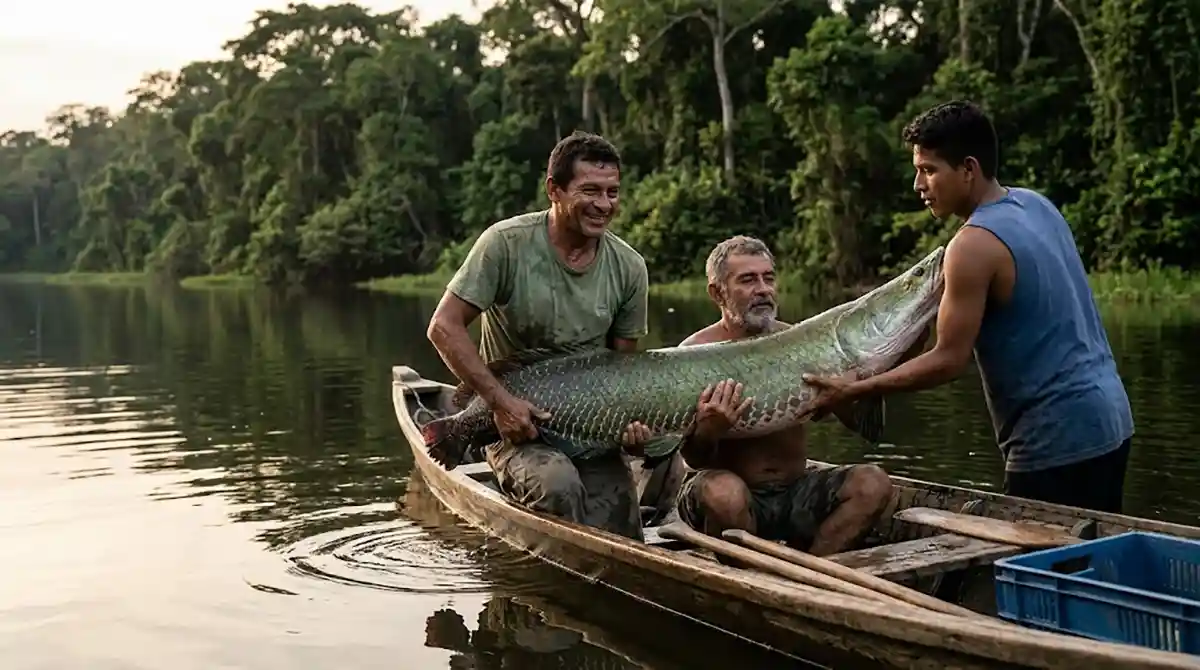
In just three decades, the arapaima rose from a species threatened with extinction to a fish population growing 25% a year in monitored reserve areas of Amazonas. A landscape once marked by absolute scarcity and territorial conflicts gave way to scientific counting and controlled harvesting.
The system generates more than 10 million reais annually for populations living in geographic isolation. This transformation did not come from a government decree alone. It grew from an alliance between the ancestral knowledge of river communities and modern biology.
The fish can reach 9.8 feet in length (3 meters) and weigh 441 pounds (200 kilograms). It is now one of the main guardians of the flooded forest, showing that arapaima income, sustainable management and conservation can move forward together.
From scarcity to community surveillance
The recovery began with a sharp change in the way fishers viewed their surroundings. Under conventional predatory fishing, the goal was to remove as much as possible in the shortest time, a logic that nearly pushed Arapaima gigas into population collapse during the 1990s.
Today, management follows the opposite logic. Communities conduct a detailed annual count, while experienced fishers identify the animals as they rise to the surface to breathe.
The method, validated by research institutions, allows communities to harvest only 30% of adult individuals. The remaining 70%, along with every juvenile, stays in the ecosystem to reproduce.
The count depends on experience, attention and knowledge of the animal’s behavior. Arapaima has an obligatory aerial breathing system and must come to the surface every 15 to 20 minutes.
A trained manager can estimate the fish’s size from the sound of its breath, known as boiada, and from the trail it leaves across the water. The technique produces an almost exact census of the local population.
Lakes that protect more than one fish
For management to be authorized by Ibama, the community must protect its territory from intruders and illegal fishers throughout the year. This constant watch also protects other vulnerable species, including manatees, Amazon turtles and caimans.
Managed lakes have become true biodiversity sanctuaries. Life flourishes there without the pressure of uncontrolled exploitation, while the várzea forest maintains the balance that depends on these bodies of water.
The flooded forest remains resilient and serves as a vital carbon store for the global climate balance. Protecting arapaima therefore extends to an entire system of rivers, lakes, forests and species.
The fish’s resilience has also become clear during extreme droughts that affected the region in recent years. Populations in managed areas recovered much faster than those in areas without controls.
One reason is the preservation of so-called mother lakes, where fishing is completely prohibited. These areas serve as natural nurseries, and arapaima concentrations become so high that a natural surplus moves into lakes where fishing is allowed.
That movement keeps the system in perpetual balance. The experience shows that when nature receives the space and respect it needs, it has an extraordinary capacity to regenerate.
Income, products and river-community pride
The economic transformation is as striking as the ecological one. In conservation units where management is established, such as the Mamirauá Sustainable Development Reserve, the average income of managers has risen consistently.
The money supports investments in community infrastructure, health and education. For thousands of families, arapaima income stopped being a promise and became a daily reality, bringing bank accounts, solar power and water-treatment systems financed by fish sales.
The product’s added value has also increased. What was once sold only as fresh meat now supports a production chain that includes arapaima leather, highly valued by the international fashion industry, and scales transformed into fine handicrafts and bio-jewelry.
The meat is white, firm and free of intramuscular bones. Those qualities earned it the nickname cod of the Amazon.
Major chefs in São Paulo and Rio de Janeiro have become ambassadors for management. They help educate consumers about the importance of looking for the product’s origin seal.
When a customer at a luxury restaurant chooses managed arapaima, that choice directly helps fund surveillance of a lake in the heart of the forest. The product’s quality is also connected to strict animal-welfare and hygiene standards during slaughter.
The success of sustainable arapaima management rests on community governance. Decisions about how to invest fishing profits are made in assemblies where every voice counts.
This process strengthens the social fabric and creates a sense of belonging that serves as an effective barrier against illegal activities such as mining and logging. Young river residents who once saw the city as the only escape from poverty can now see management as a dignified and profitable career.
There is renewed pride in being a manager. The title carries the responsibility of becoming a practical forest scientist, combining daily observation, local knowledge and stewardship of the territory.
A social technology crossing borders
Community-collected data are used by researchers to understand the species’ migration and growth patterns under different climate pressures. Academic institutions provide statistical support, while river residents supply the raw field data.
It is a symbiosis whose precision, according to the research institutions involved in validating the method, no drone or underwater sensor has managed to match so far. The innovation lies both in the counting technique and in the people who apply it.
The model is being successfully replicated in other Brazilian states and in neighboring countries that share the Amazon Basin, including Peru and Colombia. By adapting the rules to each regional context, sustainable fishing demonstrates that the economic development of the region does not have to depend on destroying the forest.
On the contrary, standing forest and living rivers are what guarantee food on the table and money in people’s pockets. The experience has become one of the major legacies of Brazilian conservation.
Logistics remains the greatest challenge. Moving tons of processed fish from remote areas to large urban centers requires refrigerated boats and an impeccable cold chain, infrastructure that has received public and private investment in recent years.
Looking ahead, the goal is to expand market access and diversify products. Arapaima organs are being studied for use in animal feed and organic fertilizers, in a search for zero waste.
Community-based tourism, focused on catch-and-release sport fishing and nature observation, is emerging as another source of income alongside management. Visitors who spend days traveling by boat to see the giant fish at close range leave resources that help maintain the reserves’ protection structure.
This creates a virtuous cycle of valuing wildlife. The Amazonas experience shows that sustainability is not an abstract concept, but a daily practice requiring effort, patience and cooperation.
Arapaima is more than a commodity. It is a symbol of cultural resilience and ecological intelligence.
By protecting the fish, river communities protect the river, the forest and their own future. The Amazon teaches that real progress happens when human success is measured by the abundance of life left behind.
Reporting: Anne Silva / Amazonia Mag

Editor, English Edition — Amazonia Mag
Anne Silva is the editor of Amazonia Mag, the English-language edition of Revista Amazônia. She curates, translates and adapts the outlet's science and environment coverage for an international audience, reporting on Amazon wildlife, flora, rivers, climate and research. Every story she edits is grounded in peer-reviewed studies, official data and on-the-ground reporting from the Revista Amazônia newsroom in Belém, Pará, Brazil. More by Anne Silva →