
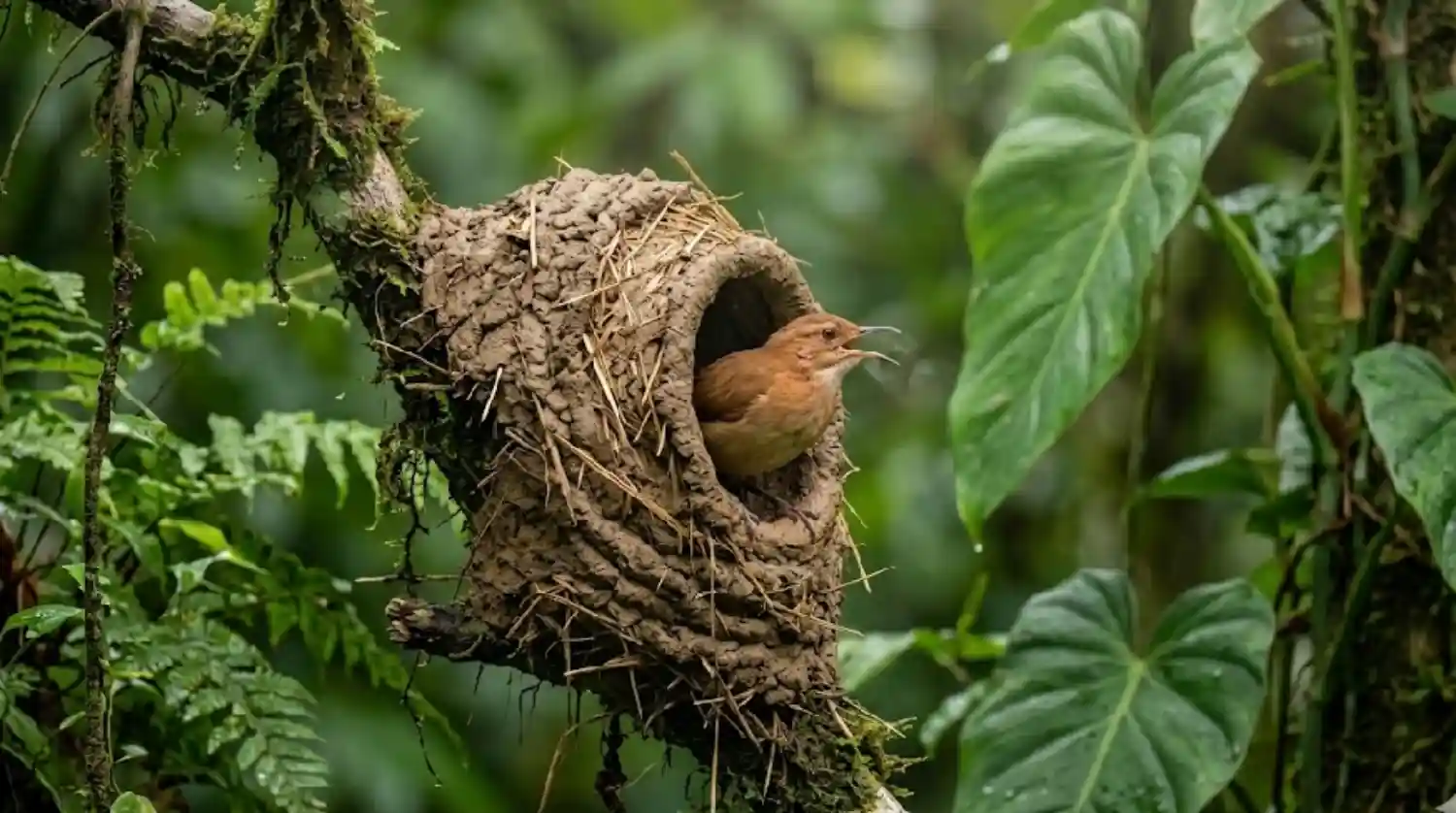
There is one precise spot in the landscape where a bird’s communication becomes visible: the doorway of its nest. For the rufous hornero (Furnarius rufus), one of Brazil’s most emblematic birds, that small curved opening works as a stage, a lookout post and the place from which a pair announces to the neighborhood that this territory already has owners. What gets sung from that doorway, and the way the doorway itself is positioned, has been keeping researchers busy as they study how wild animals move information through noisy, contested environments.
A song performed by two voices
The hornero’s song is not merely pleasant background melody. It is a complex communication mechanism. Pairs perform perfectly synchronized duets to defend their territory, and this is where the detail that most interests science shows up: the frequency and the rhythm of the song shift according to how close an intruder is and how intense the threat looks. It is not a fixed signal repeated the same way every time, but a message calibrated to what is happening nearby.
That precision turned the bird into a study model for vocal coordination and social intelligence among wild birds. Singing in two voices without overlapping requires each member of the pair to listen to the other and time its entry exactly. The duet therefore carries two messages at once: this territory is occupied, and the pair holding it is coordinated enough to defend it together. For an intruder weighing costs and benefits before moving in, that information can be worth as much as an actual fight.
The detail matters because it shifts the lens. For decades the hornero was watched mainly as a bricklayer, a bird that kneads mud. Seen through communication, something else appears: an animal that manages signals, adjusts them in real time and broadcasts them from a fixed point in its territory, the mouth of the nest, where the voice carries farther and the pair stays in plain sight.
The puzzle of the door
The hornero’s most famous adaptation is still its oven shaped nest, built from mud, straw and dung. The structure is a masterpiece of natural engineering: it offers thermal insulation and protection against predators and bad weather. But the most intriguing aspect of that construction, and the subject of a recent scientific study reported by Infobae, is the design of the entrance.
Researchers found that the orientation of the nest door is not random. For a long time the assumption was simple, that the entrance merely dodged prevailing winds and rain. New analyses suggest something else: the door can switch sides from one year to the next, or from one nest to another built by the same pair, which undercuts a purely climatic explanation.
The strongest hypothesis, supported by behavioral ecology, is that this variation works as a way of confusing predators. Snakes and other birds can memorize where the entrance of previous nests was and return to the same spot. If the door moves, the predator’s memory stops being useful. That rotating door strategy points to a level of behavioral plasticity and adaptive planning that science is only beginning to decode.
The contrast is worth pausing on, because it is communication running in two opposite directions. The duet exists to be heard, and the clearer the better. The door exists to be unpredictable, and the harder to memorize the better. The same animal handles a signal it wants to make public and a piece of information it prefers to keep private, and both happen at the same address.
It also complicates a familiar assumption about animal signals. A nest is usually read as architecture, a solved problem repeated by instinct. The evidence on entrance orientation suggests the opposite: a decision taken again with each construction, sensitive to what happened at the previous nest and to who might have been watching it.
Talking over the noise of the forest
Animal communication in natural habitats goes far beyond vocalization. In the Amazon, an environment of extremely high acoustic and visual complexity, the adaptations are extreme too. Chemical signals, body postures and even ground vibrations are used to carry vital information.
Bioacoustics, the study of the sounds produced by living beings, shows that many species developed specific song frequencies that let them be heard above the forest’s background noise, whether that is falling rain or other species singing at the same time. Each voice ends up looking for its own free band inside a crowded soundscape.
Another example of adaptation, this time in the visual field, comes from certain Amazonian frogs that developed vibrant colors to avoid predation. That aposematism communicates toxicity to potential predators. It is a form of honest communication and passive defense, where the visual signal replaces combat and secures the survival of both sides of the interaction. Science studies these interactions to understand how colors and signals evolve in nature and how they shape the biodiversity of complex ecosystems.
Communication has a price
Building complex nests and maintaining sophisticated communication systems carries a high energy cost. According to studies in bioenergetics, the hornero can spend up to 20% of its daily energy on nest construction, making thousands of trips to gather mud and materials. The territorial song of Amazonian birds also demands significant caloric expenditure and can raise the risk of predation, because it draws the attention of acoustic predators.
That is the balance every pair negotiates daily: be heard enough to keep the territory, without being heard so much that you become the prey. The loudest signal is not always the best signal.
Resilience and its limits
The capacity of wild animals to adapt and communicate is tested every day by environmental pressure, including deforestation and climate change. Species such as the hornero, which builds in open areas and forest edges, have shown resilience and adapt to altered and even urbanized settings, where they use power poles and human structures as the base for their nests.
Species with more specific habitat requirements face a different picture in the Amazon. Forest fragmentation can interrupt communication and dispersal corridors, isolating populations and reducing genetic variability. Research indicates that conserving biodiversity depends not only on protecting areas but on maintaining connectivity between habitats, so animals can communicate, move and adapt to new conditions. Understanding these adaptation mechanisms is decisive for designing conservation strategies that actually work.
The hornero and the puzzle of its nest door serve as a reminder that there is still a great deal to learn about the natural world. Decoding the mechanisms of animal communication and adaptation does more than satisfy curiosity: it delivers concrete tools for protecting wildlife and the balance of ecosystems. Readers who want to go deeper into bird behavior and conservation can find material through organizations such as SAVE Brasil and the collaborative database WikiAves. Knowledge remains the first step of any preservation effort.
Reporting: Anne Silva / Amazonia Mag. Source: Infobae, SAVE Brasil, WikiAves.

Editor · Amazonia Mag
Anne Silva is the editor of Amazonia Mag, the English-language edition of Revista Amazônia. She curates, translates and adapts the outlet's science and environment coverage for an international audience, reporting on Amazon wildlife, flora, rivers, climate and research. Every story she edits is grounded in peer-reviewed studies, official data and on-the-ground reporting from the Revista Amazônia newsroom in Belém, Pará, Brazil. More by Anne Silva →