
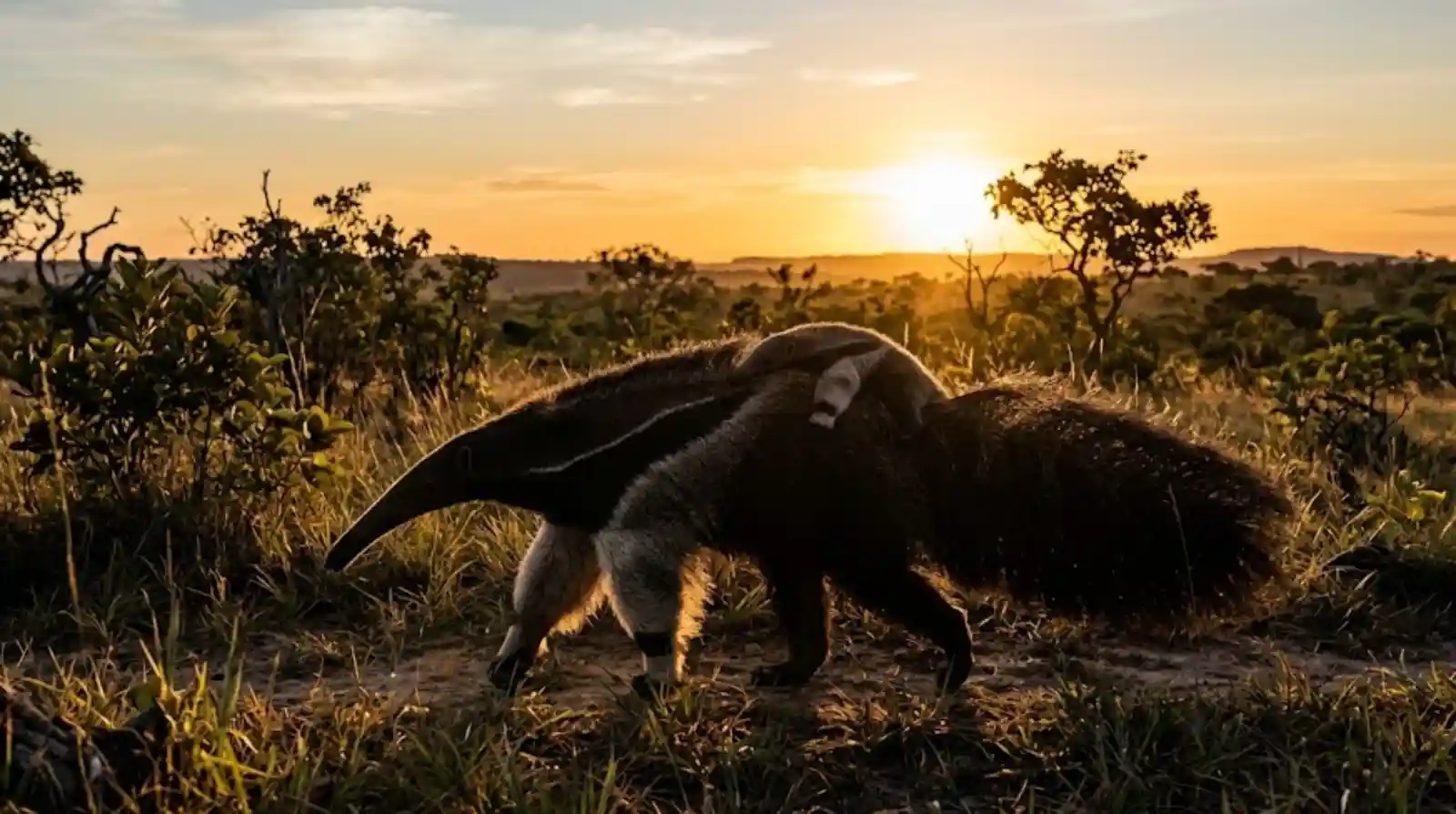
The scene is repeated hundreds of times every day across the vast expanses of Brazil’s Cerrado and along the edges of the Amazon. A giant anteater, with its impressive flaglike tail and elongated snout, approaches a sturdy termite mound. Using its sharp front claws, it opens a hole in the hard earthen structure.
Yet the animal does not stay there until it has satisfied its entire appetite. The remarkable biological secret of this mammal is its ability to consume thousands of insects without compromising the colony’s future. Contrary to what might be expected, the giant anteater does not destroy the termite mounds it visits.
This interaction is a refined example of natural sustainability that supports the survival of both sides. The predator obtains food, while the colony retains the possibility of recovering and repopulating the damaged area. In the ecosystems where the species lives, this relationship is part of a balance shaped by thousands of years of evolution.
A tongue built for speed
To accomplish this, the animal relies on a highly specialized tool. The Myrmecophaga tridactyla has a remarkable tongue that can reach 60 centimeters, or about 24 inches, in length. This thin, muscular structure is designed for efficiency and speed while the animal searches for food.
The tongue is covered with extremely sticky saliva and small backward-facing spines. It can move quickly into the tunnels of a termite mound, capturing hundreds of termites and ants in a matter of seconds. The species’ anatomy allows it to repeat the motion rapidly and remove only part of the food available inside.
According to studies of the species’ behavior, the tongue can move in and out of the mouth up to 160 times per minute. Speed is essential because, as soon as the colony detects the attack, soldier ants and soldier termites begin to respond.
The defending insects attack the intruder with bites and chemical substances. For the giant anteater, feeding becomes painful and less rewarding the longer it remains in one place. The colony’s defensive reaction, combined with a refined evolutionary instinct, determines the pace of every visit.
A meal spread across many colonies
The giant anteater eats a significant amount of insects each day. To obtain that food, it may visit as many as 200 different termite mounds or ant nests during its daily journey. This number shows that its strategy is not to exploit one resource completely, but to distribute its search across many locations.
At each site, it stays for very little time, generally less than two minutes. That haste is not only a way to avoid bites and the chemical substances released by defensive insects. It also has a fundamental ecological role because it limits the impact on every colony.
By eating only a small fraction of the colony and moving on before causing irreversible damage to the queen or the main structure, the giant anteater allows the termite mound to recover. The colony can repopulate the affected area and continue its cycle. The same principle applies to visits to ant nests, where the animal obtains food without eliminating the entire community.
This sustainable harvesting dynamic is recognized by science as essential to maintaining balance in the ecosystems where the species lives. The giant anteater does not exterminate its prey. Instead, it uses the resource in a way that preserves its renewal and leaves open the possibility of future visits.
A regulator of insects and creator of shelter
The close relationship between the giant anteater and social insect communities has consequences that go beyond feeding a single animal. The mammal’s activity helps control termite and ant populations. In doing so, it keeps them from becoming superpopulations that could disrupt native vegetation or other local dynamics.
The animal also physically changes the termite mounds it visits. By opening holes in these hard structures, it creates microhabitats for other smaller species. Those openings may be used as shelter or as a source of food, so an action connected to the anteater’s feeding ends up creating opportunities for other animals.
The sustainability of this interaction, in which the predator does not exterminate its prey but manages the resource so it can renew itself, is one of the pillars of biodiversity in Brazil’s savannas. The giant anteater acts as a specialized gardener, shaping the surrounding landscape through behavior formed by thousands of years of evolution.
For that reason, the animal’s presence matters to the entire ecological network. Its activity links insect control, the availability of small shelters and the continuation of natural cycles in the environments where it feeds.
A species that reflects landscape health
Seeing a giant anteater in its natural habitat is a unique experience. Its appearance is unmistakable: thick grayish fur, a diagonal black stripe edged in white crossing the chest and back, and an enormous furry tail.
The tail helps the animal keep its balance and can also serve as a kind of blanket that helps regulate body temperature during sleep. Often, especially at dawn or dusk, low-angle light highlights the textures of the Cerrado and makes it possible to see the animal moving across the fields.
It is also possible to spot a female carrying her young on her back. The baby remains perfectly aligned with the mother’s black stripe. This position provides effective camouflage, helping protect the young from predators as the female moves through the fields in search of the termite mounds that support her survival.
The image of mother and young expresses renewal and maternal care, while also reflecting the resilience of Brazil’s wildlife. The giant anteater is the largest of the four existing anteater species. It has no teeth and specializes in eating ants and termites.
Its long grayish fur, diagonal black stripe and huge furry tail, which resembles a flag, make it unmistakable. Adapted to both forests and open fields such as the Cerrado, it is a symbol of Brazil’s biodiversity.
Protecting one anteater protects a network
Conserving the giant anteater is crucial to the health of the biomes it inhabits, including the Cerrado and the Pantanal, as well as transition areas of the Amazon. As a keystone species, its presence indicates environmental quality and the proper functioning of food webs.
Protecting the habitat of this large mammal means protecting the entire network of ecological interactions it supports. That network includes soil health and insect cycles. It also includes the relationships among termite mounds, ant nests, native vegetation and the smaller species that use openings made by the animal.
Conservation initiatives focused on protecting ecological corridors and building awareness about the importance of coexistence with wildlife have shown positive results. These efforts demonstrate that it is possible to secure a future for the giant anteater and for many other emblematic species of Brazil.
The sight of an anteater walking freely through the fields at the beginning of the day is a testimony to hope and to the strength of biodiversity. Its feeding habits show that it is possible to meet a need without exhausting the sources that sustain it.
The balance it maintains with termite mounds is a reminder that true sustainability depends on respecting natural cycles and understanding that all life is part of an interconnected system. The care it takes while harvesting without destroying offers a way to reflect on how people can manage resources and share the planet with so many extraordinary forms of life.
Reporting: Anne Silva / Amazonia Mag

Editor, English Edition — Amazonia Mag
Anne Silva is the editor of Amazonia Mag, the English-language edition of Revista Amazônia. She curates, translates and adapts the outlet's science and environment coverage for an international audience, reporting on Amazon wildlife, flora, rivers, climate and research. Every story she edits is grounded in peer-reviewed studies, official data and on-the-ground reporting from the Revista Amazônia newsroom in Belém, Pará, Brazil. More by Anne Silva →