
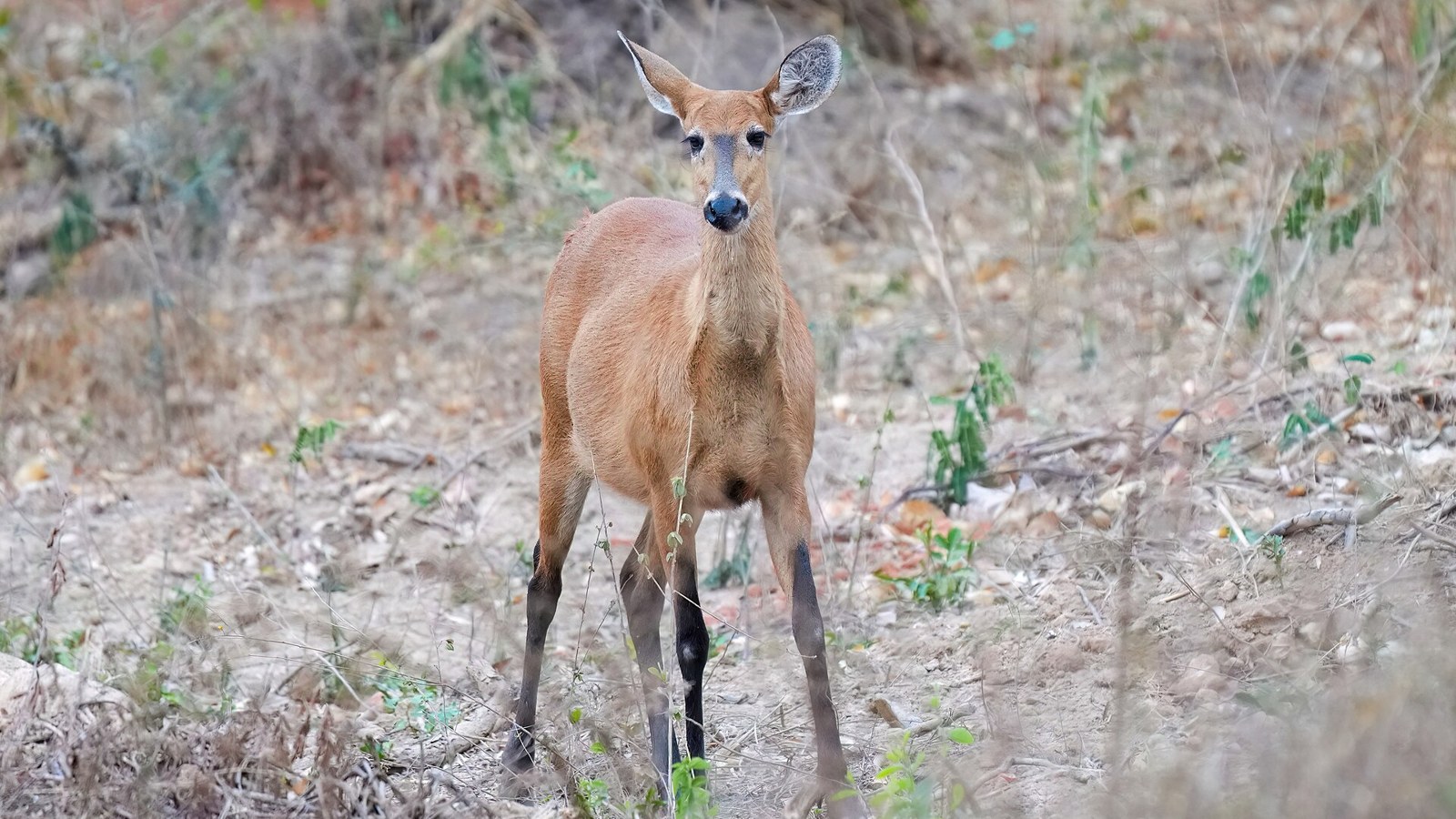
For years, fishermen and residents of the Pantanal told the same story: somewhere in the flooded fields there lived a deer with a coat so dark it looked almost black. Nobody had a photograph and science had no record, so the tale earned the reputation of a legend.
That reputation has now ended. Researchers have confirmed, for the first time, marsh deer (Blastocerus dichotomus), known in Brazil as cervo-do-pantanal, with melanism, the genetic condition that darkens the coat. The animals were documented both in the Pantanal and in the Cerrado.
The finding was published in the scientific journal Notas sobre Mamíferos Sudamericanos by researchers from Onçafari and Embrapa Pantanal.
Drones and camera traps found the first dark deer
The first three animals were recorded by drones and camera traps during long-term monitoring of wildlife. A female appeared at Caiman Pantanal, in Mato Grosso do Sul. Two males were recorded in Grande Sertão Veredas National Park, on the border between Minas Gerais and Bahia, already inside the Cerrado biome.
After the paper came out, a third male, a young one, was also seen in the Cerrado. The sequence matters: a tale that was once told only on riverbanks now has images, locations and a peer-reviewed publication behind it.
The typical marsh deer has a reddish-brown coat with dark legs. In melanistic animals the fur becomes so dense and dark that, from a distance, the deer can look black. Melanism is a known phenomenon in other Brazilian animals, such as the jaguar, whose dark form is popularly called the black jaguar (onça-preta). In deer, however, the phenomenon is far less documented, which is what makes these records so unusual.
The largest deer in South America
The marsh deer is the largest cervid in South America. It can reach 4.3 feet (1.30 meters) at the shoulder, not counting the males’ antlers, which can carry several branches. It lives in wet areas, marshes and floodable grasslands, where wide hooves and a membrane between the toes help it walk through mud and water.
The Pantanal is the species’ main stronghold and holds about 88% of the Brazilian population. Outside it, the marsh deer lost much of its habitat to the drainage of floodplains, the construction of hydroelectric dams and the expansion of agriculture.
Its conservation status reflects that history. The marsh deer is considered vulnerable to extinction in Brazil. It has lost a large share of its former floodplain areas along the Paraná, Paraguay and São Francisco rivers, which were turned into hydroelectric reservoirs, croplands and pastures. It also suffers from diseases transmitted by cattle, hunting and roadkill.
Two thirds of the sightings were dark
The most striking number came from Grande Sertão Veredas National Park, where the species is rare. Between February 2025 and January 2026, dark-coated animals accounted for 66.7% of the observations. In other words, in a place where the marsh deer is scarce, the dark coat stopped being an exception.
That detail is what turned a curiosity into a question for conservation biology. A color variant that appears in two out of every three sightings says something about the population that carries it, even if scientists do not yet know exactly what.
The researchers still do not know the cause. In the Cerrado, one hypothesis is a genetic bottleneck. When only a few animals remain, mating between relatives becomes more common, and rare traits such as melanism can show up more often than they would in a large population.
That explanation, however, does not work for the Pantanal, where the population is large and healthy. There, the origin of the dark coat remains an open question. Two different landscapes, then, may be pointing to two different stories behind the same color.
Even in the Pantanal, the picture is not simple. The population is still robust, but large fires and longer droughts, like those of recent years, shrink the flooded fields that the deer depends on for feeding and hiding.
How to tell a marsh deer from other Brazilian deer
Several deer species live in Brazil, but none comes close to the marsh deer in size. The pampas deer (veado-campeiro), common in the grasslands of the Pantanal and the Cerrado, is much smaller and lighter in color.
The red brocket (veado-mateiro) and the gray brocket (veado-catingueiro) live inside forests and have simple antlers shaped like spikes. The branching antlers, the large ears and the dark legs that look like socks are the marks of the marsh deer, which is now also known in a dark-coated version.
Why the record matters
Beyond the curiosity, the finding has value for conservation. Knowing that a visible genetic variation exists helps researchers follow populations and understand whether small isolated groups, like those in the Cerrado, are losing genetic diversity.
For people who live in the Pantanal, the confirmation also carries another meaning: the legend told at the edge of the rivers was, after all, a real animal. It is a reminder that local knowledge often runs ahead of the scientific record, and that long-term monitoring with drones and camera traps can finally give it a face.
Reporting: Revista Amazônia newsroom / Amazonia Mag

Editor · Amazonia Mag
Anne Silva is the editor of Amazonia Mag, the English-language edition of Revista Amazônia. She curates, translates and adapts the outlet's science and environment coverage for an international audience, reporting on Amazon wildlife, flora, rivers, climate and research. Every story she edits is grounded in peer-reviewed studies, official data and on-the-ground reporting from the Revista Amazônia newsroom in Belém, Pará, Brazil. More by Anne Silva →