
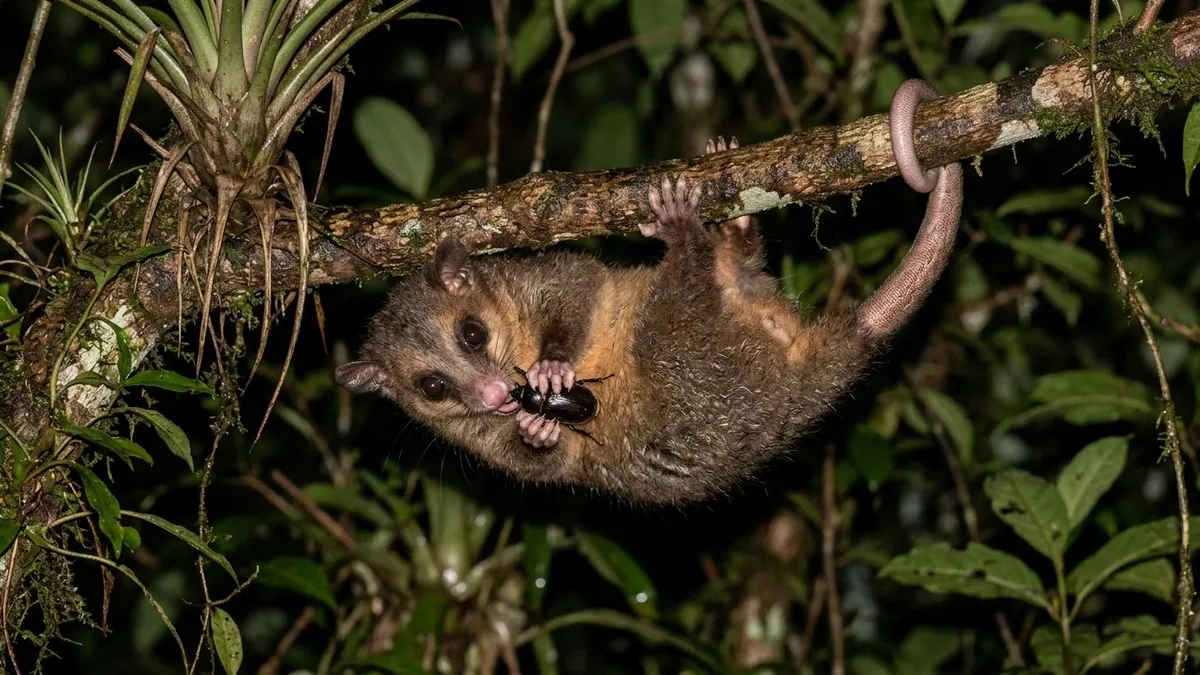
When the forest grows dark, the cuíca-lanosa, or woolly opossum, begins searching for food among branches, leaves and tree hollows. This small marsupial lives tied to the tree canopy and does not rely on a single kind of resource to survive. Fruit, nectar, insects and other small animals can all be part of its diet, depending on what the forest offers at the time.
A varied diet high in the forest
That combination makes the species a consumer at different levels of the forest, because it uses both the resources produced by plants and the organisms that live on them. Instead of filling only the role of predator or only that of fruit eater, the cuíca-lanosa moves between those functions during its nightly search for food. The result is a direct relationship with trees, flowers, invertebrates and small vertebrates that share the same space.
The diet also helps explain why the canopy matters so much to the species. In the upper layers of the forest there are ripe fruits, flowers visited by insects and a diversity of small animals hidden in the vegetation. The woolly opossum explores this variety while keeping the careful way of searching that is common among nocturnal mammals, which have to find food in low light.
Its muzzle, its sharp senses and its ability to recognize smells help it locate scattered resources. A flexible diet works as a strategy for making use of the environment, especially in a landscape where the supply of fruit and invertebrates changes over time. Each trip through the canopy can put the animal in contact with a different source of food.
The path of the seeds through the forest
When it eats fruit, the cuíca-lanosa can carry seeds away from the plant that produced them. After passing through the digestive system, part of this material is deposited at another point in the forest, where it may find conditions to germinate. This process is known as seed dispersal, and it is one of the most important links between fruit-eating animals and plants.
The opossum does not plant trees on purpose, but its movements turn the path it follows into a potential route for plant regeneration. The distance between the tree it visited and the place where the seeds are dropped varies with the animal’s route and with how long the food stays in its body. A small mammal can therefore take part in a stage that influences how plants are distributed in the environment.
This role does not mean that every seed it swallows will germinate, or that the opossum alone renews the forest. Germination depends on factors such as moisture, light, soil and the absence of predators or competitors. Even so, passage through the animal’s body can change the pulp around the seed and reduce the concentration of material that favors fungi or attracts consumers.
Transport also keeps all the seeds from piling up under the mother tree, where competition for water, nutrients and space can be greater. The woolly opossum is therefore part of a network of dispersers that includes birds, bats and other mammals. Its role looks less like an isolated event and more like one of many nightly movements that redistribute plant life.
A marsupial linked to many forms of life
The cuíca-lanosa belongs to the marsupials, mammals whose young complete an important stage of development in association with the mother’s body. As with other members of this group, reproduction involves a very early phase of development and the young staying with the mother for the period in which they still need protection and food.
This cycle ties the species to the availability of shelter and food in the forest. The female needs to find suitable conditions to keep her young while she continues to be exposed to changes in the environment. A nocturnal, tree-dwelling life reduces some encounters with threats that act on the ground, but it does not remove natural risks. Reproduction, like feeding, depends on the integrity of the places where the species finds shelter and resources.
The bond with the canopy also places the woolly opossum within a community of plants, insects, birds and other mammals. By visiting flowers, it may come into contact with the reproductive structures of plants and help carry pollen, although the importance of this process depends on each plant species. By catching insects, it takes part in the control of small invertebrates, while eating fruit puts it in the flow of energy produced by trees.
These relationships do not make the cuíca-lanosa responsible for all the processes of the forest. They show, however, that a single animal can occupy different positions in the ecological network, depending on the food it finds and the moment at which it moves. The forest works through connections like these, made of repeated and discreet interactions.
What the presence of the species reveals
Finding a woolly opossum means observing an animal that depends on a forest structure with trees, vines, hollows, flowers and fruits spread at different heights. The species is not only an inhabitant of the canopy but also a consumer that needs varied resources throughout the year.
When vegetation loses its continuity, movement between feeding areas and shelter can become harder. A reduction in fruit-bearing trees also changes the food supply, and a simplified forest reduces the places used by insects and other organisms in its diet. For this reason, conserving the species requires keeping the complexity of the environment, and not only protecting individuals found by chance. The same measure benefits plants that depend on animals to carry their seeds, and other members of the forest community.
The cuíca-lanosa usually goes unnoticed because it acts at night and stays among leaves and branches, far from everyday observation. Even so, its routine brings together three processes that sustain the forest: consumption, transport and redistribution of living matter. Looking at it from this angle changes the scale of observation. The animal stops being only a discreet visitor to the canopy and becomes part of a circuit that carries fruit, seeds and energy from one point of the forest to another.
Each silent trip may take part in the continuity of an entire forest.
Reporting: Natália Santos / Amazonia Mag

Editor · Amazonia Mag
Anne Silva is the editor of Amazonia Mag, the English-language edition of Revista Amazônia. She curates, translates and adapts the outlet's science and environment coverage for an international audience, reporting on Amazon wildlife, flora, rivers, climate and research. Every story she edits is grounded in peer-reviewed studies, official data and on-the-ground reporting from the Revista Amazônia newsroom in Belém, Pará, Brazil. More by Anne Silva →