
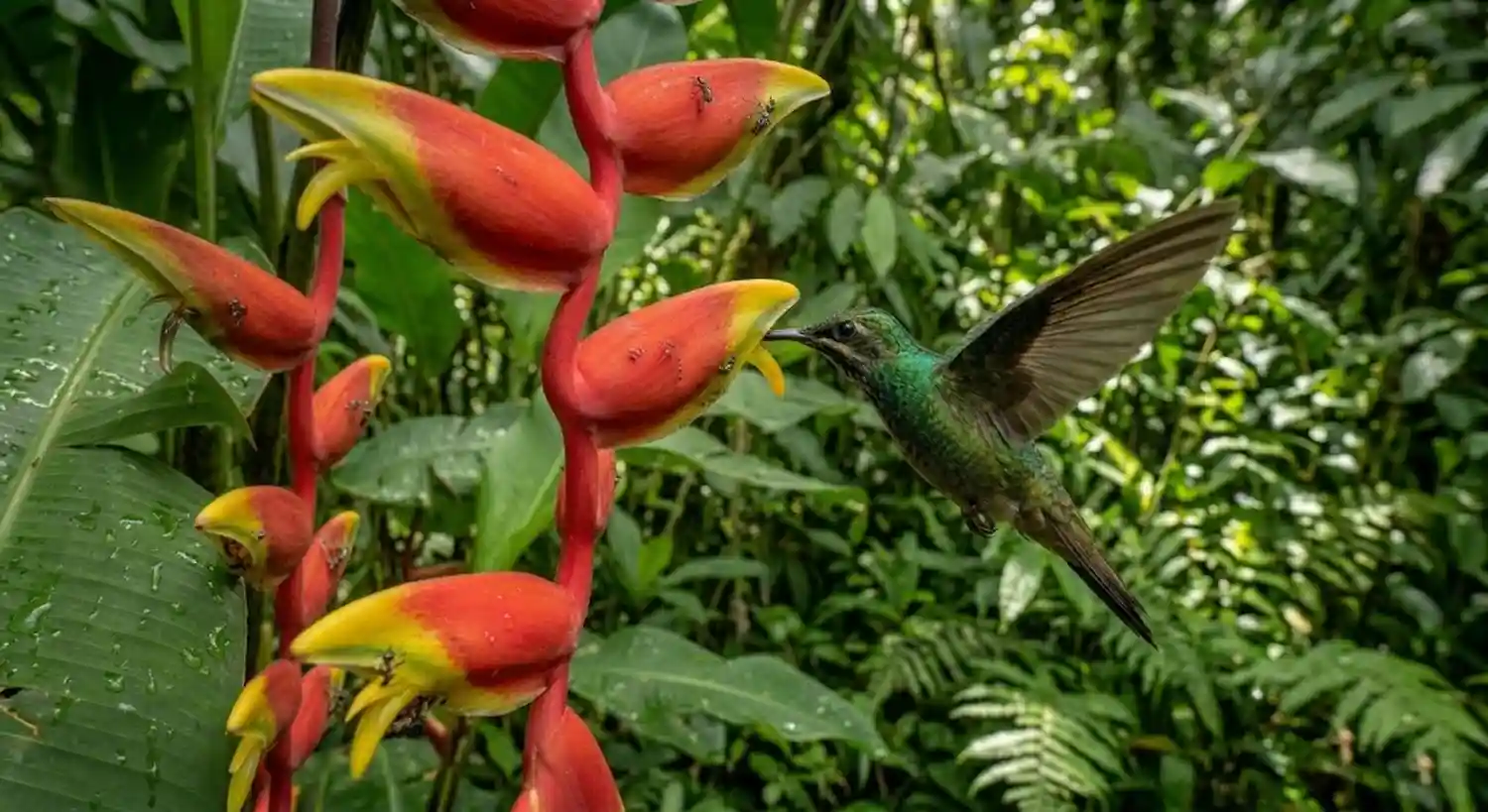
The heart of an Amazonian hummingbird can beat up to 1,200 times per minute as the bird performs an aerial maneuver in front of a heliconia bract that appears to challenge the laws of physics. This remarkable effort is not random. It is the result of biological refinement that has continued for more than five million years in dense upland forests.
The relationship between bird and plant is one of the clearest examples of coevolution in the Amazon. Science uses that term for the process in which two species exert reciprocal pressures and gradually shape each other’s traits. In this case, the survival of one has become closely tied to the other, creating a highly specialized alliance.
According to researchers who observe this kind of interaction, the partnership shows that the rainforest is not simply a collection of trees, birds, and flowers. Every organism participates in a network of exchanges, and a small change in one part can affect feeding, reproduction, and the distribution of many species.
A flower shaped like a lock
The red heliconia has bracts that resemble lobster claws. Its nectar is hidden at the bottom of long, curved floral tubes. To reach that energy-rich food, certain hummingbird species evolved bills that closely mimic the flower’s curve.
The comparison to a key and a lock helps explain the specialization. The bill enters the tube, the bird’s tongue reaches the nectar, and pollen grains are stamped onto the hummingbird’s forehead during the visit. When the bird moves to another plant, it carries that genetic material with it and promotes reproduction across distance.
This transport keeps Amazonian plant diversity active. It also helps prevent plant populations from becoming isolated, because pollen can reach heliconias growing far apart. As the researchers described in the material observe, a small bird becomes one of the rainforest’s most efficient connectors between plants.
In areas where the Amazon heliconia hummingbird occurs most frequently, specialization can reach especially precise levels. The fit between flower and bill is not merely a striking image. It reflects adaptations accumulated over more than five million years.
The energy cost of flight
A hummingbird lives close to the limit of its metabolism. To remain suspended in the air, it must consume a daily amount of nectar equivalent to as much as eight times its own body weight. Proportionally, this accelerated metabolism makes the bird one of nature’s most voracious animals.
A heartbeat reaching 1,200 beats per minute and the constant movement of its wings require a continuous energy supply. Heliconia nectar is therefore not a minor resource. Without it, these small birds would enter energy collapse within a few hours, underscoring the vital importance of preserving the Amazon’s humid microhabitats.
Some hummingbird species, including the great-billed hermit, spend more energy flying among scattered plants than defending a fixed territory. This behavior, described as “flower wandering,” takes the bird from one plant to another rather than keeping it within a single area.
The movement has an important ecological consequence. By traveling between heliconias that grow far apart, the hummingbird promotes cross-pollination. This exchange strengthens the vegetation’s genetics and helps plant populations withstand pests and temperature changes.
An alliance built on reciprocal investment
The coevolution of Amazonian fauna and flora can be understood as a dance of reciprocal adaptations in which neither side acts alone. The plant “invests” in producing high-quality nectar, rich in sugars and amino acids, to attract specifically the bird capable of pollinating it with precision.
The hummingbird, in turn, adapts its vision to see red wavelengths with absolute clarity. That ability makes it easier to locate the heliconia amid the chaotic green of the understory. The system resembles a biological market: energy is the currency, and the profit is the continuation of life.
Feeding and reproduction occur in the same act. The bird obtains fuel to sustain its flight, while the flower receives the service it needs to produce seeds. The bill’s precision, the color of the bracts, the composition of the nectar, and the pollinator’s movements are all parts of one mechanism.
Natural selection therefore appears as a force capable of shaping tiny details with broad consequences. A curve only a few millimeters different can determine which bird reaches the nectar and which plant receives pollen. In the researchers’ view, this natural engineering demonstrates the power of natural selection within the biome.
When fragmentation breaks the rhythm
The balance faces a silent threat. Hummingbird pollination depends on precise timing, and any change in the rainfall cycle or any fragmented deforestation can break the link between flower and bird.
When a clearing is opened irregularly, local temperatures rise and humidity falls. Under those conditions, the heliconia may produce less nectar or bloom out of season. The hummingbird, operating with an accelerated metabolism, no longer finds the fuel required for its local movements.
The result can be a drastic decline in the plants’ fruiting rate. The threat affects more than two isolated species. It can also disrupt a web of interdependence that supports thousands of other organisms and requires humid areas, continuous vegetation, and plants able to flower at the right time.
Without the hummingbird, the heliconia stops producing seeds. Without those seeds, the soil loses some of the plant cover that retains water and nourishes the ecosystem. This cascading effect shows how a small-scale interaction can influence the rhythm of the planet’s largest tropical rainforest.
Studying this partnership helps explain that the Amazon is a living system of invisible connections. Watching a hummingbird at work pollinating is like witnessing a natural technology that no human machine has managed to replicate with the same efficiency. The lightness of its flight and the precision of its bill are lessons in adaptation and sustainability offered by the forest every day.
Protecting the relationship between bird and heliconia means conserving far more than two living beings. It means preserving the conditions that allow pollen exchange, seed production, ground cover, and the continuity of vegetation. The survival of this ancient partnership now depends less on biological evolution than on the human ability to respect the limits of standing forest.
Reporting: Anne Silva / Amazonia Mag

Editor, English Edition — Amazonia Mag
Anne Silva is the editor of Amazonia Mag, the English-language edition of Revista Amazônia. She curates, translates and adapts the outlet's science and environment coverage for an international audience, reporting on Amazon wildlife, flora, rivers, climate and research. Every story she edits is grounded in peer-reviewed studies, official data and on-the-ground reporting from the Revista Amazônia newsroom in Belém, Pará, Brazil. More by Anne Silva →