
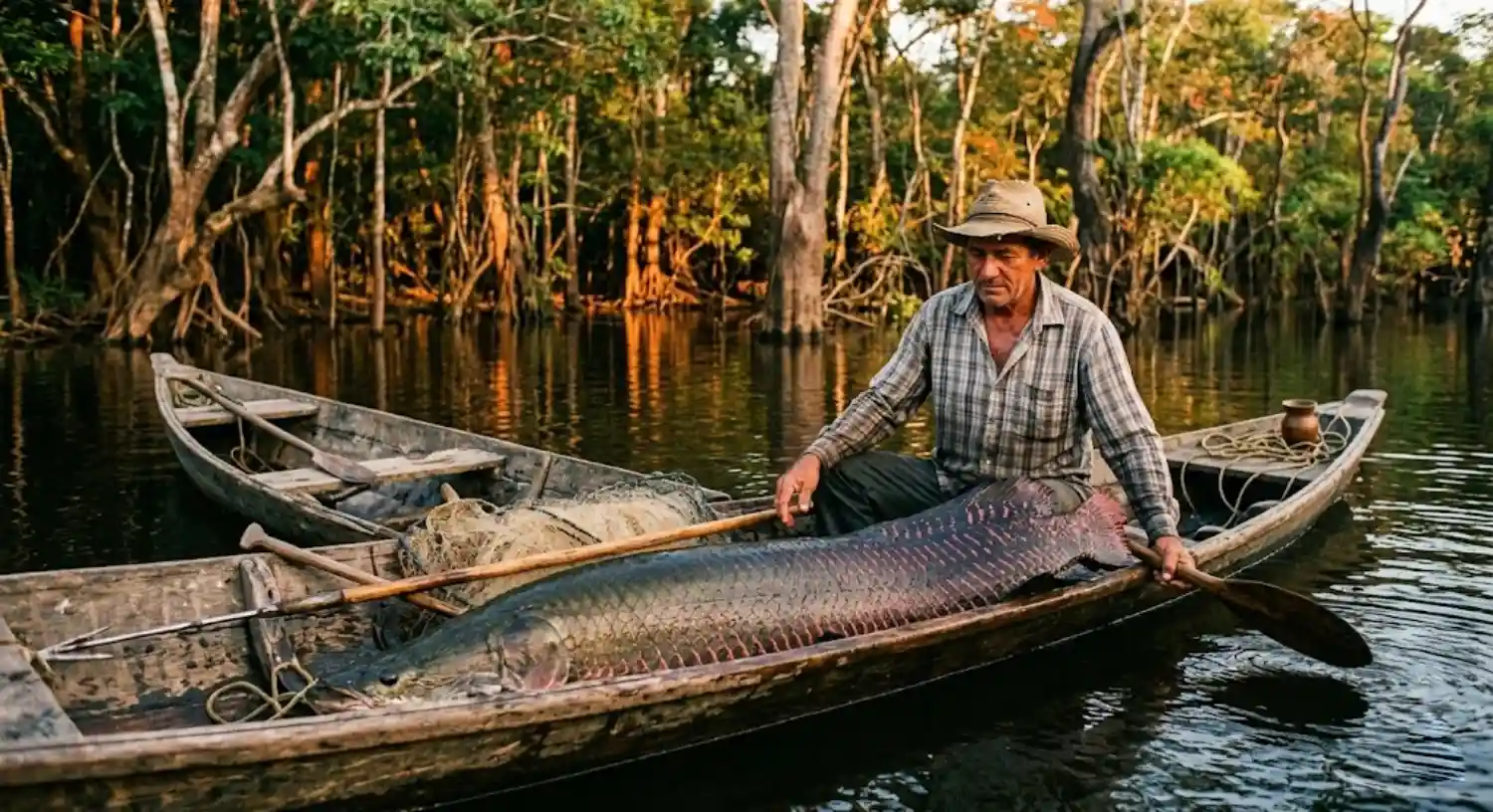
The arapaima, Arapaima gigas, is the largest freshwater scaled fish in the world. Its unique biology forces it to rise to the surface to breathe atmospheric air approximately every ten to twenty minutes, an adaptation that is essential for survival in waters with low oxygen levels.
That same trait also makes the giant Amazon fish extremely vulnerable to unregulated fishing. Whenever it appears at the surface, it reveals its exact location to fishers. According to studies on the species, this vulnerability helped push arapaima to the brink of extinction in several parts of the Amazon Basin during the last century, as a result of predatory and uncontrolled exploitation.
Turning vulnerability into conservation
In the lakes of Brazil’s Amazonas state, however, the current situation shows an extraordinary positive impact. Community-based arapaima management has turned the threat of extinction into an example of biocultural conservation by combining traditional ecological knowledge with rigorous counting methods and strict fishing quotas.
Instead of disorganized and competitive exploitation, riverine and Indigenous communities work together to manage fish stocks collectively. Their approach considers the arapaima’s biology, the conditions of the lakes and government regulations designed to protect both the water bodies and their fish populations.
The system also changes the relationship between conservation and the local economy. Protecting arapaima is no longer separate from everyday life. It becomes part of a community development strategy with defined rules, shared responsibilities and benefits distributed among the people involved in management.
Counting fish from canoes during the dry season
Sustainable management begins with an annual count of the arapaima living in the region’s lakes. Members of the communities carry out the work after receiving training to observe the fish rising to the surface and use those appearances to estimate the adult and juvenile populations.
During the dry season, community members travel across the lakes in canoes equipped with GPS. They estimate the population by considering the size and frequency of the fish as they surface. A behavior that once exposed arapaima to fishers is therefore turned into a crucial source of conservation data.
The observation requires care and organization. Each rise to the surface contributes information that helps establish a clearer picture of the stocks and supports management decisions. The result is an estimate considered precise, produced by people who know the lakes and take direct responsibility for protecting their resources.
Based on these consolidated data and in accordance with government regulations, fishing quotas are established. The rules allow the removal of only a safe fraction of the adult population, generally around 30 percent, helping ensure the species’ natural regeneration.
From predatory fishing to a regulated economy
Putting this model into practice has brought a profound transformation to local communities. Predatory fishing has been replaced by an economic activity that is regulated and profitable, allowing production to continue without separating it from the conservation of the lakes.
Income for riverine families increased significantly through arapaima management. Profits from fish sales are distributed equitably among community members, strengthening the local economy and improving the quality of life for the families involved.
The proceeds also finance projects in education, health, infrastructure and sustainability. The economic value of arapaima therefore goes beyond the sale of individual fish. The activity helps sustain collective initiatives and expands communities’ ability to decide about their own future.
Community management also strengthens social organization and local empowerment. Communities gain control over their natural resources and their own development, while traditional knowledge is recognized as an essential part of a strategy that also depends on measurements, records and protective rules.
Protecting the lakes through local surveillance
Protecting the lakes and monitoring illegal fishing are fundamental pillars of the model’s success. To defend the places where arapaima live and reproduce, communities organize local surveillance systems, fight predatory fishing and help guarantee the conservation of the aquatic and terrestrial biodiversity around the lakes.
The surveillance benefits far more than one species. Science recognizes that areas protected through community management serve as refuges for many other fish, birds, mammals and reptiles. By caring for the lakes, communities also help preserve the biodiversity of the surrounding environments.
This effect supports the health and resilience of the Amazon ecosystem as a whole. Protecting a resource with economic importance becomes connected to the protection of a broader network of habitats and species, reinforcing the biocultural character of the model.
A model with lessons beyond the Amazon
Community management of arapaima shows that Amazon conservation can be achieved through the active involvement of local populations and the recognition of their traditional knowledge. When communities’ economic interests are aligned with the conservation of natural resources, a virtuous cycle of sustainable development and social justice can emerge.
Sustainable fishing for Arapaima gigas is not only a way to secure the survival of an iconic species. It also promotes the dignity and autonomy of the riverine and Indigenous populations living in the forest, recognizing their ability to manage the resources on which their communities depend.
The successful experience offers valuable lessons for biodiversity conservation in other parts of the world. Recognizing the central role of local communities in managing natural resources and investing in their skills and knowledge can help create solutions that are more effective and lasting in the face of environmental and social challenges.
The sustainability and profitability demonstrated by this model testify to the potential of cooperation among science, tradition and community action. Its purpose is not only to preserve a fish of major ecological and cultural importance, but also to help build a fairer and more balanced future for the Amazon and the planet.
The conservation of the Amazon and the future of its traditional populations depend on the ability to value and replicate sustainable development models such as community management of arapaima. By protecting the lakes, applying quotas and continuing counts conducted by trained community members, the biological and cultural wealth of the world’s largest tropical forest can be preserved for present and future generations.
Reporting: Anne Silva / Amazonia Mag

Editor, English Edition — Amazonia Mag
Anne Silva is the editor of Amazonia Mag, the English-language edition of Revista Amazônia. She curates, translates and adapts the outlet's science and environment coverage for an international audience, reporting on Amazon wildlife, flora, rivers, climate and research. Every story she edits is grounded in peer-reviewed studies, official data and on-the-ground reporting from the Revista Amazônia newsroom in Belém, Pará, Brazil. More by Anne Silva →