
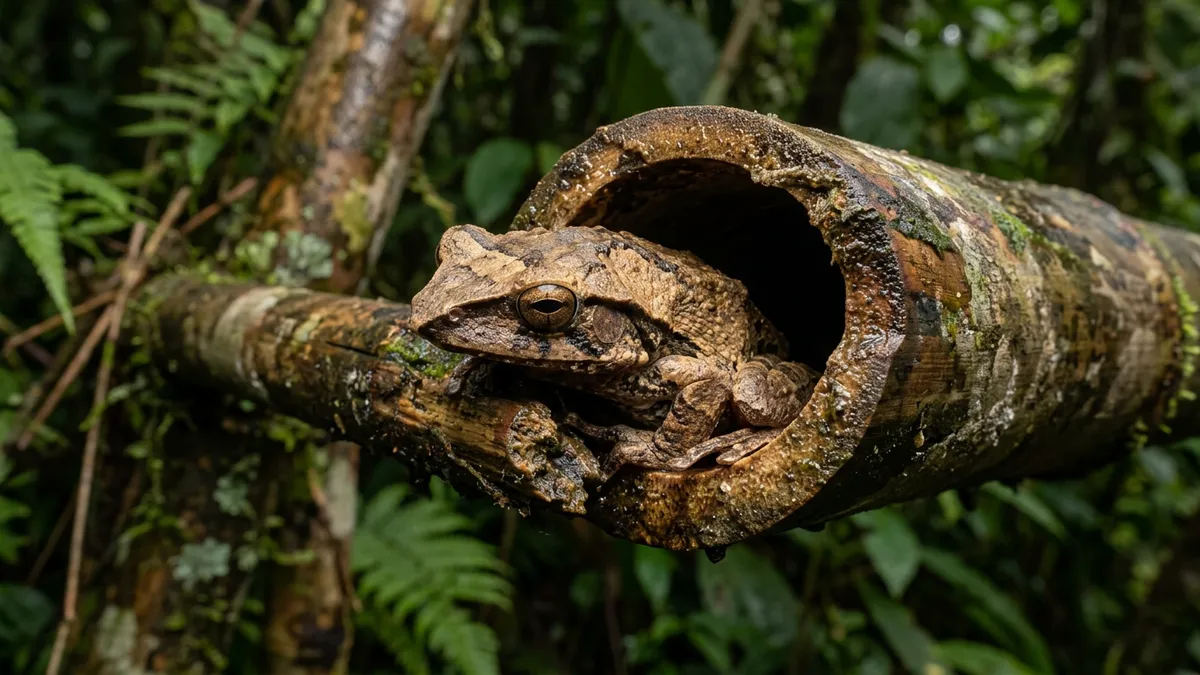
During the day, the casque-headed treefrog hides in a cavity and uses its own head to block the entrance. The behavior works because the animal’s skull is ossified, forming a rigid structure that acts as a lid. Instead of leaving its body exposed inside the shelter, the treefrog places its head in the opening and shrinks the space through which air can move.
At that moment the shape of the body stops being only about getting around or protecting the internal organs. It also becomes part of a system for holding in moisture. Biologists have a word for using the head to plug a refuge: phragmosis.
The skull becomes a lid
The mechanism combines anatomy and behavior. The hardened head sits in the entrance of the hideout while the rest of the body stays inside the cavity. This creates a physical barrier against the quick escape of water, an important condition for an amphibian that depends on damp surfaces to keep its body in balance.
The common name points to a helmet, and the idea fits: the head is hardened enough to act as a shield for the opening. What matters is concrete and functional, because ossification makes it possible to use the head as a seal.
The head, in short, does a second job. Besides housing the brain and sense organs, it closes the door of the home.
Two kinds of shelter in the life of a tree-dwelling frog
The casque-headed treefrog is arboreal and nocturnal. That means its routine is split between a period of shelter during the day and a phase of activity after the light fades. To hide, it uses bamboo hollows and bromeliads, two settings that offer a well-defined entrance and can hold the body.
The cavity is not just a resting place. It supplies a protected surface, cuts direct exposure and creates the condition that allows the animal to set its head in the opening.
Using bamboo and bromeliads also shows that the behavior depends on the architecture of the environment. A bamboo hollow gives a narrow, elongated passage, while a bromeliad gathers leaves into a structure that can hold water and organic matter. In both cases, an opening is what allows the ossified head to be placed as a barrier between the protected interior and the outside world.
Sealing the entrance cuts water loss while the frog waits for night
The most direct adaptive function of the behavior is to reduce water loss. Amphibians exchange gases and water through the skin, which makes controlling moisture a constant issue. When the treefrog withdraws and plugs the opening with its head, it exposes less of its body and limits the air circulating in the shelter.
The mechanism does not eliminate water loss, but it helps make the body’s internal environment less prone to drying out while the animal sits still.
Water matters this much because an amphibian has no waterproof covering. Moisture leaves the body surface whenever the surrounding air is drier than the skin, and an animal resting all day in an enclosed space does best with as little airflow around it as possible. The plugged entrance keeps still air close to the body, which is the practical gain of the behavior.
The strategy is also tied to the hours of activity. Because the species is nocturnal, it spends the day sheltered and leaves its hideout when conditions change. The head used as a lid turns that stretch of inactivity into a stage of water conservation. The key point is a specific one: the ossified skull closes the entrance of the shelter and helps reduce water loss while the animal stays hidden during the day.
A body feature that organizes the daily routine
The treefrog does not use its head as a lid in isolation from the life of the habitat. The ossification of the skull becomes useful when it meets a shelter with a suitable opening, and the shelter becomes more efficient when the animal manages to seal it. There is, therefore, a combination between the anatomy of the species and the spaces available in the vegetation.
This also explains why the behavior is tied so closely to the shelters. Take away the hollow or the bromeliad and the skull has nothing to close. The adaptation belongs to the animal and its surroundings at once.
Hollow bamboo and bromeliads are not simply scenery. They are part of the resting behavior. The result is a body-based solution for staying protected and conserving water until nighttime activity begins.
For a small amphibian that lives above the ground, keeping water is a constant concern, because its skin lets moisture pass in and out. No hideout can be taken for granted. A solution that uses the animal’s own skull as a door shows how a single anatomical feature can organize an entire day of waiting.
One scene, one clear function
The picture is a precise one. A nocturnal frog tucked inside a bamboo hollow or bromeliad, its head fitted into the entrance, keeps the water it will need for the night. Nothing in it depends on speed or force. It depends on a hard head, a suitable opening and a long daylight stretch spent perfectly still.
By closing the shelter with its skull, the casque-headed treefrog makes its own body a door to get through the day and preserve the water needed for the night.
Reporting: Natália Santos / Amazonia Mag

Editor · Amazonia Mag
Anne Silva is the editor of Amazonia Mag, the English-language edition of Revista Amazônia. She curates, translates and adapts the outlet's science and environment coverage for an international audience, reporting on Amazon wildlife, flora, rivers, climate and research. Every story she edits is grounded in peer-reviewed studies, official data and on-the-ground reporting from the Revista Amazônia newsroom in Belém, Pará, Brazil. More by Anne Silva →