
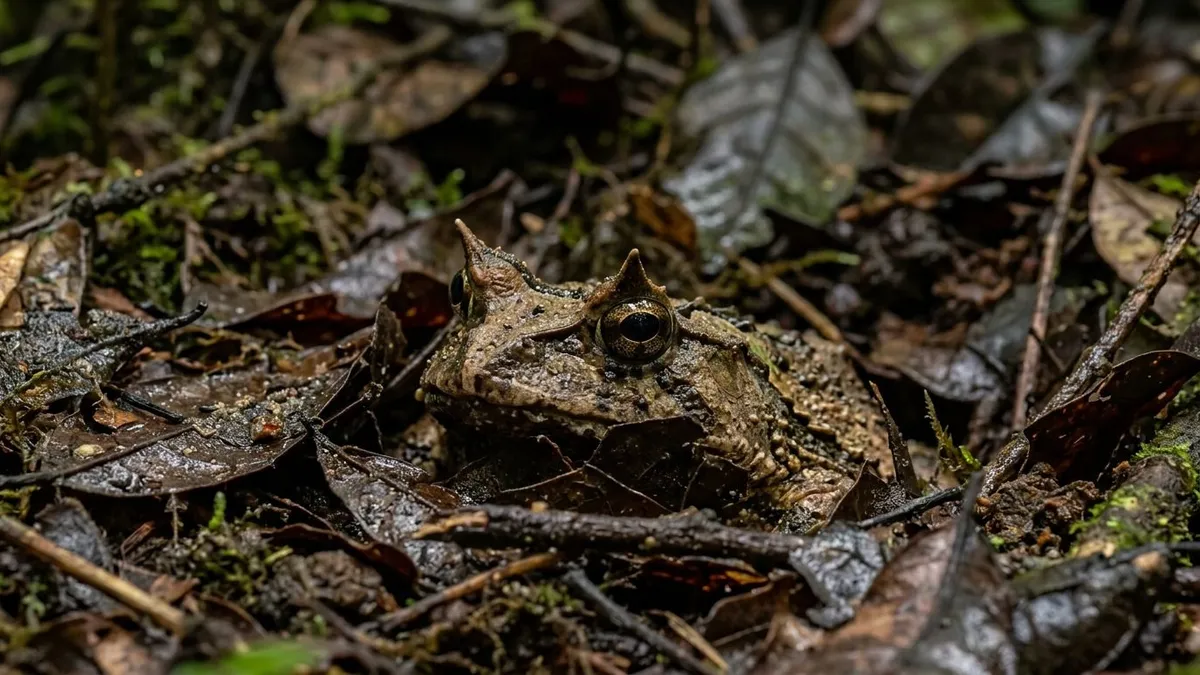
The Amazonian horned frog hunts with an ambush system built on near-total burial and long stillness on the forest floor. Using its modified hind feet to dig into the organic layer, the amphibian sinks its body into the dry leaves until only its eyes and the top of its nostrils stay in view. That posture sharply reduces how visible the animal is to both prey and predators.
From that spot it can stay put for weeks at a time without any noticeable movement. When a small vertebrate comes within reach, the horned frog lunges out of the leaf layer and uses its oversized mouth to seize the target. Camouflage in the shape of the body, paired with an instant muscular strike, is the basis of its survival in the biome.
Hiding by looking like dead leaves
The frog’s camouflage depends on a direct match between its skin and the makeup of the Amazonian leaf litter. Triangular skin projections sit just above each eye, the horn-like structures that give the animal its name. They break up the outline of the head and imitate the shape of twisted dead leaves.
The back adds to the effect. Its coloring mixes brown, dark brown, olive green and beige in irregular patches that follow the tonal changes of the damp forest soil. Against that background, the head and body stop reading as a single animal.
Sinking into the ground is a matter of leg work. The hind limbs rotate in alternation, and their hard foot tubercles act like small digging blades. As the substrate is pushed to the sides, the rounded body drops down until fallen leaves cover the back and the flanks, leaving only the top of the skull exposed. The result is an animal lined up with the leaf layer, so that prey walking past has little chance of noticing it.
A mouth built for large prey
The horned frog’s mouth is unusually large compared with that of other South American frogs and toads. The opening spans almost the whole width of the front of the skull, which lets the animal take in organisms that are big relative to its own body. Strong jaw muscles give it a grip firm enough to hold prey that struggles hard after the first strike.
Unlike most common toads, whose jaws lack hard projections, the horned frog has true teeth on the upper jaw and tooth-like bony points on the lower jaw. These small, curved structures point toward the throat and work as retaining hooks, making it harder for rodents, lizards or other amphibians to wriggle free.
The short, muscular tongue helps push the catch straight toward the esophagus. Swallowing begins at once, with no chewing.
Waiting, then a strike that takes a fraction of a second
A strategy that depends on food passing by chance only works for an animal that spends very little energy while it waits. Sitting buried and motionless is exactly that kind of routine, and it explains how a frog can go without moving for so long.
The strike itself is the opposite of the wait. When prey of a suitable size enters the frog’s immediate range, the hind limbs contract explosively and the body is thrown forward in a movement that lasts a fraction of a second. The mouth opens to its full width to wrap around the target.
That speed leaves small vertebrates no time to flee. The first impact can disorient the prey before the frog has even settled back into its defensive posture on the ground. Its eyes sit on top of the head, which keeps the line of the ground in view while the rest of the body stays hidden.
What it eats and what that means for the forest floor
Unlike amphibians that feed only on small insects, the horned frog takes a wide range of vertebrates. Its diet includes wild rodents, small reptiles, young snakes and other frogs. That breadth makes it a direct regulator of small animals that move across the surface of the soil.
A sedentary predator can still leave a mark on its surroundings. The presence of one buried frog creates a pocket of risk for animals that cross the leaf litter, which can change where and how other ground-dwelling creatures move. The picture is of a slow amphibian that keeps shaping the community of the forest floor from a single spot.
Why an intact leaf layer matters
The frog’s preferred habitat is well-preserved terra firme forest, where the layer of dead leaves stays thick and damp all year. A continuous, undisturbed forest floor is essential for the burying to work and for the animal to keep its skin moist. Loose soil rich in decaying matter offers just the right resistance for quick digging with the hind limbs.
Changes in the microclimate of the soil, such as those caused by deforestation or forest fragmentation, directly affect the viability of horned frog populations. When the leaf litter dries out, camouflage becomes less effective and the frog has a harder time keeping its body water in balance. That can force it to move when it should not, which increases its exposure to larger predators.
Protecting the physical structure of the leaf litter is therefore decisive for this specialized hunting method to continue. The horned frog shows that strict stillness can be as lethal a tool as speed, and that a quiet piece of ground can hold a whole ecological strategy.
Reporting: Natália Santos / Amazonia Mag

Editor · Amazonia Mag
Anne Silva is the editor of Amazonia Mag, the English-language edition of Revista Amazônia. She curates, translates and adapts the outlet's science and environment coverage for an international audience, reporting on Amazon wildlife, flora, rivers, climate and research. Every story she edits is grounded in peer-reviewed studies, official data and on-the-ground reporting from the Revista Amazônia newsroom in Belém, Pará, Brazil. More by Anne Silva →