
Pulling carbon dioxide from the atmosphere is central to almost every plan to slow global warming. But a new study warns that the most common way of doing it on land, planting forests and growing bioenergy crops, can collide head-on with another priority: protecting biodiversity.
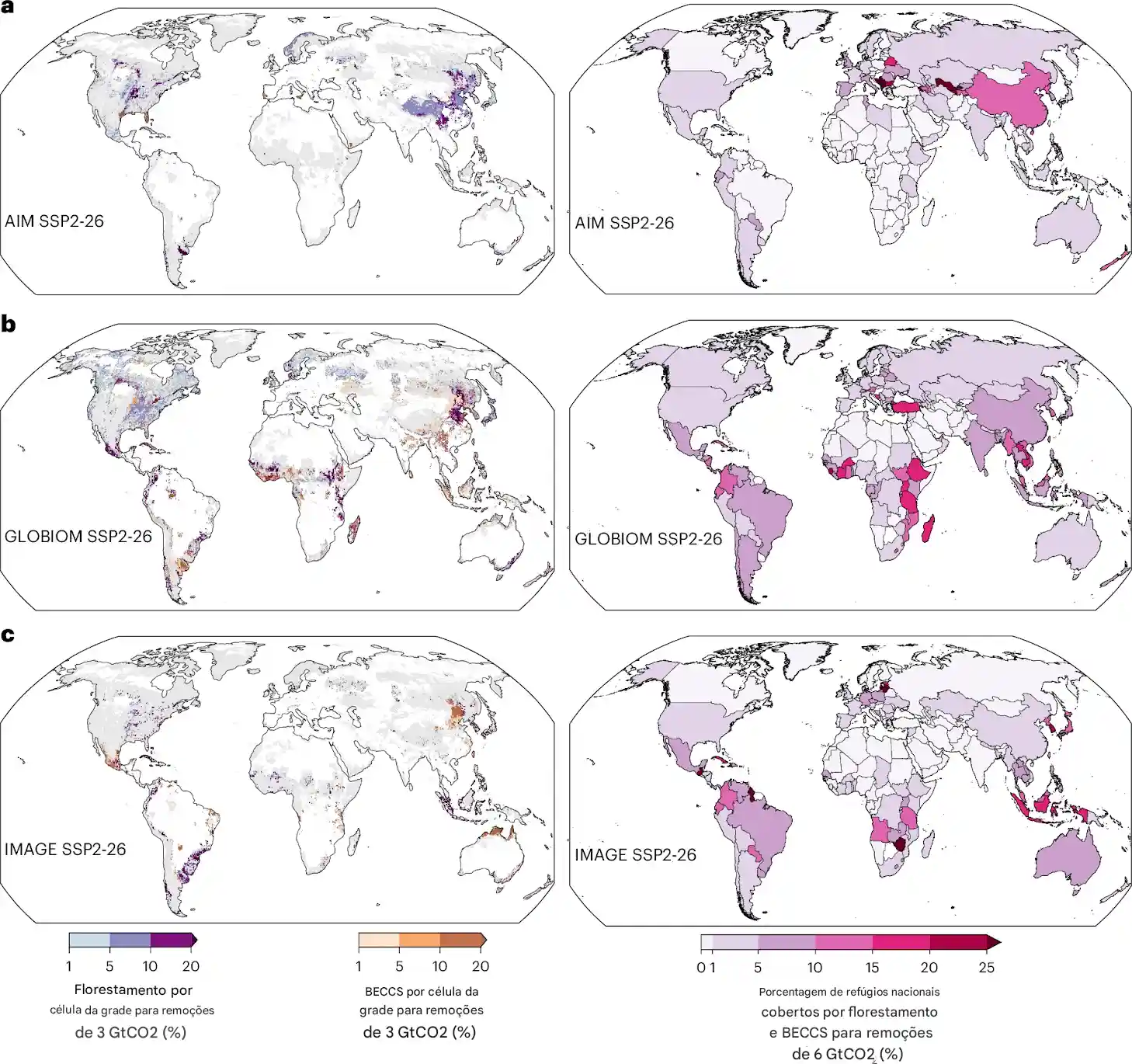
The research, led by scientists at the Potsdam Institute for Climate Impact Research (PIK), analyzed projections from five major climate models, cross-referencing them with the distribution of 135,000 species and 70 biodiversity hotspots. The goal: to map where land-based carbon removal would be deployed in the future, and which ecosystems would end up in the crosshairs.
Up to 13% of the most valuable areas
The finding is uncomfortable. Scenarios consistent with limiting warming to 1.5°C allocate up to 13% of the world’s high-biodiversity areas to land-intensive carbon removal, such as reforestation and bioenergy with carbon capture and storage (BECCS).
The burden is not spread evenly: the largest overlaps fall on low- and middle-income countries, many of them in the tropics, where much of the planet’s wildlife is concentrated. In other words, the cost of a global climate fix tends to land on precisely the most biodiverse regions, the ones least responsible for emissions.
Reforest, yes, but with a map
The authors’ conclusion is not to abandon carbon removal, which remains necessary, but to plan its location better. Planting trees or energy crops in the wrong place can destroy habitats, while doing it on already-degraded or low-value land delivers the climate benefit without sacrificing biodiversity.
To that end, the study argues that location should be treated as a strategic decision, not a detail. The same models that project how much carbon must be removed can, with the right data, point to where it can be done with the least harm to species.
Why it matters for the Amazon
For a region like the Amazon, the message is direct. The standing forest is already one of the world’s largest carbon sinks and an unmatched refuge of biodiversity. Protecting and restoring what exists is often more valuable, for the climate and for wildlife, than converting natural ecosystems into carbon-capture plantations.
The study reinforces an idea science keeps repeating: climate solutions and nature conservation are not separate goals. Planned together, they reinforce each other. Ignoring each other, one can end up destroying the other.
Reporting: Anne Silva / Amazonia Mag. Source: Potsdam Institute for Climate Impact Research (PIK); analysis of five integrated assessment models.
This article is the English edition of reporting originally published by Revista Amazônia. Images: Revista Amazônia archive.

Editor · Amazonia Mag
Anne Silva is the editor of Amazonia Mag, the English-language edition of Revista Amazônia. She curates, translates and adapts the outlet's science and environment coverage for an international audience, reporting on Amazon wildlife, flora, rivers, climate and research. Every story she edits is grounded in peer-reviewed studies, official data and on-the-ground reporting from the Revista Amazônia newsroom in Belém, Pará, Brazil. More by Anne Silva →