
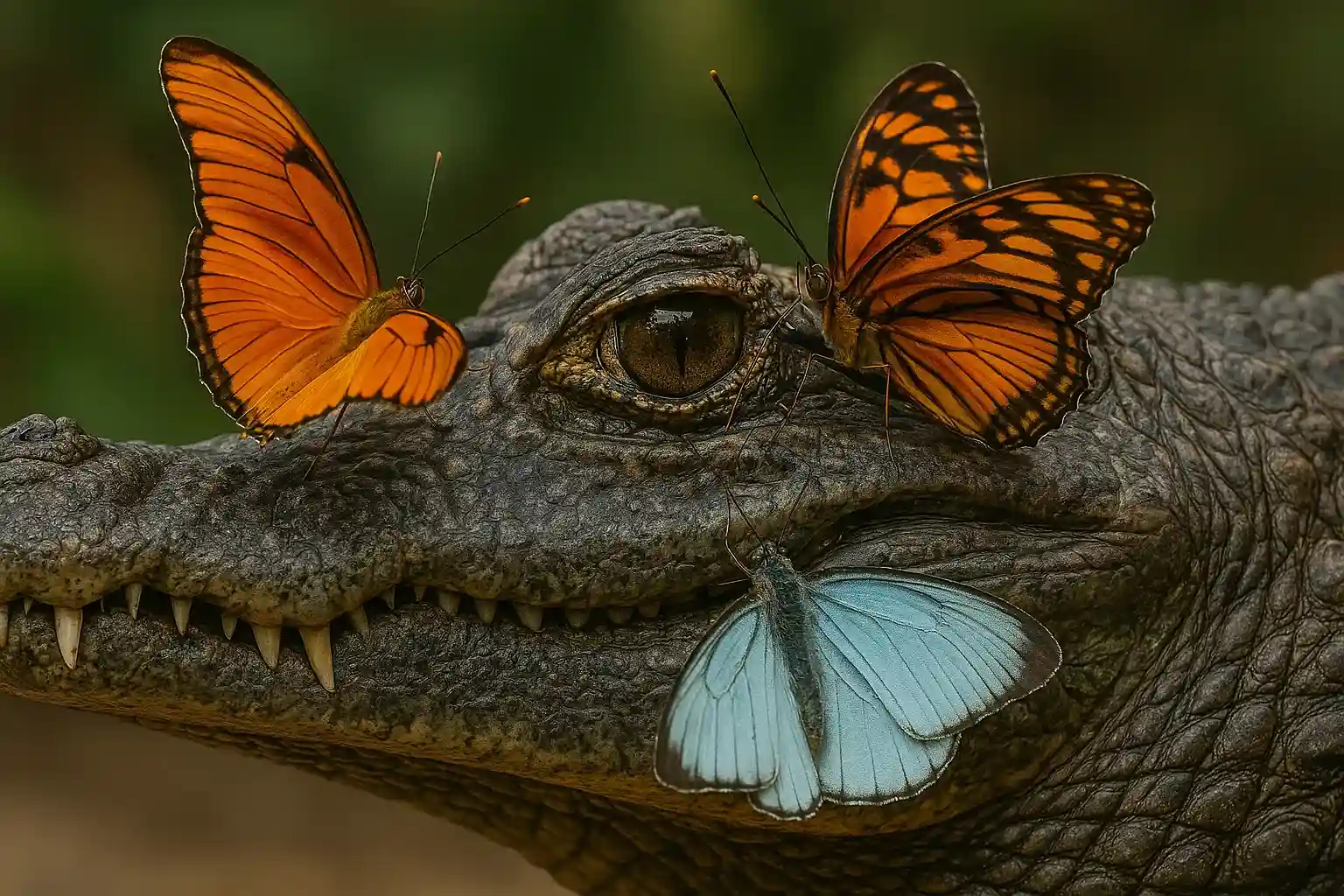
Butterflies are symbols of lightness, transformation and beauty, but they also hide intriguing behaviors. One of the most curious is the habit of drinking the tears of other animals. Yes, you read that right: in certain situations, some species of butterflies land on reptiles, birds or even mammals to feed on the liquid that runs from their eyes.
The behavior, besides being eccentric, shows how these insects adapt to the resources available to get essential nutrients. Why do they do it? What is in tears that attracts butterflies? And which animals serve as a “source”? Here are the answers.
Tears as a source of minerals
Although they feed mainly on flower nectar, butterflies also need minerals and salts, especially sodium, which plants do not offer in large amounts. For that reason many turn to alternative sources to supplement their diet. Among them are damp soil, droppings and animal carcasses. And, more unexpectedly, tears.
The tears of vertebrates contain sodium, potassium, proteins and other nutrients. For butterflies, and particularly for males, those compounds would matter in reproduction: part of the minerals they collect is believed to be passed to females during mating, improving the odds of reproductive success.
Nectar, for its part, is rich in sugars but very poor in salt. It is a good source of energy for flight, but it does not cover every need of the body. That imbalance explains why such a delicate insect can end up seeking salt in places that look unappealing to humans.
A behavior called lachryphagy
The habit of feeding on tears is known scientifically as lachryphagy. It has been observed in several tropical regions of the world, mainly in the forests of South America, Africa and Southeast Asia. Butterflies settle gently on the eyes of sleeping or distracted animals and use the proboscis, a long tube that works like a drinking straw, to suck up the tears.
The behavior has been recorded on animals such as river turtles. A widely shared image showed butterflies perched on the eye of a river turtle in the Peruvian Amazon while it rested at the water’s edge. That photograph helped popularize the concept of lachryphagy among the general public.
A peaceful interaction, most of the time
Curiously, lachryphagy does not usually cause pain or irritation to the animals. Because the proboscis is extremely thin, the touch is almost imperceptible. That lets the butterflies feed calmly, with no immediate risk.
Still, the contact is not always welcome. There are reports of birds trying to shoo the insects away with eye or head movements, and of reptiles that grow bothered after a few minutes. Even so, the frequency with which the behavior is recorded suggests that, most of the time, the interaction is tolerated or at least ignored.
That tolerance has a practical explanation. An animal at rest, especially a cold-blooded one beside the water, rarely reacts to such a slight touch. For the butterfly, a moist eye is a concentrated, easy-to-reach source of liquid, and the lack of reaction lets it feed without hurry.
A clever evolutionary strategy
Lachryphagy is only one of the strategies butterflies use to obtain mineral salts. On damp days it is common to see them at mud puddles, a behavior known as mud-puddling, or near animal droppings and carrion. These practices, which may seem bizarre to humans, are in fact efficient ways to survive.
Males, in particular, are the most motivated to seek sodium-rich sources. After mating, they pass those minerals to the females along with the sperm, which would help strengthen the eggs and improve the survival odds of the future caterpillars. In other words, drinking tears is also a matter of reproductive success.
Seen as a whole, the pattern is consistent: whether at mud, droppings, carrion or tears, the butterfly is after the same thing, salt and minerals that nectar does not supply. What changes is the source available at a given moment and place, and lachryphagy is one of the most unusual because it requires approaching a living animal, with everything that implies.
The name itself helps in remembering it: lachryphagy comes from the Latin word for tear and means, literally, feeding on tears. It is an exact description of the behavior.
This phenomenon has drawn the attention of documentary makers and biologists around the world. Researchers continue to study what the behavior means for ecological balance and for interactions between insects and vertebrates.
In times of climate change and biodiversity loss, understanding this kind of relationship helps reinforce the importance of preserving natural habitats. If a butterfly depends on rivers with turtles or forests with birds to obtain a mineral, protecting those species and their environments also benefits the insects around them.
Nature always has creative solutions
Seeing a butterfly perched on an eye may look like a scene from a fairy tale or a surreal film, but it is just one more proof that nature is full of creative and sometimes unusual solutions. Lachryphagy shows that even the most delicate and beautiful creatures hide very practical behavior.
So the next time you see a butterfly, remember that, besides beauty and symbolism, it carries a complex web of survival strategies, including the ability to drink tears.
Reporting: Revista Amazônia newsroom / Amazonia Mag

Editor · Amazonia Mag
Anne Silva is the editor of Amazonia Mag, the English-language edition of Revista Amazônia. She curates, translates and adapts the outlet's science and environment coverage for an international audience, reporting on Amazon wildlife, flora, rivers, climate and research. Every story she edits is grounded in peer-reviewed studies, official data and on-the-ground reporting from the Revista Amazônia newsroom in Belém, Pará, Brazil. More by Anne Silva →