
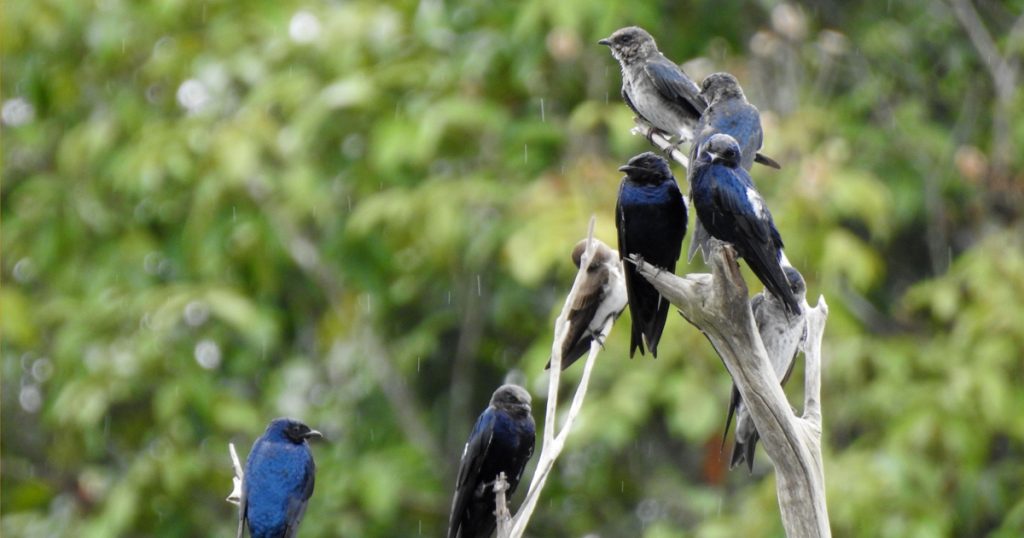
When a weather radar in the Amazon shows colored blotches on its screen, the first reading is usually the same: rain on the way. Yet on many occasions, the blotches are not storm clouds at all. What shows up on the charts is something far more alive: enormous flocks of swallows that, as they take off, produce signals mistaken for storms.
For years the phenomenon was treated as nothing more than an annoying noise for meteorologists. Today it is starting to mean something else, and it has become a tool for studying birds that almost no one can observe directly.
Radar as invisible binoculars
Researchers from the University of São Paulo and the University of Colorado, in the United States, realized that this “data junk” hid a scientific treasure. By analyzing the patterns in those signals, they are uncovering details about the habits of birds that spend much of their lives out of sight.
The Amazon rainforest, with its dense and hard-to-reach vegetation, has always been a challenge for anyone studying bird behavior. Swallows, known for their fast flight and their large flocks, practically vanish under the closed canopy. Watching their movements directly is almost impossible.
That was when chance turned into opportunity. Radars built to monitor rain proved to be valuable tools for recording the movements of birds as well. At the highest counts, the data reflect flocks of hundreds of thousands of swallows leaving their roosts together: a kind of biological storm crossing the sky.
Why a weather radar sees birds
A weather radar works by sending out pulses of energy and measuring what bounces back. When a pulse meets raindrops, part of the energy returns to the instrument, and from that signal the system works out where it is raining and how hard. But rain is not the only thing that can send back such an echo. A very large group of birds in flight also reflects the energy, and on the screen the result can resemble a storm.
The difference lies in how the signal behaves. A rain cloud drifts with the wind and changes shape in a characteristic way. A flock leaving its roost, by contrast, appears at a very specific time and place and spreads out from a central point. For anyone who knows how to read the charts, those features make it possible to tell the echo of birds from the echo of clouds.
The science of invisible traces
For meteorologists, those records were mere interference. For biologists, they are a rare chance to understand how these birds relate to the forest. By interpreting the intensity, duration and location of the signals, researchers can estimate the size of the flocks and map the places where they gather.
That information comes without entering the forest, without disturbing the birds and on a continuous basis, something no field team could match with binoculars. A single radar watches a very large area day after day, and each dawn can add a new data point.
The use of radars widens the frontier of knowledge about Amazonian swallows. They offer an overview that would hardly be possible from the ground, where each observer sees only a fragment of the sky.
Between real rain and a rain of wings
The mix-up between storms and flocks of birds also invites a symbolic thought: in a forest where everything is abundant, even the sky can be populated by phenomena that blur together. The so-called “swallow rains” reveal not only the effect of the birds on radars, but also the scale of life that pulses through the Amazon.
This technological coincidence helps give weather work a new meaning. What used to be noise becomes valuable data, showing how science and nature can intertwine in unexpected ways. A tool designed to anticipate the weather ends up telling how wildlife moves.
Knowledge that goes beyond birds
Understanding the habits of such numerous flocks opens room to investigate their role in the ecosystem. Swallows feed on insects in flight, and flocks of that size are a visible part of the region’s food chains. Tracking their presence over time yields information about how life is organized in the Amazonian sky.
More than a scientific curiosity, the finding helps us see the Amazon as a complex network in which every element is connected. Swallows flying in mass are not just a visual spectacle: they are parts of invisible machinery that belongs to life in the largest tropical forest on the planet.
Cooperation between Brazilian and foreign institutions is also a reminder that knowledge about the Amazon is still being built. Weather radars, created to forecast the weather, now prove to be allies in understanding biological rhythms on a large scale.
The mystery of the “swallow rain” is, in practice, an invitation: to use technology not only to measure storms, but to understand the wealth of life that fills the skies of the forest. If the Amazon is a living organism, its flocks of birds are a pulse that insists on showing itself, even when disguised in the charts of machines.
Reporting: Revista Amazônia newsroom / Amazonia Mag

Editor · Amazonia Mag
Anne Silva is the editor of Amazonia Mag, the English-language edition of Revista Amazônia. She curates, translates and adapts the outlet's science and environment coverage for an international audience, reporting on Amazon wildlife, flora, rivers, climate and research. Every story she edits is grounded in peer-reviewed studies, official data and on-the-ground reporting from the Revista Amazônia newsroom in Belém, Pará, Brazil. More by Anne Silva →